

If a regulator subpoenas our chat logs six months from now, can we hand them a tool-level trace — which retrieval tool fired, which policy version was in force at that exact moment, which document chunks were returned, and which got redacted before the model ever saw them?
That's the question. Not "how good is the search." Not "does it have a Slack connector." The audit-trail question is what kills or closes Glean deals in healthcare, financial services, and the public sector right now, and it's why the regulated-industries shortlist looks different from the rest of the enterprise market.
Disclosure. This article is published by ASCENDING, an AWS Advanced Consulting Partner (founded 2018, Fairfax VA) that builds the Jarvis AI Agent platform — including the MCP Gateway and Jarvis Registry discussed below. We compete with Glean in some accounts. We've tried to keep the regulatory facts straight; the recommendation is ours.
What changed in 2025 and 2026
Glean is a strong product. Series F at roughly $7.2B in 2025 on a $150M raise [1], SOC 2 Type II in pocket, real customers in pharma and insurance. Glean's own security page claims "strict compliance to SOC 2, HIPAA, GDPR, and more," single-tenant deployment and zero-retention agreements with model providers [2]. None of that's in dispute. The dispute is whether a retrieval-augmented assistant designed around a closed connector model can produce the evidence a HIPAA auditor, an FFIEC examiner, or a FedRAMP sponsor now expects.
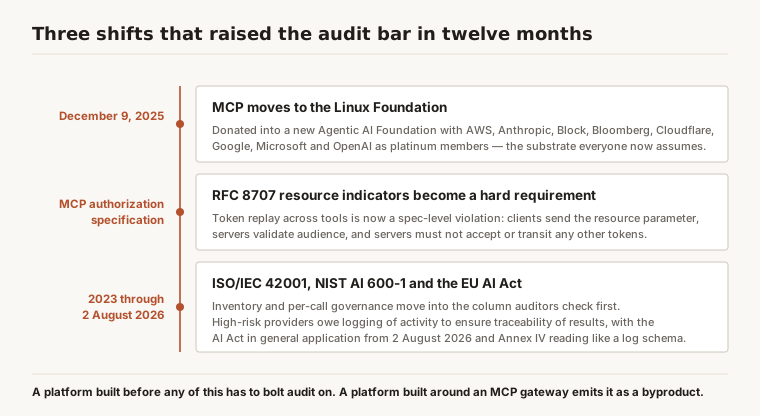
Three things shifted the bar:
- MCP went to the Linux Foundation on December 9, 2025. The protocol stopped being an Anthropic side project and started being the substrate everyone — AWS AgentCore Gateway (GA October 13, 2025) [4], Azure AI Foundry (GA June 16, 2025) — assumes you'll speak. The donation landed inside a new Agentic AI Foundation with AWS, Anthropic, Block, Bloomberg, Cloudflare, Google, Microsoft and OpenAI as platinum members [3].
- RFC 8707 resource indicators are required by the MCP authorization spec. Token replay across tools is now a spec-level violation [5]. If your agent stack can't prove the access token it presented was bound to the specific resource it was talking to, you have a finding — the specification puts it as a hard requirement on both sides, and says outright that "MCP servers MUST NOT accept or transit any other tokens" [6].
- ISO/IEC 42001 (the AI management system standard, published 2023) [7] and NIST AI 600-1 (the Generative AI Profile of the AI RMF) [8] both pushed inventory and per-call governance from "nice to have" into the column auditors check first. The EU AI Act's Annex IV technical documentation list reads almost like a per-call log schema; the Commission's own summary of high-risk obligations names "logging of activity to ensure traceability of results" alongside detailed technical documentation, with general application from 2 August 2026 [9].
A platform built before any of that — and Glean's architecture predates all of it — has to bolt audit on. A platform built around an MCP gateway can emit it natively.
Healthcare: HIPAA, BAAs, and the data-residency footnote
Healthcare buyers ask two questions in the first meeting. Will you sign a Business Associate Agreement that covers the AI workload, not just storage? And where, physically, does the embedding inference run?
Glean will sign a BAA. Good. The harder question is BAA scope — specifically whether the agreement covers the LLM inference path, the embedding model, and any third-party reranker. The regulation is why scope is the whole fight: a business associate contract must require the associate to "ensure that any subcontractors that create, receive, maintain, or transmit protected health information on behalf of the business associate agree to the same restrictions and conditions" [10]. We've watched BAA negotiations stall for ten weeks on exactly that point. Glean's hosted architecture also makes the residency answer awkward when a hospital system is on Epic in a state that has its own health-data localization rule on top of HIPAA. (For the control architecture these questions are probing — the BAA subprocessor chain, minimum necessary applied to prompts, and the audit-trail spec HIPAA expects of an agent deployment — see HIPAA-compliant AI agents for clinics.)
Where Glean falls short for HIPAA buyers:
- PHI redaction happens after retrieval, not before tool selection. The model sees what came back. That's a per-call audit gap.
- BAA scope is negotiable but uneven. Some sub-processors are inside; some aren't. Read carefully.
- Connector-level access control, not tool-level. You can scope Glean to a SharePoint site. You can't scope it to "this clinical-notes retrieval, only when the requesting agent presents a token bound to this resource." Glean does document tenant-level admin control over which MCP tools are exposed, and role-based access over who may wire them into agents [15]; what its published MCP security model never references is RFC 8707 resource indicators or token-audience validation, resting instead on OAuth 2.0 with dynamic client registration and per-document Knowledge Graph permissions [16].
A Jarvis Registry deployment closes those gaps three ways. PHI policies attach to the tool in the registry, not the user session, so de-identification fires before any retrieval result enters model context. The MCP Gateway emits a per-call record that includes the policy snapshot in force at the moment of the call — same call, replayed an hour later under a new policy, looks different in the log, and you can prove it. And BAA scope is contractual at the ASCENDING level, covering the inference and embedding paths together. Fair warning: the Jarvis native connector catalog is narrower than Glean's. If you need 70 SaaS sources out of the box, that gap matters.
Financial services: FFIEC, the SEC, and classification at retrieval time
The FFIEC IT Examination Handbook's third-party section now reads, in practice, as if it were written about AI vendors. Examiners are asking for data-classification evidence at the retrieval step — meaning, when a Jarvis AI Agent or any other agent pulled the document, was it tagged Confidential, was the tag honored, did the response surface a citation that respects the tag.
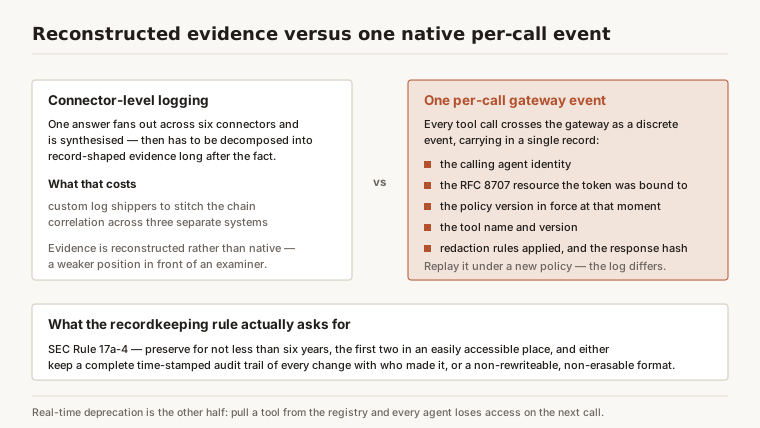
Glean does data classification well at the index level. The gap is at the call boundary. SEC Rule 17a-4 and FINRA 4511 expect records that prove which underlying tool was invoked and what was returned. Rule 17a-4 requires preservation for not less than six years, the first two in an easily accessible place, and its electronic-recordkeeping paragraph gives firms a binary choice: maintain "a complete time-stamped audit trail" of every modification and deletion with the identity of who made it, or preserve records exclusively in a non-rewriteable, non-erasable format [11]. A Glean response that fans out across six connectors and synthesizes an answer is hard to decompose into 17a-4-shaped records after the fact. Banks we've talked to ended up writing custom log shippers to reconstruct that chain. Not impossible. Not cheap.
This is where the MCP-gateway architecture earns its keep. Every tool call passes through the MCP Gateway as a discrete event. Each event carries: the calling agent identity, the resource indicator (RFC 8707) the access token was bound to, the policy version, the tool name and version, the redaction rules applied, and the response hash. That's the artifact a Series 24 supervisor needs when the SEC asks how the desk's research assistant came up with a number. It's also the artifact your model-risk-management team needs under SR 11-7 to show the model wasn't fed restricted data — though note that the Federal Reserve superseded and replaced SR 11-7 with SR 26-2 on 17 April 2026, so the letter your MRM policy cites may need updating before your next exam [12].
One more thing finance buyers underestimate: real-time deprecation. When a tool is pulled from the Jarvis Registry, every agent loses access on the next call. No cache. No 24-hour propagation window. In a market-abuse investigation, that distinction is the difference between a finding and a footnote.
Government: FedRAMP, ISO 42001, and the Annex IV problem
Federal and state-government buyers have the tightest stack to satisfy and the smallest tolerance for "we're working on it."
FedRAMP status. Glean is not FedRAMP High authorized at the time of writing — the FedRAMP Marketplace is the authoritative searchable register of certified services, and Glean's own security page claims SOC 2, HIPAA and GDPR without asserting FedRAMP anywhere [13][2]. That alone disqualifies it from a chunk of the DoD and IC workload. Microsoft 365 Copilot has a path through GCC High — Microsoft documents Copilot availability as an add-on in GCC, GCC High and DoD environments on G3, G5 and F1 base plans [14] — but the Copilot tooling available in GCC High lags the commercial release by quarters, and the connector catalog you can actually use is narrower than the public collateral implies.
ISO/IEC 42001. The standard expects an AI management system with a documented inventory of AI components, a governance loop, and risk treatment evidence. A registry-driven architecture maps onto 42001 almost line for line — every tool in the Jarvis Registry has an owner, a risk class, a lifecycle state, and a change-history record. That's the inventory clause, done.
EU AI Act Annex IV. Even US public-sector buyers care about this when they have European subsidiaries or use European-funded data. Annex IV asks for a description of the system, the data used, the human oversight measures, the monitoring, and the changes through the lifecycle. The per-call audit emitted by the MCP Gateway is most of that documentation, automatically, as a byproduct of running the platform.
Comparison: Glean / Microsoft 365 Copilot (GCC High) / Jarvis Registry
Disclosure. ASCENDING builds Jarvis. Read the row with that in mind. We've tried to be fair on the negative axes; check our work against the vendor docs.
| Axis | Glean | M365 Copilot (GCC High) | Jarvis Registry |
|---|---|---|---|
| FedRAMP High authorization | Not authorized | In Authorization (GCC High path) | In Authorization via AWS GovCloud (ASCENDING is AWS Advanced Consulting Partner) |
| HIPAA BAA scope (covers inference + embeddings) | BAA available; scope varies by sub-processor | BAA available within GCC High boundary | BAA covers the gateway + agent + embedding path under a single ASCENDING agreement |
| Per-call audit granularity (tool-level + policy snapshot) | Connector-level; reconstruction needed | Activity logs at user/app level | Per-call MCP event with policy snapshot, tool version, resource indicator, redaction trace |
| RFC 8707 resource indicators (required by the MCP authorization spec) | Not MCP-native | Partial via Foundry adapters | Enforced at gateway; token-replay attempts are blocked, not just logged |
| ISO/IEC 42001 alignment (inventory + governance loop) | Manual mapping required | Manual mapping required | Registry maps to 42001 inventory clause directly; governance loop built in |
| Where Jarvis concedes | — | — | Narrower native connector inventory than Glean — if you need 70+ SaaS sources out of the box, Glean ships more of them today. |
The procurement questions to actually ask
Save these. Run them past every vendor on the shortlist, including us.
- At the moment a tool call fires, what policy version is bound to that call, and can you produce the policy snapshot a year later? If the answer involves log correlation across three systems, you have an evidence problem.
- Will your BAA cover the LLM inference and embedding path, not only data at rest, and will it name the sub-processors involved? Ask for the redlines, not the marketing one-pager.
- What's your stance on RFC 8707 resource indicators? Enforced, logged, or roadmap? "Roadmap" was an acceptable answer in 2025. It isn't in 2026.
- When a tool is deprecated from your catalog, what's the propagation time before every agent loses access? Anything measured in hours is a gap.
- Show me the ISO/IEC 42001 inventory artifact your platform emits, not the one we'd build in a spreadsheet. If the artifact doesn't exist as a platform output, treat that as missing capability.
FAQ
Is Glean a bad choice for regulated industries?
No. It's a good product. It's a poor fit for buyers whose audit posture depends on per-call tool-level evidence and whose pipeline includes FedRAMP High or strict BAA scope. For a healthtech company two years from a HITRUST audit, with mostly SaaS data and no public-sector ambition, Glean can still be the right answer.
Does Microsoft 365 Copilot in GCC High solve the FedRAMP problem?
For some workloads, yes. The catch is feature parity: the Copilot release available in GCC High trails the commercial product, and the connector set you can lawfully use is smaller. Procurement teams routinely discover this after signing.
Why does RFC 8707 keep coming up?
Because token replay across tools — taking an access token meant for tool A and presenting it to tool B — is the easiest way to exfiltrate data through a poorly governed agent. RFC 8707 binds a token to a resource. The MCP authorization spec requires it. If your platform doesn't enforce it, you're outside the spec.
Can we get a per-call audit out of Glean with custom work?
Sometimes. We've seen teams ship custom log shippers and stitching layers to approximate it. The cost is real, and the evidence is reconstructed rather than native, which is a weaker position with an auditor.
Where does Jarvis Registry pricing sit?
On AWS Marketplace and Azure Marketplace. Starter is $1,500/month, Pro is $2,500/month, and there's a Custom Enterprise tier for federal and FSI deployments that need GovCloud, dedicated VPC, or non-standard BAA scope. For the broader pricing teardown, see Glean pricing in 2026 and the cheaper paths to the same outcome.
About ASCENDING
ASCENDING is an AWS Advanced Consulting Partner founded in 2018 in Fairfax, Virginia. We build Jarvis AI Agent — a governance-first, MCP-native agent platform — along with the MCP Gateway and Jarvis Registry referenced above. We work with regulated buyers in healthcare, financial services, and the public sector on FedRAMP, HIPAA, FFIEC, and ISO/IEC 42001 alignment. If you want to test our claims against your specific audit posture, talk to us.
References
- Glean announced a $150M Series F at a $7.2B valuation — Glean (2025): https://www.glean.com/press/glean-raises-150m-series-f-at-7-2b-valuation-to-accelerate-enterprise-ai-agent-innovation-globally
- Glean's security page claims "strict compliance to SOC 2, HIPAA, GDPR, and more," regional deployment across AMER, EMEA and APAC, single-tenant deployments, enforced data permissions and zero-retention agreements with model providers — it does not assert ISO 27001, ISO/IEC 42001 or FedRAMP — Glean (2026): https://www.glean.com/security
- The Linux Foundation announced the Agentic AI Foundation on 9 December 2025, anchored by Anthropic's Model Context Protocol, Block's goose and OpenAI's AGENTS.md, with AWS, Anthropic, Block, Bloomberg, Cloudflare, Google, Microsoft and OpenAI as platinum members — The Linux Foundation (2025): https://www.linuxfoundation.org/press/linux-foundation-announces-the-formation-of-the-agentic-ai-foundation
- Amazon Bedrock AgentCore reached general availability on 13 October 2025 across Runtime, Memory, Gateway, Identity and Observability, with Gateway connecting to existing MCP servers and Runtime adding A2A protocol support — Amazon Web Services (2025): https://aws.amazon.com/about-aws/whats-new/2025/10/amazon-bedrock-agentcore-available/
- RFC 8707 defines the OAuth
resourceparameter so a client can explicitly signal the protected resource it intends to use a token with, enabling audience-restricted tokens that remain valid only at their intended resource and preventing reuse across services — IETF (2020): https://www.rfc-editor.org/rfc/rfc8707.html - The MCP authorization specification requires clients to implement RFC 8707 and send
resourcein both authorization and token requests, requires servers to validate that tokens were issued specifically for them, and states "MCP servers MUST NOT accept or transit any other tokens" — Model Context Protocol (2025): https://modelcontextprotocol.io/specification/2025-06-18/basic/authorization - ISO/IEC 42001:2023, edition 1.0, published 18 December 2023, specifies requirements for establishing, implementing, maintaining and continually improving an AI management system in any organization providing or using AI-based products or services — International Electrotechnical Commission (2023): https://webstore.iec.ch/en/publication/90574
- NIST AI 600-1, the Generative AI Profile of the AI Risk Management Framework, was published 26 July 2024 as a cross-sectoral companion to AI RMF 1.0 (released 26 January 2023) — NIST (2024): https://www.nist.gov/publications/artificial-intelligence-risk-management-framework-generative-artificial-intelligence
- The European Commission's regulatory-framework summary sets out the AI Act's four risk levels and requires high-risk providers to deliver "logging of activity to ensure traceability of results," detailed technical documentation, human oversight and robustness, with general application from 2 August 2026 and high-risk obligations in sensitive areas from 2 December 2027 — European Commission (2026): https://digital-strategy.ec.europa.eu/en/policies/regulatory-framework-ai
- A HIPAA business associate contract must establish permitted uses and disclosures, require appropriate safeguards and breach reporting, and require the associate to "ensure that any subcontractors that create, receive, maintain, or transmit protected health information on behalf of the business associate agree to the same restrictions and conditions" — 45 CFR 164.504(e), via Cornell Legal Information Institute: https://www.law.cornell.edu/cfr/text/45/164.504
- SEC Rule 17a-4 requires preservation of specified records "for a period of not less than 6 years, the first two years in an easily accessible place," and its electronic-recordkeeping paragraph requires either "a complete time-stamped audit trail" documenting every modification and deletion with the identity of the person making it, or preservation "exclusively in a non-rewriteable, non-erasable format," with immediate production capability for examination — 17 CFR 240.17a-4, via Cornell Legal Information Institute: https://www.law.cornell.edu/cfr/text/17/240.17a-4
- Federal Reserve Supervisory Letter SR 26-2, "Revised Guidance on Model Risk Management," issued 17 April 2026, states that it "supersedes and replaces SR letter 11-7, Guidance on Model Risk Management (issued April 4, 2011)" and SR 21-8 — Board of Governors of the Federal Reserve System (2026): https://www.federalreserve.gov/supervisionreg/srletters/SR2602.htm
- The FedRAMP Marketplace is "a searchable database of FedRAMP certified cloud services, authorizing agencies, and FedRAMP recognized assessors," listing 529 certified services including 28 FedRAMP 20x certified services — the register against which any FedRAMP claim should be verified — FedRAMP (2026): https://www.fedramp.gov/
- Microsoft documents Microsoft 365 Copilot as an add-on available in Government Community Cloud, GCC High and Department of Defense environments on Microsoft 365 G3, G5 and F1 and Office 365 G1/G3/G5/F3 base plans — Microsoft (2026): https://learn.microsoft.com/en-us/copilot/microsoft-365/microsoft-365-copilot-licensing
- Glean documents itself as both an MCP server and an MCP gateway, exposing Search, Chat, Read Document, Code Search and People as built-in tools, surfacing agents as callable tools, and routing external MCP servers through one governed endpoint with admin-set tool visibility — Glean (2026): https://docs.glean.com/administration/platform/mcp/about
- Glean's published MCP security model documents OAuth 2.0 with Dynamic Client Registration, per-document and per-object permission enforcement, tenant-resident indexing, admin audit logs for configuration changes, and 7-day access / 180-day refresh token lifetimes — it cites RFC 8252 and makes no reference to RFC 8707 resource indicators or token-audience validation — Glean (2026): https://docs.glean.com/administration/platform/mcp/security