
An MCP gateway is the protocol-specific flavor of the agent gateway — the inline component that every Model Context Protocol tool call passes through, where authentication, RBAC, routing, and the per-call observability record happen. The pattern emerged in early 2025 from production deployments where teams were running fifty MCP servers across dozens of clients and needed one place to enforce policy.
By April 2026 six vendors ship a production-grade MCP gateway. Sorting them by name is not the procurement question. The question is which gateway fits your federation reach, your identity surface, your compliance shape, and your existing infrastructure. The full MCP gateway definition covers the pattern itself; this page is the buyer's guide.
Selection criteria for 2026
Five criteria carry most of the procurement weight. We see them surface in every gateway evaluation conversation; the priority order varies, but the questions do not.
- 01
Federation reach
Can the gateway federate across AWS AgentCore, Azure AI Foundry, Cloudflare MCP Server Portals, and self-hosted MCP servers, or does it terminate at one provider's perimeter? Single-cloud gateways are an architecture decision, not a feature gap.
- 02
Auth conformance
OAuth 2.1 with PKCE (RFC 7636), resource indicators (RFC 8707), and Protected Resource Metadata (RFC 9728, which defines the
/.well-known/oauth-protected-resourcediscovery document). These are not nice-to-haves: the MCP authorization specification states that MCP servers MUST implement RFC 9728 and MCP clients MUST implement RFC 8707. A vendor a full revision behind on auth will fail security review even if the rest of the product is strong. - 03
Identity propagation
On-behalf-of identity has to follow nested tool calls. The gateway should consume your IdP groups directly through SAML / OIDC / SCIM, not ship a parallel role system that diverges within a quarter.
- 04
Audit granularity
Per-call records that name the resolved MCP tool, the resolved arguments, the resolved result, and the policy snapshot the gateway authorized against. Tool-level, not request-level.
- 05
Revocation timing
When access is revoked or an agent version deprecated, the change has to propagate on the next call, not the next sync interval. We cover the diagnostic question in Agent Registry vs. Agent Gateway.
Vendor landscape, April 2026
The market has consolidated into three shapes: cloud-native gateways from the hyperscalers (AWS AgentCore, Azure AI Foundry), edge-native gateways from CDN providers (Cloudflare MCP Server Portals), and platform-native gateways from agent-focused vendors. The full vendor table with capabilities and pricing lives in the MCP Gateway glossary entry; this is the procurement-shape view.
Read the hyperscaler documentation before the sales deck, because the two shapes differ in ways the decks flatten. AWS documents AgentCore Gateway as a single endpoint that converts OpenAPI, Smithy, and Lambda targets into MCP-compatible tools, fronts A2A traffic through passthrough targets, and — the part worth underlining — provides both ingress and egress authentication with per-tool credential injection, plus semantic tool selection so agents can search thousands of tools without inflating the prompt. Microsoft documents Foundry Agent Service around a different centre of gravity: remote MCP servers added from a tool catalog, a dedicated Microsoft Entra identity per agent, OAuth on-behalf-of passthrough, and a Toolbox that republishes a curated tool set through one MCP-compatible endpoint. Same category, different assumption about where identity lives.
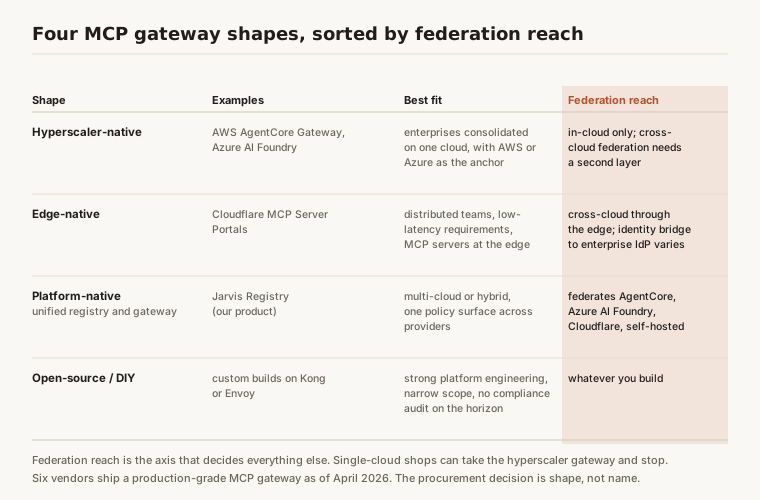
| Shape | Examples | Best fit | Federation reach |
|---|---|---|---|
| Hyperscaler-native | AWS AgentCore Gateway, Azure AI Foundry | Enterprises consolidated on one cloud, with AWS / Azure as the agent-platform anchor | In-cloud only; cross-cloud federation requires a second layer |
| Edge-native | Cloudflare MCP Server Portals | Distributed teams, low-latency requirements, MCP servers already running at the edge | Cross-cloud through Cloudflare's edge; identity bridge to enterprise IdP varies |
| Platform-native (unified registry + gateway) | Jarvis Registry | Multi-cloud / hybrid environments, one policy surface across providers, MCP-compatible client variety | Federates AgentCore, Azure AI Foundry, Cloudflare, self-hosted A2A and MCP servers |
| Open-source / DIY | Custom builds on Kong / Envoy | Teams with strong platform engineering, narrow scope, no compliance audit on the horizon | Whatever you build |
The federation question
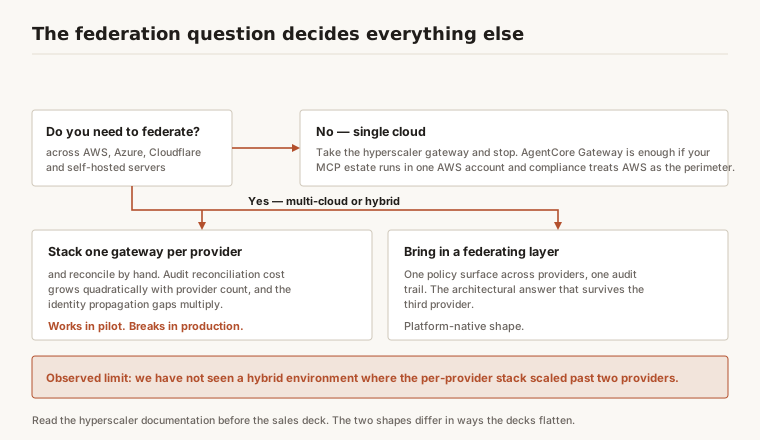
The procurement decision that decides everything else is whether you need to federate. Single-cloud shops can take the hyperscaler gateway and stop. Multi-cloud or hybrid shops have a choice: stack one gateway per provider and reconcile by hand, or bring in a federating layer that gateways across providers under one policy surface.
We have not yet seen a hybrid environment where the per-provider stack scaled past two providers without breaking. The audit reconciliation cost grows quadratically with provider count, and the identity propagation gaps multiply. The federating layer is the architectural answer that survives the third provider.
Where Jarvis Registry fits
Jarvis Registry is the unified registry and gateway under the platform-native shape. It federates across AWS AgentCore, Azure AI Foundry, Cloudflare MCP Server Portals, and self-hosted MCP and A2A servers, exposing one MCP-compatible endpoint that Jarvis Chat, Claude Desktop, Claude Code, VS Code, Cursor, GitHub Copilot, Microsoft Copilot, Windsurf, and ChatGPT connect to. The catalog and data planes share schemas and policy objects so deprecation and revocation propagate on the next call, not the next sync.
Pricing is published on AWS Marketplace and Azure Marketplace at $1,500 / $2,500 / custom per month across three tiers. The Pro tier ($2,500 / month) bundles Jarvis Chat with Jarvis Registry — the multi-LLM enterprise chat client and the unified MCP gateway under one deployment. Most enterprise procurement starts there.