

Your renewal quote landed 60 days out. The price went up. Read this before the call.
Publisher disclosure: This site is published by ASCENDING, which builds Jarvis AI — a competing agent platform. The five signals below come from real procurement reviews we ran with customers in 2025-2026; the product comparison appears only in the closing section.
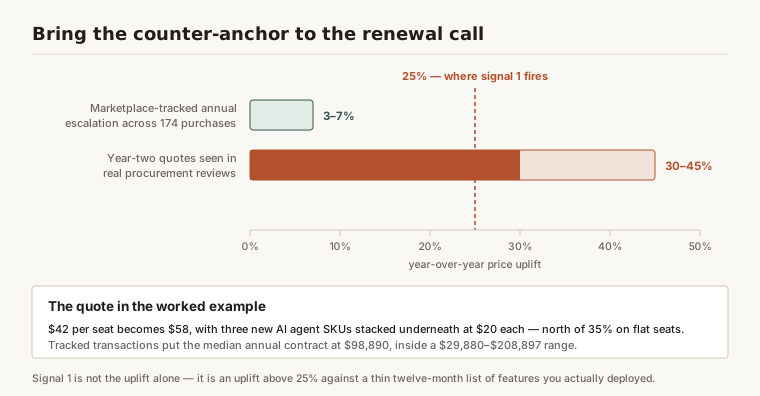
It usually shows up on a Tuesday. The CSM sends a calendar invite — "Q3 renewal review" — and a PDF attached. You open the PDF. Last year was $42 per seat. This year is $58. Three new "AI agent" SKUs are stacked underneath at $20 each. Total uplift: somewhere north of 35% on a flat seat count.
You knew the conversation was coming. You didn't know it would arrive with that math.
This is the field-note version of what to check before you sign. Five signals. Eight to ten hard yes/no questions for procurement. And one short list of things to evaluate alongside Glean — because in 2026, the alternatives stopped being toys.
The five signals
Each signal below has the same shape: something in the quote or the support history triggers it, there is a specific artifact you should demand in writing before signing, and there is an answer that tells you the artifact does not exist. Use the table as the call agenda, then read the detail underneath.
| Signal | What triggers it | Demand in writing | Red-flag answer |
|---|---|---|---|
| 1. Price jump | Uplift above 25% YoY against a thin twelve-month list of features you actually deployed | A feature-delivery rider that credits you if named GA dates slip | Establishing what is GA on your SKU takes three follow-ups |
| 2. Connector debt | Break-fix history on the sources you depend on, especially permissions drift | Connector changelog for your top five sources, plus an SLO for permissions-propagation incidents | The changelog needs a week to produce |
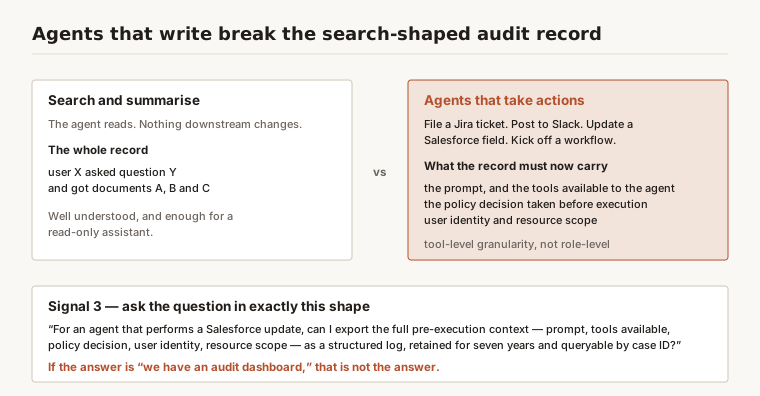
| 3. Agent-action governance | Agents that write rather than read — Jira tickets, Slack posts, Salesforce updates, workflow kickoffs | Per-tool-call audit schema covering prompt, available tools, policy decision, user identity, resource scope | "We have an audit dashboard" |
| 4. Roadmap dependency | Renewal price justified by agent features that are not GA in your region yet | GA date, published audit-log schema, rollback story for tool calls, and the credit structure on the order form | The roadmap lives in a slide deck rather than the contract |
| 5. Concentration risk | One vendor owning the index, the ranking model, the connectors, the agent runtime, and the audit surface | A contractual right to route agent actions through an external gateway | Agent actions are bundled exclusively into the Glean runtime |
1. Price jump greater than 25% YoY without new feature delivery
The Series F round Glean closed in 2025 — reported at roughly a $7.2B valuation on a $150M raise — put real pressure on per-customer ARR [1]. We've seen renewal quotes land 30-45% above year-one pricing, sometimes higher when the original deal was a heavily discounted land. Aggregated marketplace data puts typical annual escalations lower, at 3–7%, which is the number to bring to the call as a counter-anchor [10]. That's not unusual for a growth-stage vendor. It is unusual when the feature delta over the past twelve months is mostly UI polish and a "Glean Agents" beta you haven't been onboarded to yet. For the broader pricing teardown, see Glean pricing in 2026 and the cheaper paths to the same outcome.
Pull the release notes. Make a list of every feature your team actually turned on between renewal cycles. Not what was announced — what got deployed. If that list is thin, the price uplift isn't buying you new capability; it's buying the vendor more runway.
Ask the CSM: "Of the features shipped in the last twelve months, which ones are GA in our region, on our SSO stack, and covered by our current SKU — not behind a separate add-on?"
If the answer requires three follow-ups, you've found signal one.
2. Connector maintenance debt on integrations you actively use
Glean's pitch leans on the connector library — Confluence, Slack, Jira, Google Drive, Salesforce, the usual surface area. Most of those work. The question is the break-fix queue on the connectors you depend on.
Seen this twice this quarter: a customer's Confluence Server connector silently stopped indexing comments for six weeks, and a SharePoint Online connector had a permissions-propagation lag that surfaced documents to people who shouldn't have seen them. Both got fixed. Neither got proactively reported to the customer. The audit trail was reconstructed after.
Before you renew, pull your support ticket history. Filter to connector-related tickets only. Look at median time-to-resolution and how many of them involved permissions drift versus pure indexing lag. Permissions drift is the dangerous one — that's the category that becomes a compliance incident if HR or legal documents are in scope.
Ask the CSM: "Can you send me the connector changelog for our top five sources over the last 18 months, plus the SLO you commit to for permissions-propagation incidents specifically?"
A vendor that ships connectors will answer in one email. A vendor that treats connectors as a long tail will need a week.
3. Governance gap at the agent-action layer
This is the signal that gets ignored most often, and it's the one that matters most in 2026.
Search-and-summarize is well-understood. The audit trail is "user X asked question Y, got documents A, B, C." Easy. Agents that take actions — file a Jira ticket, post to Slack, update a Salesforce field, kick off a workflow — break that model. You need a per-tool-call audit log. You need pre-execution policy checks. You need tool-level granularity, not just role-level.
ISO/IEC 42001 (the AI management system standard most regulated enterprises started adopting through 2025-2026) leans heavily on demonstrable agent-action auditability; the standard was published in December 2023 and specifies requirements for establishing, implementing, maintaining and continually improving an AI management system [2]. RFC 8707 resource indicators — required by the MCP authorization spec — exist precisely because the protocol layer needed a way to bind a token to a specific resource, not a whole tenant [3]. The MCP authorization specification carries that through as a hard requirement: clients MUST send the resource parameter, servers MUST validate that tokens were issued for them, and "MCP servers MUST NOT accept or transit any other tokens" [4].
If your Glean instance is moving toward agents that write, ask what the audit surface looks like, in detail.
Ask the CSM: "For an agent that performs a Salesforce update, can I export the full pre-execution context (prompt, tools available, policy decision, user identity, resource scope) as a structured log, retained for seven years, and queryable by case ID?"
If the answer is "we have an audit dashboard," that's not the answer.
4. Agentic roadmap dependency — will "Glean Agents" actually ship in your window
Glean has been talking about agents for a while. The Federated Search Apps SDK has been the public scaffolding. The hard question for renewal is: are you signing year two on the assumption that the agent capability ships in time for your enterprise timeline, or are you signing for the search product you already have?
Be honest about which one you're buying. If the renewal pricing is justified by future agent features, get the roadmap commitments in writing — region availability, SSO compatibility, audit format, data residency. "Roadmap" in a slide deck is not a contract.
In practice, the safer pattern is to renew for the current product at a price that reflects current value, and treat agents as a separate evaluation track. That keeps you from paying agent prices for search results.
Ask the CSM: "Will the agent SKUs we're being quoted today be GA — not preview, not LA, GA — by [your specific date], with a published audit-log schema and a documented rollback story for tool calls? If not, what's the credit structure?"
Get the credit structure in the order form.
5. Vendor concentration risk versus federated alternative
The last signal isn't about Glean specifically. It's about the shape of the bet.
A single-SaaS enterprise search vendor owns the index, the ranking model, the connector library, the agent runtime, and the audit surface. That's a lot of surface area for one renewal cycle. When Anthropic released MCP in November 2024 and the Linux Foundation took it over on December 9, 2025, the federated alternative stopped being theoretical — the donation landed inside a new Agentic AI Foundation whose platinum members include AWS, Anthropic, Block, Bloomberg, Cloudflare, Google, Microsoft and OpenAI [5], and the spec has kept shipping dated revisions since [6]. You can now route an agent across multiple knowledge sources via an MCP gateway, swap the model, swap the registry, and keep the audit layer constant.
Fair warning: federated is not free. You assemble more pieces. You own more of the integration. But you also stop paying a single vendor for the privilege of being locked into their connector roadmap.
Ask the CSM: "If we wanted to keep Glean for search and route agent actions through a separate governance layer next year, does our contract allow that, or are agent actions bundled exclusively into the Glean runtime?"
The answer to that question tells you what the renewal is really selling.
Pre-renewal procurement checklist
Hard yes/no. Don't accept "we're working on it."
- Is the year-two price uplift under 25%, or have you secured a feature-delivery rider that triggers a credit if specific GA features slip?
- Do you have a written connector SLO for permissions-propagation incidents on your top five sources?
- Has Glean provided a per-tool-call audit log schema, in writing, that maps to ISO/IEC 42001 evidence requirements?
- Are the agent SKUs in the quote GA today in your region, on your SSO stack, with documented data residency?
- Does the contract allow you to point agent actions at an external MCP gateway or governance layer without violating ToS?
- Is there an exit clause for connector-related security incidents (not just uptime SLA breach)?
- Has procurement reviewed the auto-renewal language, the price-uplift cap on year three, and the data-export format?
- Do you have a 90-day data egress plan if you leave — including embeddings, audit logs, and connector configurations?
- Is the named CSM the same person who'll handle escalations, or does that route to a different team?
- If the answer to any of items 1-9 is no, do you have written acknowledgement of that gap before you sign?
If you can't get to "yes" on at least seven of these, the renewal isn't ready.
What to evaluate next
If you're seriously weighing options — not just leverage for the renegotiation, actually weighing — three product surfaces matter in mid-2026.
Jarvis AI, built by ASCENDING, is governance-first and MCP-native by design. The MCP Gateway handles tool-level audit and per-call policy with RFC 8707 resource binding out of the box. Jarvis Registry — priced at $1,500 and $2,500 tiers on AWS and Azure Marketplace, with a custom enterprise tier — handles agent and MCP server cataloging, ownership, and versioning [14]. Jarvis AI Agent is the application surface that consumes both. We mention this because we publish this site; we'd rather you do the comparison yourself than take our word.
Microsoft Copilot (now layered on Azure AI Foundry, which went GA June 16, 2025) is the safe choice if your stack is already Microsoft-aligned [7]. Strong on Office and Teams integration, weaker on multi-vendor MCP federation, and the governance story leans on Purview rather than a dedicated agent-action audit layer [8]. Right answer for an M365 enterprise that wants one throat to choke.
AWS AgentCore (Gateway GA October 13, 2025) is the federated option from the hyperscaler side [9]. Strong on AWS-native identity and observability, MCP-compatible by design, less mature on the registry and developer-experience layers. Right answer if you're AWS-centric and willing to assemble more of the stack yourself.
For a deeper side-by-side covering all of these plus Moveworks, Guru, and the regulated-industry angle, read the Glean alternatives 2026 shortlist.
FAQ
How much room is there to renegotiate a Glean renewal price?
More than the CSM will admit in round one. We've seen 15-25% reductions on year-two quotes when the customer brought a documented competitive evaluation and a concrete walk-away date. Without a credible alternative on the table, expect 5% at most.
Is switching from Glean realistic mid-contract?
Realistic, not free. The painful piece is connector reconfiguration and re-indexing — budget 8-12 weeks for a clean cutover on a mid-size enterprise tenant, longer if you have heavy SharePoint or custom-source dependencies. The audit-log export format is the other gotcha; get the egress spec in writing before you decide.
Does Glean support MCP natively as of mid-2026?
Glean has shipped MCP-adjacent integration through the Federated Search Apps SDK, but full MCP server compatibility with RFC 8707 resource indicators is not the default posture as of this writing. Glean does document a remote MCP server and an MCP gateway of its own, exposing Search, Chat, Read Document, Code Search and People as tools and routing third-party MCP servers through it [12]; what its published MCP security model does not reference anywhere is RFC 8707 resource indicators or token-audience restriction, resting instead on OAuth 2.0 with dynamic client registration and per-document Knowledge Graph permissions [13]. Check the current docs before signing — this surface has been moving fast.
What's the right benchmark for enterprise search pricing per seat in 2026?
Third-party data clusters around $40-80 per seat per month for Glean enterprise quotes, depending on volume and add-ons [11]. Vendr's tracked transactions put the median annual Glean contract at $98,890 with a $29,880–$208,897 range [10]. Federated alternatives that pair a registry plus gateway plus a separate agent runtime can land lower per seat but carry implementation cost. The honest comparison is total cost of ownership over three years, not month-one sticker.
When should procurement be brought in?
Day one of the 60-day window. Procurement teams that get the quote in week ten of a twelve-week cycle have no leverage. The vendors know this.
About ASCENDING
ASCENDING is an AWS Advanced Consulting Partner founded in 2018 and headquartered in Fairfax, Virginia. We build Jarvis AI — a governance-first, MCP-native agent platform — and we publish this site as an independent industry resource. When a piece compares Jarvis to a competitor, the disclosure stays on the page.
References
- Glean announced a $150M Series F at a $7.2B valuation — Glean (2025): https://www.glean.com/press/glean-raises-150m-series-f-at-7-2b-valuation-to-accelerate-enterprise-ai-agent-innovation-globally
- ISO/IEC 42001:2023, edition 1.0, published 18 December 2023, specifies requirements for establishing, implementing, maintaining and continually improving an AI management system, and applies to any organization providing or using AI-based products or services — International Electrotechnical Commission (2023): https://webstore.iec.ch/en/publication/90574
- RFC 8707 defines the OAuth
resourceparameter so a client can signal the identity of the protected resource it is requesting access to, enabling audience-restricted tokens that remain valid only at their intended resource — IETF (2020): https://www.rfc-editor.org/rfc/rfc8707.html - The MCP authorization specification requires clients to implement RFC 8707 and send
resourcein both authorization and token requests, requires servers to validate that tokens were issued specifically for them, and states that "MCP servers MUST NOT accept or transit any other tokens" — Model Context Protocol (2025): https://modelcontextprotocol.io/specification/2025-06-18/basic/authorization - The Linux Foundation announced the Agentic AI Foundation on 9 December 2025, anchored by contributions of MCP (Anthropic), goose (Block) and AGENTS.md (OpenAI), with platinum members including AWS, Anthropic, Block, Bloomberg, Cloudflare, Google, Microsoft and OpenAI, a year after MCP's November 2024 launch — The Linux Foundation (2025): https://www.linuxfoundation.org/press/linux-foundation-announces-the-formation-of-the-agentic-ai-foundation
- MCP versions the protocol with
YYYY-MM-DDidentifiers marking the last backwards-incompatible change, and publishes a single current revision at a time — Model Context Protocol (2026): https://modelcontextprotocol.io/specification/versioning - Microsoft announced Azure AI Foundry Agent Service as generally available at Build, in a post dated 19 May 2025 — Microsoft (2025): https://azure.microsoft.com/en-us/blog/azure-ai-foundry-your-ai-app-and-agent-factory/
- Microsoft documents that data security and compliance for Microsoft 365 Copilot run through Purview — DSPM for AI, sensitivity labels, DLP, Insider Risk Management, unified-audit capture of prompts and responses, eDiscovery and retention — rather than a dedicated agent-action audit layer — Microsoft (2026): https://learn.microsoft.com/en-us/purview/ai-microsoft-purview
- Amazon Bedrock AgentCore reached general availability on 13 October 2025 across Runtime, Memory, Gateway, Identity and Observability, with Gateway connecting to existing MCP servers and Runtime adding A2A protocol support — Amazon Web Services (2025): https://aws.amazon.com/about-aws/whats-new/2025/10/amazon-bedrock-agentcore-available/
- Vendr reports a median tracked Glean contract of $98,890 annually across 174 purchases, a $29,880–$208,897 range, 20.19% average savings, and annual escalations "typically 3–7%" — procurement-reported marketplace data, not vendor-published pricing — Vendr (2026): https://www.vendr.com/buyer-guides/glean
- A third-party teardown reports roughly $50 per user per month for Glean, with some buyers closer to $75, plus a ~100-seat minimum at about $60,000 annually — secondary reporting from a Glean competitor, compiled from buyer-submitted data and labelled as estimates — GoSearch (2026): https://www.gosearch.ai/blog/glean-pricing-explained/
- Glean documents itself as both an MCP server and an MCP gateway, exposing Search, Chat, Read Document, Code Search and People as built-in tools, surfacing Glean agents as callable tools, and routing external MCP servers through a single governed endpoint — Glean (2026): https://docs.glean.com/administration/platform/mcp/about
- Glean's published MCP security model documents OAuth 2.0 with Dynamic Client Registration, per-document permission enforcement, tenant-resident processing, admin audit logs for MCP and OAuth configuration changes, and 7-day access / 180-day refresh token lifetimes — and cites RFC 8252 while making no reference to RFC 8707 resource indicators or token-audience restriction — Glean (2026): https://docs.glean.com/administration/platform/mcp/security
- ASCENDING's Jarvis Registry page documents tool-level access control with OAuth/SAML, complete audit trails, AWS Marketplace availability and Kubernetes deployment across EKS, AKS and GKE; it publishes no price tiers and claims no security certification — ASCENDING (2026): https://ascendingdc.com/jarvis-ai/jarvis-registry/