Glossary entry

MCP gateway

also known as MCP server gatewayMCP federation layer

An MCP gateway is the control point between MCP clients and MCP servers. It authenticates callers, authorizes each tool call, brokers downstream credentials, routes requests and logs the result. Our rule of thumb from client work: you need one once more than three MCP servers are shared across users or clients, or once any server touches regulated data. One developer running a few servers against their own accounts usually does not; per-server OAuth or local credentials suffice. The MCP specification defines no gateway role and mentions gateways only as intermediaries [1]. The pattern grew up in production; managed versions followed, among them Amazon Bedrock AgentCore Gateway, generally available since October 13, 2025 [2].

Contributing Writer · AWS Agents
Reviewed by Gloria Qian Zhang
8 min · Updated October 11, 2026 · Last verified

Why the category exists

Three servers is the threshold we keep running into. Past it, the same four questions reach the CISO's desk in sequence. Who may call which tool, under what conditions? Where is every tool call logged? How do we rate-limit? And the one that wakes people up: how do we stop handing user-level credentials to a model at inference time?

The protocol leaves those answers to you. MCP defines hosts, clients and servers, and mentions gateways only as intermediaries: the transport mirrors fields into headers so that "intermediaries (load balancers, gateways, observability tooling)" can route and inspect requests [1], and the caching rules say what a shared gateway may cache [3]. The 2026-07-28 revision made their job easier: it removed protocol-level sessions and requires an Mcp-Method header on every request and an Mcp-Name header on tool calls, so an intermediary can route a call without parsing the body [1].

Authorization itself is optional, but once an HTTP server uses it the spec sets the floor. A protected MCP server is an OAuth 2.1 resource server: it must reject tokens not issued for it, clients must name it with an RFC 8707 resource indicator [4], and it must not pass the client's token through to an upstream API [5]. Meeting those rules once, at a gateway, is cheaper than meeting them in every server.

In August 2025 Solo.io's Christian Posta and Louis Ryan called the June 2025 authorization spec "a non-starter for enterprise" for leaning on anonymous dynamic client registration, and argued for existing SSO plus a gateway [6]. Solo.io builds gateways, and the spec has since deprecated that registration path [4], but the conclusion held. On client work the arc repeats: OAuth wired per server, trouble around server five, a gateway built by hand.
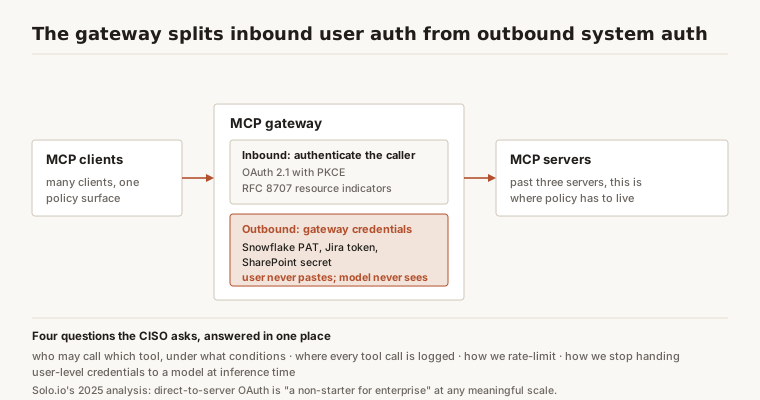
MCP clients on the left feed an ochre arrow into a central MCP gateway box, which feeds MCP servers on the right. Inside the gateway, an inbound band reads 'authenticate the caller' with OAuth 2.1 with PKCE and RFC 8707 resource indicators. Beneath it an ochre outbound band reads 'gateway credentials', listing a Snowflake PAT, a Jira token and a SharePoint secret, and states that the user never pastes them and the model never sees them. Below, the four questions the CISO asks are listed, with a footnote referencing Solo.io's 2025 critique of the MCP authorization spec.
The spec forbids passing a client's token through to upstream APIs, so inbound user auth and outbound system credentials have to be split. A gateway makes that split once, for every server.

MCP proxy vs MCP gateway

A proxy forwards MCP traffic. It may put several servers behind one URL, bridge a local stdio server onto HTTP, or terminate TLS, but it does not decide who may call which tool. A gateway is a proxy that makes that decision on every call and records it. Every MCP gateway is a proxy; most MCP proxies are not gateways.

The spec already binds proxies: one using a static client ID must get user consent for each dynamically registered client before forwarding to a third-party authorization server [5]. Our test is cruder: ask for the written policy that says this caller may call this tool. No policy artifact, no gateway.

Proxy, gateway or API gateway: what each one decides
ConcernMCP proxyMCP gatewayAPI gateway without MCP support
What it readsEnough MCP to forward messagesMethods and tool names: tools/list, tools/callHTTP routes and headers; every client message is a POST to one endpoint, and tool calls carry the tool name in an Mcp-Name header [1]
Who may call which toolNot decidedDecided per tool, every callPer route; a header rule on Mcp-Name can block a named tool, but nothing trims what tools/list shows
CredentialsPasses the connection onChecks the caller's token, attaches its own downstream credentialChecks keys or JWTs for the route
Tool discoveryLists every toolLists only what the caller may use [7]Passes tools/list through unfiltered
RecordRequest logsOne entry per tool call: caller, tool, decision, outcomeRequest logs per route

When you need one, and when you don't

One developer running local stdio servers against their own accounts does not need a gateway; the spec tells stdio servers to take credentials from the environment [4]. You need one when any of these is true.

  • More than three MCP servers are shared. Per-server OAuth, logs and rate limits stop being manageable.
  • Several clients call the same servers. Claude, Copilot, Cursor and an in-house agent should meet one policy, not four configurations.
  • Users would otherwise paste tokens into a client config. That credential belongs on the gateway.
  • Any server touches regulated data. PHI, cardholder data or customer PII needs a record of who called which tool, when, under which policy.
  • Access must be revocable in one step, for a user or a tool, across every server.

Who ships MCP gateways, October 2026

Since our April edition, two independents changed hands and the protocol went stateless: 2026-07-28 dropped protocol-level sessions, so gateways that pinned calls to a session had to change how they route [1]. The table now also covers Microsoft and Google.

Rows are shapes, not rankings, each checked against the vendor's own pages on October 11, 2026. To choose, use the MCP gateway hub; for scores, see our ten-gateway documentation audit, which scores our own product alongside the rest.

Named MCP gateway offerings, October 2026
VendorShapeWhat ships
Amazon Bedrock AgentCore GatewayHyperscaler (AWS-hosted)GA October 13, 2025, when it also began fronting existing MCP servers [2]. Turns Lambda, OpenAPI and Smithy into MCP tools, passes A2A traffic through, routes LLM inference; inbound and outbound auth [8].
Azure API ManagementHyperscaler (Azure-hosted or self-hosted gateway)Exposes a REST API as an MCP server, or governs an existing one with JWT, rate-limit and IP policies. Tools yes, prompts no [9].
Google Agent GatewayHyperscaler (Google Cloud)Entry and exit point for agent traffic in Gemini Enterprise Agent Platform, including calls to third-party MCP servers, under IAM and Model Armor policies [10].
Cloudflare MCP server portalsZero Trust SaaS (Cloudflare One)GA September 24, 2026: one endpoint for approved MCP servers, with Cloudflare Access logging tool activity [11]. On Cloudflare's own internal portal, four servers' 52 tools (about 9,400 tokens) collapsed into 2 (about 600) with Code Mode on, a 94% cut [12].
Kong AI GatewayAPI gateway that added MCPEnterprise plugin with per-tool allow and deny lists and an audit log of every attempt [13]. A2A via Agent Gateway, GA in AI Gateway 3.14, announced April 14, 2026 [14]. Kong's AI Gateway changelog lists 2.1.0 (September 22, 2026) as adding MCP revision 2026-07-28 [15].
ComposioIntegration platform that added a gateway1,500+ managed toolkits plus your own MCP servers behind per-team endpoints; SSO, SCIM, action-level access control, metadata-only audit records [16].
Bifrost (Maxim AI)LLM gateway that added MCPApache 2.0; an MCP client to servers and an MCP server to agents [17]. Its 11 µs overhead was measured at 5,000 RPS against mocked OpenAI calls on an AWS t3.xlarge, excluding JSON marshalling and HTTP calls; it is not an MCP tool-call benchmark [18].
agentgateway; IBM ContextForgeOpen source, self-hostedagentgateway: Linux Foundation project, Apache 2.0, MCP and A2A, RBAC in the CEL policy language [19]. ContextForge: IBM's open-source gateway, GA at v1.0.0 on May 1, 2026, with A2A [20].
Portkey; Lunar.devIndependents that changed hands in 2026Portkey: acquired by Palo Alto Networks on May 29, 2026, and now the core AI gateway of Prisma AIRS [21]. Lunar.dev: acquired by Boomi, per Boomi's July 27, 2026 post; its AI gateway becomes part of the Boomi Enterprise Platform [22].
Zuplo; Docker MCP GatewayAPI gateway that added MCP; open-source proxyZuplo: MCP Gateway in public beta June 2, 2026, now generally available, with OAuth, credential brokering, tool curation and observability [23]. Docker: open-source proxy that orchestrates your MCP servers and manages their configuration, credentials and access control; the version inside Docker AI Governance is invite-only [24].
Jarvis Registry (ASCENDING, this site's publisher)Customer-hosted registry + gatewayRuns in the customer's AWS or Azure environment (EKS/AKS guide). One permission-scoped Registry Endpoint; RBAC plus per-tool ACLs; registers Streamable HTTP servers and legacy SSE servers, a transport the spec has deprecated [1]. OpenTelemetry and Prometheus metrics cover MCP activity and latency, but the docs do not specify per-call payload or policy-snapshot logging [25]. No SOC 2, HIPAA or FedRAMP attestation is claimed [26].

What a serious gateway has

  • Per-tool policy as code. Versioned and reviewable. AgentCore writes it in Cedar [27]; Kong in plugin configuration [13].
  • Credential brokering. The gateway holds the Snowflake PAT, the Jira token, the SharePoint secret. The user never pastes them; the model never sees them.
  • Permission-scoped discovery. The spec lets tools/list return only what the caller may use [7]. An agent should never see a tool it cannot call.
  • Per-tool observability. Latency, errors and volume per tool, traceable to a conversation, ideally in OpenTelemetry's GenAI conventions.
  • Egress control. Region-locked routing and PII redaction, the chokepoint where you can show regulated data stayed in region.
  • A way to find what bypasses it. Cloudflare documents scanning for MCP traffic that skips its portals [12]; ask every vendor how they find unregistered servers.
  • Federated targets. Ask what happens when a tool is itself another MCP server or an agent. The spec says proxies that aggregate servers should disambiguate colliding tool names, for example by prefixing them with a server identifier [7]; AgentCore, Kong, agentgateway and ContextForge also front agent-to-agent (A2A) traffic [8][14][19][20].
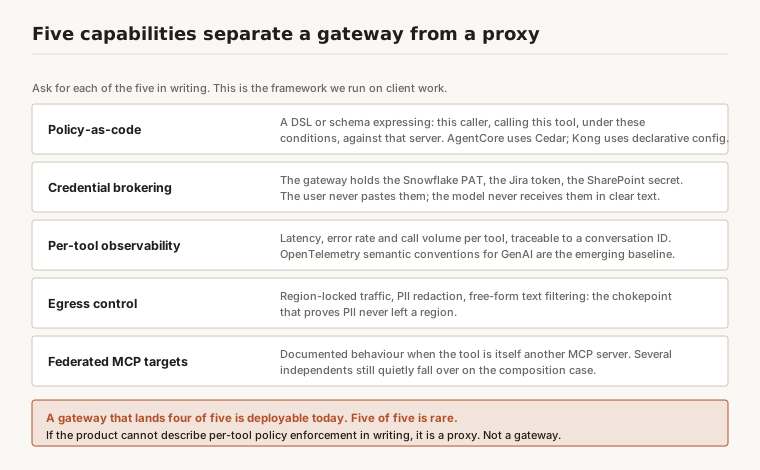
Five stacked rows, each naming a capability on the left and the check that proves it on the right. Policy-as-code asks for the DSL expressing caller, tool, conditions and server, noting that AgentCore uses Cedar and Kong declarative config. Credential brokering, per-tool observability against OpenTelemetry GenAI conventions, egress control covering region-locked traffic and PII redaction, and federated MCP targets follow. An ochre band at the foot states that four of five is deployable today, five of five is rare, and that a product unable to describe per-tool policy enforcement in writing is a proxy.
The five rows are a purchase-order checklist, not a wish list: each is something a vendor can either hand you in writing or cannot.
Frequently asked

MCP gateway, the common questions

  1. What is an MCP gateway and do I need one?

    An MCP gateway is the control point between MCP clients and MCP servers: it authenticates the caller, authorizes each tool call, attaches the downstream credential, routes the call and logs it. An MCP server exposes one system's tools; the gateway sits in front of many servers and, to a client, looks like one server that lists only what that caller may use [7]. You need one once more than three servers are shared across users or clients, as soon as any server touches regulated data, or when users would otherwise paste tokens into client configs. A single developer running local stdio servers does not; the spec has stdio servers read credentials from the environment [4].
  2. What is the difference between an MCP proxy and an MCP gateway?

    A proxy moves MCP traffic; a gateway rules on it. Putting several servers behind one URL, bridging stdio to HTTP or terminating TLS are proxy jobs. A gateway adds a decision on every call (this caller, this tool, this credential) and keeps a record of the outcome. Ask the vendor for its written per-tool policy. If there is nothing to read, you are looking at a proxy.
  3. Is an MCP gateway the same as an API gateway?

    No. An API gateway authorizes HTTP routes; an MCP gateway authorizes tools. Every client message over Streamable HTTP is a POST to one endpoint. Since the 2026-07-28 revision the tool name also travels in an Mcp-Name header, so a header rule can block a named tool, but a plain API gateway still cannot trim tools/list to what the caller may use or attach a per-tool downstream credential [1]. Azure API Management and Kong now add MCP features to their API gateways [9][13]. An LLM gateway routes prompts to models instead, and an agent gateway also covers agent-to-agent traffic; see our agent gateway vs API gateway comparison.
  4. How do I control which users can call which MCP tools?

    Put the rule at an MCP gateway rather than in each server. The gateway authenticates the user against your identity provider, evaluates a per-tool policy (this caller, this tool, these conditions) on every tools/call, and can trim tools/list so each user sees only what they may call [7]. Hiding a tool is not enforcement, so test a direct call to a hidden tool and check that the denial lands in the audit record. Per-server OAuth can do the same job for a handful of servers; past that, one policy layer is easier to review and to revoke.
References

Sources & citations

Each [n] above points here. URLs go to the publisher's canonical page. The access date is the day we last opened the link and confirmed the cited claim was still on the page. If a source has rotted, file a correction at /about#corrections.

  1. [1]
    Model Context Protocol . Specification 2026-07-28: Streamable HTTP
    https://modelcontextprotocol.io/specification/2026-07-28/basic/transports/streamable-http · accessed 2026-10-11

    Every client message is an HTTP POST to a single MCP endpoint. Revision 2026-07-28 removed protocol-level sessions and requires an Mcp-Method header on all requests and an Mcp-Name header on tools/call, resources/read and prompts/get, so that "intermediaries (load balancers, gateways, observability tooling)" can route and inspect requests without parsing the body. The HTTP+SSE transport has been deprecated since 2025-03-26. The spec defines no gateway role.

  2. [2]
    AWS . Amazon Bedrock AgentCore is now generally available
    https://aws.amazon.com/about-aws/whats-new/2025/10/amazon-bedrock-agentcore-available/ · accessed 2026-10-11

    Posted October 13, 2025. AgentCore Gateway now connects to existing MCP servers in addition to turning APIs and Lambda functions into tools.

  3. [3]
    Model Context Protocol . Specification 2026-07-28: Caching
    https://modelcontextprotocol.io/specification/2026-07-28/server/utilities/caching · accessed 2026-10-11

    A "public" cacheScope means any client, shared gateway or caching proxy may store and serve the response to any user; "private" responses must not be shared across authorization contexts.

  4. [4]
    Model Context Protocol . Specification 2026-07-28: Authorization
    https://modelcontextprotocol.io/specification/2026-07-28/basic/authorization · accessed 2026-10-11

    Authorization is optional; HTTP implementations should conform, and a protected MCP server acts as an OAuth 2.1 resource server that must validate token audience; clients must send RFC 8707 resource indicators; stdio servers take credentials from the environment. Dynamic Client Registration is deprecated in favor of Client ID Metadata Documents.

  5. [5]
    Model Context Protocol . Specification 2026-07-28: Authorization Security Considerations
    https://modelcontextprotocol.io/specification/2026-07-28/basic/authorization/security-considerations · accessed 2026-10-11

    An MCP server must not pass the client's token through to upstream APIs. MCP proxy servers using static client IDs must obtain user consent for each dynamically registered client (confused deputy).

  6. [6]
    Solo.io . MCP Authorization is a Non-Starter for Enterprise
    https://www.solo.io/blog/mcp-authorization-is-a-non-starter-for-enterprise · accessed 2026-10-11

    August 13, 2025, Christian Posta and Louis Ryan. A critique of the June 2025 authorization spec (anonymous dynamic client registration, OAuth delegation) that recommends existing SSO plus gateway-side policy. Solo.io created agentgateway, now a Linux Foundation project, and sells an enterprise distribution of it.

  7. [7]
    Model Context Protocol . Specification 2026-07-28: Tools
    https://modelcontextprotocol.io/specification/2026-07-28/server/tools · accessed 2026-10-11

    The tools/list result may vary by the authorization presented on the request, for example returning only the tools the caller's granted scopes permit. Clients or proxies that aggregate tools from several servers should implement a disambiguation strategy, such as prefixing tool names with a server identifier.

  8. [8]
    AWS (docs) . Amazon Bedrock AgentCore Gateway: A secure AI gateway for agents, tools, and models
    https://docs.aws.amazon.com/bedrock-agentcore/latest/devguide/gateway.html · accessed 2026-10-11

    Fully managed gateway for tools, agents and LLMs: OpenAPI, Smithy and Lambda tool targets, A2A passthrough, inference routing, ingress and egress auth, semantic tool selection.

  9. [9]
    Microsoft Learn . Overview of MCP servers in Azure API Management
    https://learn.microsoft.com/en-us/azure/api-management/mcp-server-overview · accessed 2026-10-11

    REST API as MCP server, or governance of an existing MCP server; JWT validation, rate limits, IP filtering; self-hosted gateway option; supports MCP tools, not prompts.

  10. [10]
    Google Cloud . Agent Gateway overview
    https://docs.cloud.google.com/gemini-enterprise-agent-platform/govern/gateways/agent-gateway-overview · accessed 2026-10-11

    Network entry and exit point for agentic interactions; egress to MCP servers including third-party remote servers; IAM, Agent Registry, Model Armor and semantic policies.

  11. [11]
    Cloudflare (docs) . MCP server portals are now generally available
    https://developers.cloudflare.com/changelog/post/2026-09-24-mcp-portals-ga/ · accessed 2026-10-11

    Changelog dated September 24, 2026, filed under Access and Cloudflare One: one endpoint for approved MCP servers, available to all Cloudflare customers; Cloudflare Access logs tool, prompt and resource activity.

  12. [12]
    Cloudflare . Scaling MCP adoption: Our reference architecture for simpler, safer and cheaper enterprise deployments of MCP
    https://blog.cloudflare.com/enterprise-mcp/ · accessed 2026-10-11

    April 14, 2026, Sharon Goldberg and Matt Carey. Cloudflare's internal portal, connected to four internal MCP servers, exposed 52 tools (about 9,400 tokens); with Code Mode enabled on the portal they collapsed into 2 portal tools (about 600 tokens), a 94% reduction. Shadow-MCP discovery with Cloudflare Gateway hostname, path and DLP rules.

  13. [13]
    Kong (docs) . AI MCP Proxy plugin
    https://developer.konghq.com/plugins/ai-mcp-proxy/ · accessed 2026-10-11

    Per-tool ACLs control which consumers can discover and invoke specific tools; all allowed and denied attempts are written to the audit log. AI Gateway Enterprise only.

  14. [14]
    Kong . Kong Agent Gateway Is Here — And It Completes the AI Data Path
    https://konghq.com/blog/product-releases/kong-agent-gateway · accessed 2026-10-11

    April 14, 2026. Agent Gateway extends Kong AI Gateway to agent-to-agent (A2A) traffic; GA as of AI Gateway 3.14.

  15. [15]
    Kong (docs) . Kong AI Gateway changelog
    https://developer.konghq.com/ai-gateway/changelog/ · accessed 2026-10-11

    Changelog for the on-prem Kong AI Gateway runtime. Release 2.1.0, dated September 22, 2026, added support for MCP protocol revision 2026-07-28.

  16. [16]
    Composio . MCP Gateway
    https://composio.dev/mcp-gateway · accessed 2026-10-11

    1,500+ toolkits plus customer MCP servers; per-team endpoints; SAML/OIDC SSO, SCIM 2.0, action-level access control; audit records hold metadata only; Cloud, VPC or self-hosted.

  17. [17]
    Maxim AI . Enterprise MCP Gateway for Agents and Tools | Bifrost
    https://www.getmaxim.ai/mcp-gateway · accessed 2026-10-11

    Bifrost is open source under Apache 2.0 and self-hostable; a client to upstream MCP servers and a server to agents; role-based tool access synced from Okta, Entra or Keycloak.

  18. [18]
    Bifrost (docs) . t3.xlarge benchmark
    https://docs.getbifrost.ai/benchmarking/t3.xl · accessed 2026-10-11

    11 µs total overhead at 5,000 RPS on an AWS t3.xlarge (59 µs on a t3.medium); excludes JSON marshalling and HTTP calls. Bifrost's benchmarking overview (https://docs.getbifrost.ai/benchmarking/getting-started) states: "All benchmarks are on mocked OpenAI calls."

  19. [19]
    agentgateway (GitHub) . agentgateway: Next Generation Agentic Proxy for AI Agents and MCP servers
    https://github.com/agentgateway/agentgateway · accessed 2026-10-11

    Linux Foundation project, Apache 2.0; MCP and A2A; fine-grained RBAC with a CEL policy engine.

  20. [20]
    IBM (GitHub) . ContextForge release v1.0.0: General Availability
    https://github.com/IBM/mcp-context-forge/releases/tag/v1.0.0 · accessed 2026-10-11

    Released May 1, 2026; release notes include Rust A2A 1.0 runtime support.

  21. [21]
    Palo Alto Networks . Palo Alto Networks Completes Acquisition of Portkey to Secure AI Agents
    https://www.paloaltonetworks.com/company/press/2026/palo-alto-networks-completes-acquisition-of-portkey-to-secure-ai-agents · accessed 2026-10-11

    Press release dated May 29, 2026; Portkey becomes the core AI gateway for Prisma AIRS.

  22. [22]
    Boomi . Lunar.dev Acquisition Strengthens AI Governance for Boomi Customers
    https://boomi.com/blog/lunar-dev-boomi-acquisition/ · accessed 2026-10-11

    July 27, 2026. Boomi has acquired Lunar.dev; its capabilities become part of the Boomi Enterprise Platform, including Boomi Connect, Boomi's managed MCP server offering.

  23. [23]
    Zuplo . Introducing the Zuplo MCP Gateway
    https://zuplo.com/blog/introducing-zuplo-mcp-gateway · accessed 2026-10-11

    Public beta from June 2, 2026, now generally available: one spec-compliant gateway in front of every MCP server, with OAuth, credential brokering, tool curation and observability.

  24. [24]
    Docker (docs) . MCP Gateway
    https://docs.docker.com/ai/mcp-catalog-and-toolkit/mcp-gateway/ · accessed 2026-10-11

    Docker's open-source solution for orchestrating MCP servers: a centralized proxy between clients and servers that manages configuration, credentials and access control. MCP Gateway as part of Docker AI Governance is invite-only.

  25. [25]
    ASCENDING (our publisher) . Customer-Hosted Enterprise MCP Gateway & Server Registry (Jarvis)
    https://ascendingdc.com/jarvis-ai/mcp-gateway/ · accessed 2026-10-11

    Vendor page for our own product, last verified by ASCENDING October 9, 2026. Documented behavior: AWS or Azure hosting (EKS/AKS guide), permission-scoped Registry Endpoint, RBAC plus per-tool ACLs, Streamable HTTP and SSE registration, encrypted downstream OAuth credentials with refresh. OpenTelemetry/Prometheus metrics for MCP activity including latency; the page states the docs do not specify per-call payload or policy-snapshot logging.

  26. [26]
    Jarvis Registry docs (ASCENDING, our product) . FAQ
    https://jarvisregistry.com/faq/ · accessed 2026-10-11

    "This documentation does not claim that Jarvis Registry itself is SOC 2 certified, and deploying it does not automatically certify the customer." No HIPAA or FedRAMP claim appears.

  27. [27]
    AWS (docs) . Policy in Amazon Bedrock AgentCore: Control Agent Interactions
    https://docs.aws.amazon.com/bedrock-agentcore/latest/devguide/policy.html · accessed 2026-10-11

    Policy in AgentCore intercepts all traffic through AgentCore Gateways and evaluates each request against policies written in Cedar.