
The CFO question that comes up in every RFP
A VP of IT walks into a procurement meeting with two tabs open. Tab one: a Microsoft renewal that already includes E3 for 1500 seats. Tab two: a Glean demo deck. The CFO asks one question. "Why are we adding a $40-80 per-seat line item when Copilot is a $30 add-on we can bolt onto the bill we already pay?" Microsoft's own price list backs the second half of that sentence: "Supercharge your plan with Microsoft 365 Copilot for $30.00 user/month, paid yearly" [1].
The first half is harder to source, and we want to be precise about why. Glean publishes no public price list, so every per-seat figure on this page comes from procurement reporting rather than a vendor rate card. Vendr's buyer-reported benchmark, drawn from 174 purchases, puts the median Glean contract at $98,890 a year across a $29,880–$208,897 range [6]. (For the long version — Glean's reported $45-50/seat base, the $15 Work AI add-on, the $70K POC fee, and the all-in TCO bands — see our Glean pricing teardown.)
It's also the wrong question — or rather, the incomplete one. Because the $30 number assumes your knowledge actually lives in M365. For roughly 40% of mid-market and enterprise buyers we've sat in RFP rooms with, the knowledge lives in Slack, Jira, Confluence, GitHub, Zendesk, Notion, and a Drive instance that Microsoft sales pretends doesn't exist. Once that's true, the bundled price stops being a price and starts being a coverage gap.
Let's walk it through.
What each product actually is, in plain terms
Microsoft 365 Copilot is an LLM layer welded onto the M365 graph. It reads Outlook, Teams chats, SharePoint, OneDrive, Word, Excel, and Loop. Microsoft's architecture doc is blunt about the boundary: Copilot "uses Microsoft Graph to access user data that's in the user's unique context," and "doesn't access data that the user doesn't have permission to access" [3]. Copilot Studio (announced 2024, GA via Azure AI Foundry in 2025) lets you author custom agents that call Microsoft Graph and a growing list of connectors; the Foundry Agent Service now also hosts remote MCP servers as tools, issues each agent a dedicated Microsoft Entra identity, and supports OAuth on-behalf-of passthrough [5]. The pitch is integration depth inside the suite. The whole pitch.
Glean is a federated work-AI platform. Series F at a ~$7.2B valuation in 2025 — a $150M round, per Glean's own announcement [8]. Its connector library — built up over years — pulls structured search and chat across Slack, Drive, Confluence, Jira, GitHub, Salesforce, ServiceNow, Notion, Box, Dropbox, plus M365; Glean now advertises "275+ apps across ecosystems out of the box" [7]. The Federated Search Apps SDK shipped in 2024, opening the door to in-house connectors and embedded answer widgets. Glean's pitch is reach, not bundle.
Two genuinely different architectures. Bundled-and-deep vs federated-and-wide. Don't pretend either is the other.
The license math, at 1500 seats
Here's the part procurement actually cares about. Numbers are list — your AE will discount, but the structure stays.
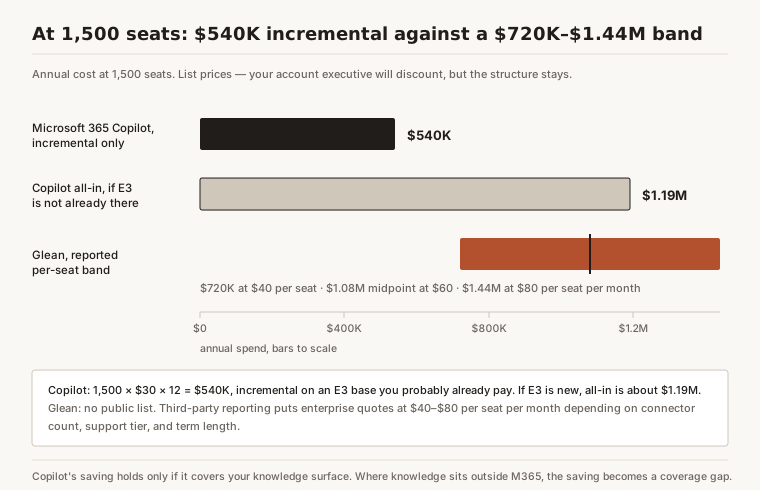
Naive read: Copilot is cheaper. Of course it is — it's an add-on to a license you already bought.
Real read: the comparison only works if Copilot actually covers your knowledge surface. Copilot grounds prompts against Microsoft Graph inside the Microsoft 365 service boundary [3], so if your engineering org runs on GitHub + Linear + Slack, Copilot can't see most of it without custom Graph connectors, and now you're either building those (people-cost) or paying for Copilot Studio agent capacity (consumption-cost) to bridge the gap. A 1500-seat shop where 60% of the meaningful knowledge sits outside M365 will spend the "savings" on integration work inside 18 months. We've watched it happen twice.
The honest framing is not "which is cheaper." It's: are you paying for a bundle that matches your knowledge map, or paying for a federation layer because your knowledge map sprawls?
Where Glean wins
Federation reach. Genuinely. This is the axis we'll concede without hedging.
Glean has been doing the connector-and-permission-mirroring work since 2019. The Slack connector understands threads. The Jira connector respects per-project ACLs. The Drive connector handles shared-drive inheritance. The current catalogue runs to "275+ apps across ecosystems out of the box," offered in native, MCP and Push API form [7]. None of that is glamorous — it's the kind of grunt work that takes four years of engineering and you can't shortcut with a launch announcement. When a sales engineer connects to your environment in a POC and surfaces a 2022 design doc in Confluence that nobody on the call remembered existed, that's the moat.
Glean also embeds. The Federated Search Apps SDK means answers can render inside your existing portals, not just in the Glean tab. For companies with strong intranet investment, that matters. The same reach now extends through Glean's own MCP gateway, which proxies third-party MCP servers out to Claude, ChatGPT, Cursor, Gemini and Microsoft Copilot "while enforcing permissions, policy, and audit on every call" [10].
Where Copilot wins
License consolidation and Outlook/Teams depth. Two real advantages, not three.
If 90% of your knowledge work happens in Outlook threads, Teams meetings, SharePoint sites, and Word docs, Copilot's tight Graph integration is hard to beat. The "summarize this 14-message thread and draft a reply" loop is genuinely faster than any federated alternative because Copilot doesn't have to leave the data plane — it's already there, inside the Microsoft 365 service boundary, honouring Conditional Access and MFA [3]. Same for Teams meeting recaps, Loop component generation, Excel formula assist.
Procurement also loves the single-vendor story. One EA, one renewal cycle, one set of compliance attestations. Purview is the reason that story holds up under audit: prompts and responses are "captured in the unified audit log," with DLP, retention, eDiscovery and Insider Risk policies extending over Copilot interactions [4]. For a Microsoft-shop CFO, that's a tangible win.
The third path: federated, but gateway-governed
After enough RFP cycles, you start to notice the same pattern. Buyers want Glean's federation reach, Copilot's licensing simplicity, and neither product's gap at the agent-action layer. They want federation underneath, governance on top.
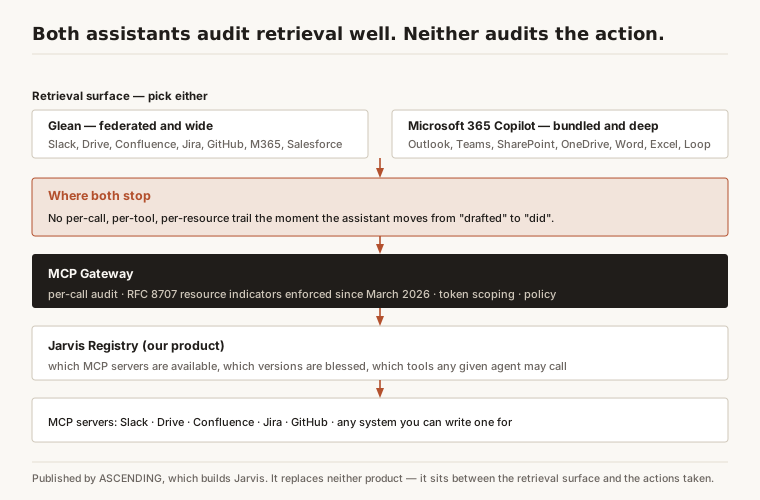
That's the architecture Jarvis AI Agent is shaped around. Instead of bundling agents into a SaaS UI, the agent sits on top of a registry of MCP servers — your own, your vendors', your hyperscaler's. The MCP Gateway handles per-call audit, RFC 8707 resource indicator enforcement (required by the current MCP revision, 2026-07-28 [11]), token scoping, and policy. The spec language is unambiguous in both directions: "MCP clients MUST implement Resource Indicators for OAuth 2.0 as defined in RFC 8707," and servers "MUST validate that access tokens were issued specifically for them as the intended audience" [12]. One thing to design away from rather than toward: Dynamic Client Registration is now "deprecated and retained for backwards compatibility with authorization servers that do not support Client ID Metadata Documents" [12]. Above the gateway, the Jarvis Registry catalogs which MCP servers are available, which versions are blessed, and which tools any given agent is allowed to call; it lists publicly on AWS Marketplace [14].
The shape this gives you: Glean-style federation reach (because MCP servers exist for Slack, Drive, Confluence, Jira, GitHub, and any system you can write one for), Copilot-style suite depth (Microsoft shipped Azure AI Foundry MCP support GA in December 2025; the Foundry Agent Service documents remote MCP servers as first-class tools, with per-agent Entra identity and OAuth on-behalf-of passthrough [5]), and a per-call audit trail that Glean and Copilot both leave as homework.
It's not a Glean replacement and not a Copilot replacement. It's the layer that sits between a Glean-or-Copilot retrieval surface and the actions your agents need to take. The MCP donation to the Linux Foundation in December 2025 — December 9, as a founding project of the Agentic AI Foundation, co-founded with Block and OpenAI and supported by Google, Microsoft, AWS, Cloudflare and Bloomberg [13] — is what makes this architecturally durable. You're not betting on any one vendor's protocol.
5-axis comparison
| Axis | Glean | Microsoft 365 Copilot | Jarvis Registry (flagged — our product) |
|---|---|---|---|
| License model | Per-seat enterprise contract, ~$40-80/seat/mo per third-party reports (procurement-reported; no Glean rate card exists) [6] | $30/user/mo add-on [1]; requires M365 E3+ baseline (Microsoft in fact qualifies Business, F-series and Office 365 E1 too, with no seat minimum) [2] | Platform license + MCP server costs; no per-seat retrieval tax [14] |
| Federation reach | Broad: Slack, Drive, Confluence, Jira, GitHub, M365, Salesforce, ServiceNow, Notion, Box — 275+ apps advertised [7] | Deep within M365 Graph [3]; thinner outside; Copilot Studio connectors growing | As wide as your MCP server inventory — any system with an MCP surface |
| Agentic execution | Retrieval-first; agent flows added 2024-2025; multi-step workflows still emergent — though Glean Agents has been GA since May 2025 [9] | Copilot Studio + Foundry agents GA 2025; multi-step still mostly assisted [5] | Built around agent execution from day one; registry-scoped tool access |
| Per-call audit | Retrieval logs strong; per-tool agent audit thinner — Glean's MCP gateway does log and enforce policy per call [10] | M365 audit logs deep; per-agent-action audit still maturing [4] | Per-call audit at the gateway; RFC 8707 resource indicators [12] enforced since March 2026 |
| Cross-cloud posture | SaaS layer, federates to clouds, single-tenant options available | Azure-native | AWS + Azure + on-prem; gateway sits above your cloud boundary [14] |
The recommendation, grounded in seat math
At 1500 seats with a heavy Microsoft footprint and a moderate spread to Slack and Jira: pilot Copilot first because the marginal cost is $540K/yr on top of license you already pay, then layer a gateway above it when agent-execution requirements show up.
At 1500 seats where knowledge is genuinely scattered — Slack-first culture, GitHub-heavy engineering, Confluence-heavy product — Glean's $1.08M midpoint is the honest number and it probably earns it back in surfaced work. At 1500 seats with regulated workloads or cross-cloud, neither product alone closes the agent-action audit gap; that's where the federated-plus-gateway architecture earns its place.
The bundled-vs-federated debate is real. The third path is real too.
Frequently asked
-
Is Glean worth it if we're already paying for M365 Copilot?
Depends on where your knowledge actually lives. Copilot grounds against Microsoft Graph and returns only what the signed-in user is already permitted to see [3], so if more than 40% of meaningful work happens outside the M365 Graph (Slack, Jira, Confluence, GitHub, Notion), Glean's federation reach — 275+ advertised connectors [7] — typically pays back inside 12-18 months. If you're a true Microsoft-only shop, the case is thinner. -
Can Copilot Studio close the federation gap?
Partially. You can build Graph connectors for Slack, Salesforce, etc., and the Foundry Agent Service can now mount remote MCP servers as agent tools with Entra-backed identity and OAuth on-behalf-of passthrough [5]. The work is real — connector engineering, permission mirroring, freshness tuning. Glean has been compounding that work since 2019 and now advertises 275+ out-of-the-box connectors [7]. Catching up is possible but not free. -
Why does the $30 Copilot price feel misleading?
Because it assumes M365 E3 or E5 is already in your stack (~$36-57/user; Microsoft's current enterprise list is E3 $39.00 and E5 $60.00 on annual commitment, with the Copilot add-on at $30.00 [1]). The all-in floor is closer to $66/user/month, not $30. Two fairness notes: Microsoft qualifies far more base plans than E3/E5 — Business Basic, Business Standard, Business Premium, F1, F3 and Office 365 E1 all count — and publishes no minimum seat count for the add-on [2]. And it assumes your knowledge map matches M365's coverage map. -
Where does MCP fit in this comparison?
MCP (Anthropic's Model Context Protocol, donated to the Linux Foundation's Agentic AI Foundation on December 9, 2025 [13]) is the emerging standard for how agents call tools and data. The current revision is 2026-07-28 [11], and it makes RFC 8707 resource indicators a MUST for clients and audience validation a MUST for servers [12]. Both Microsoft (Foundry Agent Service mounts remote MCP servers as tools [5]) and Glean (which runs both an MCP server and an MCP gateway [10]) are converging on it. It's the substrate the Jarvis architecture sits on [14]. -
What about Moveworks, ServiceNow Now Assist, or other contenders?
Worth a separate look. We've covered Moveworks vs Glean specifically — see related reading.