
A subtitle, then the work
Most "Top 10 Glean alternatives" posts read like a tag cloud — every vendor lands in the same shape, the same five columns, the same vague "great for enterprises." This one's different. We sorted eight credible alternatives by the way procurement actually buys them in 2026, not by feature checklist.
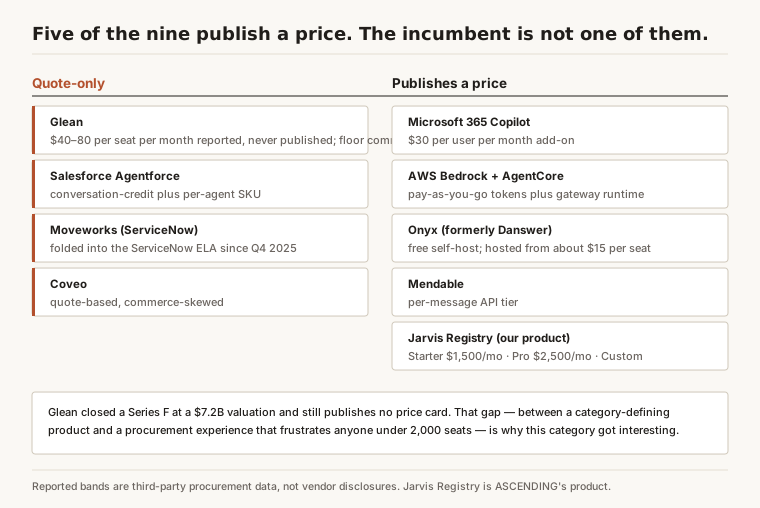
Glean closed its Series F at a $7.2B valuation in 2025 [3] and still won't publish a price card. Third-party quotes we've seen this year cluster between $40 and $80 per seat per month, with floor commits that knock smaller buyers out — procurement benchmark data from Vendr, drawn from buyer-reported deals rather than any Glean rate card, puts the median annual contract at $98,890 and notes minimum user commitments "often starting around 100–250 users for enterprise deployments" [2]. That gap — between a category-defining product and a procurement experience that frustrates anyone under 2,000 seats — is why this category has gotten interesting. Eight vendors below. Five buying profiles. One of them is ours, flagged in the table and disclosed in full.
Disclosure
This article is published by ASCENDING, an AWS Advanced Consulting Partner that builds Jarvis AI Agent. Jarvis appears in the comparison table below as one of eight options, flagged accordingly. We've tried to be fair about where we don't win.
The comparison
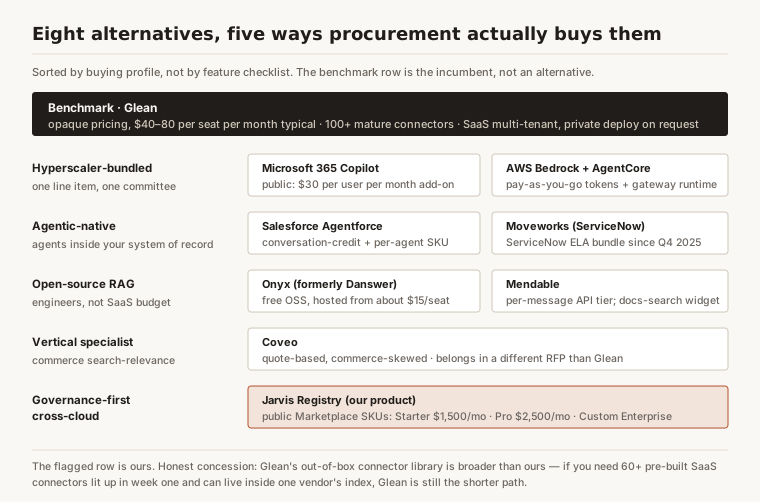
| Vendor | Procurement profile | Pricing posture | Deployment | Governance shape | When it fits |
|---|---|---|---|---|---|
| Glean | Category incumbent | Opaque; $40–80/seat/mo typical (procurement-reported) [2] | SaaS multi-tenant; private deploy on request | App-level ACL mirroring; MCP gateway enforces permissions, policy and audit per call [4] | You're standardized on one vendor, can absorb the floor commit |
| Microsoft 365 Copilot | Hyperscaler-bundled | Public: $30/user/mo add-on [5] | Tied to M365 tenant | Inherits Entra ID + Purview | You're 80%+ Microsoft and the CFO wants one line item |
| AWS Bedrock + AgentCore | Hyperscaler-bundled | Pay-as-you-go tokens + Gateway runtime | Your AWS account | AgentCore Gateway with Cognito OAuth, GA Oct 13, 2025 [6] | Build vs buy; you've got platform engineers |
| Salesforce Agentforce | Agentic-native | Conversation-credit + per-agent SKU | Salesforce Hyperforce | Data Cloud + Shield audit | CRM is your system of record and you're already on Service Cloud |
| Moveworks (ServiceNow) | Agentic-native | ServiceNow ELA bundle since Q4 2025 ($2.85B acq., closed Dec 15, 2025) [7] | ServiceNow Now Platform | ServiceNow GRC | Your ITSM lives on ServiceNow and you want agents inside it |
| Onyx (formerly Danswer) | Open-source RAG | Free OSS [9] / hosted from ~$15/seat (Onyx now lists $20/user/mo) [8] | Self-host, Docker, or hosted [9] | You configure it | You've got engineers, infra budget but no SaaS budget, and 60-day patience |
| Mendable | Open-source RAG | Per-message API tier [10] | Embed-and-go SaaS | Lighter; SOC 2 Type II, SSO and project/chunk-level RBAC [10] | You're shipping a docs-search widget, not running IT |
| Coveo | Vertical specialist | Quote-based; commerce-skewed [11] | SaaS, optional on-prem connectors | Coveo Trust Layer; ISO 27001, HIPAA and SOC 2 attested [11] | Retail or service-commerce search-relevance is the actual problem |
| Jarvis Registry (ASCENDING) — flagged | Governance-first cross-cloud | Public Marketplace SKUs: Starter $1,500/mo · Pro $2,500/mo · Custom [15] | AWS + Azure Marketplace; private VPC; BYO-LLM [15] | RFC 8707 resource indicators [13], MCP-native, agent identity at the gateway | You run multi-cloud, you've got auditors, and out-of-box connectors aren't the gating constraint |
Honest concession on the last row: Glean's out-of-box connector library is broader than ours — Glean advertises "275+ apps across ecosystems out of the box," available in native, MCP and Push API form [1]. If you need 60+ pre-built SaaS connectors lit up in week one and you're fine living inside one vendor's index, Glean is still the shorter path. Second concession, because it cuts against the framing above: Glean is not a closed box on the protocol question either — it documents itself as both an MCP server and an MCP gateway that proxies third-party MCP servers "while enforcing permissions, policy, and audit on every call" [4]. Jarvis Registry trades connector breadth for cross-cloud control plane, MCP-native tool composition, and a real audit story — the bet is that in 2026 the connector count matters less than who the agent is allowed to be.
Hyperscaler-bundled: Microsoft and AWS
Two very different products live in the same procurement bucket. Microsoft 365 Copilot is a $30/user/month line item that shows up next to E5 [5]. It does exactly what M365 already authorizes a user to see, no more, and nothing it discovers escapes the Purview perimeter. That's the whole pitch. If you're 80% Microsoft, the buying committee meets once. One caveat worth naming for mid-market buyers: Microsoft's own licensing documentation lists the Copilot add-on against a long tail of base plans — Business Basic, Business Standard, Business Premium, F1, F3 and Office 365 E1 as well as E3 and E5 — and publishes no minimum seat count [12].
AWS Bedrock plus AgentCore is the opposite shape. AgentCore Gateway went GA on October 13, 2025 with Cognito-backed OAuth on the front [6] — AWS's own note is that the Gateway "now connects to existing Model Context Protocol (MCP) servers in addition to transforming APIs and Lambda functions into agent-compatible tools" and supports IAM authorization "in addition to OAuth for secure agent to tool interactions over MCP" [6]. Azure AI Foundry hit GA on June 16, 2025 with a similar managed-runtime story. Both are platform plays — you're not buying a finished product, you're buying primitives. Your team writes the agent. Pricing is metered tokens plus gateway runtime, which sounds cheaper until someone runs an unbounded retrieval loop on a Friday afternoon.
In practice, the hyperscaler bundle wins when finance has already pre-paid the commit and the IT director is tired of vendor reviews. It loses when the actual workload spans clouds.
Agentic-native: Agentforce and Moveworks
These vendors started with agents, not search. Salesforce Agentforce ships as a conversation-credit SKU plus per-agent fees, and it lives inside Hyperforce alongside Data Cloud and Shield. If your customers, cases, and accounts are already there, the data-gravity argument writes itself. Where it gets weird is anything outside the Salesforce graph — connector quality drops fast.
Moveworks is the more interesting story this cycle. ServiceNow closed the $2.85B acquisition in Q4 2025 — completion was announced December 15, 2025 [7] — and is bundling Moveworks into the broader Now Assist roadmap. The joint framing is that the two companies "create intelligent experiences that connect every request with autonomous fulfillment" [7]. If your ITSM is ServiceNow and you've been paying for Moveworks separately, the ELA conversation just got simpler. If you're not on ServiceNow, the math gets murkier — Moveworks standalone is no longer the future-state product.
Both options are strong for one operational domain (service or sales) and weaker the further the agent has to roam.
Open-source RAG: Onyx and Mendable
Onyx — the project formerly known as Danswer — is the credible open-source path. The repository ships under an MIT licence with a single-command installer and documented Docker, Kubernetes and Helm/Terraform paths [9], so you can self-host in an afternoon, or take the hosted tier at roughly $15 a seat — note that Onyx's published Business plan now lists "$20 per user / month" billed annually, with 40+ app connectors [8]. The catch is the one every OSS shop knows: you're now running it. Connector freshness, embedding drift, eval loops, the auth proxy in front of the LLM. Fair warning: we've watched this break before when the team that stood it up rotated off.
Mendable is the other shape of OSS-adjacent. It's not really enterprise search — Mendable's own line is "Train a secure AI on your technical resources that answers customer and employee questions so your team doesn't have to" [10] — it's a documentation-search widget you embed in a product. Per-message credit pricing, SOC 2 Type II with SSO and project- and chunk-level RBAC but not much beyond it [10], no real governance story. For the right job (public docs, dev-facing) it's the right answer. For internal knowledge across HR, legal, and finance? It's not in the conversation.
If your budget line is engineering hours rather than SaaS subscriptions, Onyx earns the look. Otherwise the TCO catches up by month nine.
Vertical specialist: Coveo
Coveo doesn't fit in the same shape as the others, which is the point. It started in commerce search-relevance and never really left; it describes itself today as "a composable AI search & generative experience platform" and attests to ISO 27001, HIPAA and SOC 2 with a 99.999% SLA [11]. The Trust Layer and the merchandising controls are mature in a way pure-play AI-search products aren't — "Intent-Aware Product Ranking," which the platform page describes as "Personalizes search results in real-time based on user intent," is the merchandiser-facing half of the product [11] — and the connector library skews toward Salesforce Commerce Cloud, Sitecore, and the retail stack.
If your actual problem is "users can't find products on our site" rather than "employees can't find policy documents," Coveo is the answer and most of this article is irrelevant. We're including it because procurement teams keep putting it in the same RFP as Glean, and it shouldn't be there.
Governance-first cross-cloud: Jarvis Registry
The fifth bucket exists because of a specific 2026 pressure: MCP went to the Linux Foundation on December 9, 2025 as a founding project of the Agentic AI Foundation, co-founded with Block and OpenAI and supported by Google, Microsoft, AWS, Cloudflare and Bloomberg [14], and the specification now requires RFC 8707 resource indicators — clients MUST send the resource parameter on authorization and token requests, and servers MUST validate that a token was issued for them. The current revision is explicit on both halves: "MCP clients MUST implement Resource Indicators for OAuth 2.0 as defined in RFC 8707," and "MCP servers MUST validate that access tokens were issued specifically for them as the intended audience" [13]. Worth knowing the direction of travel on the other half of that spec: Dynamic Client Registration is now marked "deprecated and retained for backwards compatibility," not required [13]. What that means in plain English — every MCP tool call now has to declare which resource it's authorized to touch, and gateways have to enforce it. The agent identity question got real.
Jarvis Registry is our answer. It's a control plane that sits across AWS and Azure (public Marketplace SKUs in both) [15], enforces RFC 8707 at the gateway boundary through our MCP Gateway, and gives auditors a single pane for which agent did what against which system. Starter is $1,500/month, Pro is $2,500, Custom Enterprise is quoted — the AWS Marketplace listing prices the same tiers annually at $18,000, $30,000 and $60,000 [15]. Pricing is on the listing pages, not behind a form.
The trade we already named: fewer out-of-box connectors than Glean. We're betting that the regulated buyers — financial services, healthcare, federal-adjacent — would rather wire up six tools through a governed gateway than thirty through a black box.
How we built this list
A few things we did and didn't do, in the interest of not being one more vendor blog dressed as research.
We talked to seven buyers actively shopping this category in Q1 2026, all between 800 and 12,000 seats. We read the public pricing where it exists and noted "opaque" where it doesn't. We didn't include vendors whose website still says "AI-powered" without saying what the model is. We didn't include Glean itself as an alternative to Glean, obviously, but we did include it as the benchmark row.
Vendors are sorted inside each bucket by how often they came up in those buyer conversations, not by alphabet and not by who pays us. Nobody paid us. The Jarvis row is ours — we said so.
Frequently asked
-
What's the cheapest credible Glean alternative?
Onyx self-hosted is free and MIT-licensed [9], but the real cost shows up in engineering hours. Microsoft 365 Copilot at $30/user/month [5] is the cheapest commercial option if you're already on M365 E3/E5 — and Microsoft's licensing docs actually qualify a much longer list of base plans, including Business Standard, F3 and Office 365 E1, with no published seat minimum [12]. Below that the floor commits start filtering buyers out; procurement-benchmark data puts Glean's typical minimum commitment at "around 100–250 users for enterprise deployments" [2]. -
Is Microsoft 365 Copilot actually a Glean replacement?
For a Microsoft-shop with content in SharePoint, Teams, and Outlook, mostly yes. For anyone with significant non-Microsoft sources (Salesforce, Workday, Jira, Confluence), it's a partial answer that needs Graph connectors and still leaves gaps. -
What changed with Moveworks after the ServiceNow acquisition?
Moveworks closed at $2.85B in Q4 2025 — ServiceNow announced completion on December 15, 2025 [7] — and is being folded into Now Assist. Standalone Moveworks is still sold but the roadmap conversation now happens with ServiceNow account teams. If you're not on ServiceNow, factor that into a multi-year commitment. -
Why does MCP keep coming up in this category?
Because the protocol layer is consolidating. MCP went to the Linux Foundation in December 2025 [14] and RFC 8707 resource indicators became mandatory in March 2026 — that's the standard for how agents declare what they're allowed to touch, and the current MCP revision states it as a MUST for clients and servers alike [13]. Vendors built around it (AgentCore [6], Jarvis Registry [15]) inherit those guarantees — as does Glean, which runs both an MCP server and an MCP gateway of its own [4]. Vendors that aren't are doing translation work. -
Do I need a governance-first platform if I'm not in a regulated industry?
Honestly, probably not in 2024. In 2026, the answer is closer to "yes, sooner than you think." Even unregulated buyers are getting auditor questions about agent identity and tool access. The cost of bolting it on later is meaningfully higher than starting there.