
The pricing-opacity problem
A VP of IT we spoke with last quarter described her Glean evaluation like this: three sales calls, a custom quote on PDF, no list price anywhere, and a procurement team that wanted a spreadsheet by Friday. She built one. It had question marks in half the cells.
That's the whole problem with pricing-opacity sales. A buyer can't compare what isn't published. So they reach for whatever number a third party leaked, anchor on it, and lose months in back-and-forth before they even know if the platform fits.
This piece doesn't pretend to have Glean's rate card. Nobody outside Glean has it. What we can do is collect what's been reported publicly, walk through the TCO components that don't show up in any seat-license headline, and put four pricing shapes next to each other so you can argue with your CFO from a stronger position.
What we (think we) know about Glean's pricing
Glean closed a Series F in 2025 at a roughly $7.2B valuation and has reported 1M+ daily active users across its customer base. The company does not publish pricing on its website. It does not list on AWS Marketplace or Azure Marketplace with public SKUs (as of this writing).
What's been reported, with sources we can name:
- $45-50 per user per month is the base band reported across third-party pricing analysis — gosearch.ai's Glean pricing teardown [1] and Workativ's 2026 TCO write-up [2] converge on the same band. Older RFP-leak aggregators cite up to $80; the procurement marketplaces have anchored lower as the seat count has scaled. Vendr's marketplace listing reports comparable enterprise deal data [3].
- A Work AI / agentic add-on of roughly $15 per user per month sits on top of the base, per Workativ's same teardown [2]. Stacked, that lands a fully-enabled seat near $60-65 per user per month.
- A 100-seat floor is widely reported for enterprise contracts [2]. At the floor, the all-in math (base + add-on) puts a year-one minimum somewhere around $60K-$75K before implementation services, plus any paid POC.
- A paid POC up to $70,000 — typically a 200-seat, 6-8 week proof-of-concept — is in the public reporting [2]. Some Glean docs reference a Flex Pricing path for shorter pilots [4]; rate cards are not published.
- A 10% premium support fee on annual license, and renewal escalators in the 7-12% range, surface consistently in procurement-marketplace data [3]. Neither is a Glean disclosure.
- Connector add-ons and the agent SKUs are negotiated separately. Forrester's TEI write-up for Glean's work-AI platform [5] models a composite organization but does not publish the per-line rate card. Nobody outside Glean does.
Read that twice. The $40-80 number isn't wrong, but it isn't Glean's number either. If you cite it back to a Glean AE in a negotiation, expect a polite redirect. The honest answer is: ask for a quote, then benchmark it against the alternatives below.
TCO components people miss
Seat license is the line item everyone fixates on. It's also the smallest line item in year one. The expensive parts:
Implementation hours. Enterprise federated search rollouts run 60-200 hours of professional services for the initial deployment. That's connector configuration, identity wiring, permission-mirror testing, content tuning. At a partner blended rate of $250/hr you're looking at $15K-$50K before anyone sends a query.
Connector maintenance. Every SaaS you connect — Salesforce, ServiceNow, Confluence, Notion, GitHub, Slack — has API changes, auth-flow updates, and rate-limit quirks. Glean owns this for connectors they support. For anything custom you build on top, you own it. Plan one FTE-quarter per year of internal effort on the connector layer if you're serious.
Governance retrofits. Permission mirroring is the silent killer. If your source systems have inconsistent ACLs (and they do), the federated index will surface things your CISO doesn't want surfaced. Cleanup work is real. Budget for it.
SSO and IdP integration. Trivial if you're already on Okta or Entra. Painful if you're on a homegrown setup or migrating. Either way, it's not in the seat price.
Agentic upsell. When the agent tier ships in its full form, it almost certainly costs more per seat than the search tier. Microsoft's pattern (Copilot at $30 on top of M365) is the template the whole industry is copying. Plan for a 30-50% uplift on whatever your search-only number lands at.
Three pricing shapes, walked through
The market has settled into three rough archetypes. Each has tradeoffs.
1. Federated enterprise — high-flat-seat (Glean). You pay a healthy per-seat fee. In exchange you get years of connector engineering, a mature permissions model, and a product that works on day 30 instead of day 300. The bet is that your time-to-value beats the seat math. For companies with 50+ source systems and a real knowledge-fragmentation problem, the bet sometimes pencils out. The federation breadth here is genuine — we'll concede that point cleanly. The opacity is the friction.
2. Bundled platform — included in the suite (M365 Copilot, AgentCore). Microsoft 365 Copilot is $30 per user per month, but only on top of a Microsoft 365 baseline — E3 at $36, E5 at $57. So your real all-in cost is $66-87 per user per month for Copilot-eligible seats. The pitch: it's "free" because you're already paying for M365. The reality: you're paying twice and your CFO will eventually notice.
AWS AgentCore went GA on October 13, 2025 with consumption-based pricing — per invocation plus per tool call. Great for variable workloads. Hard to budget for if your usage curve hasn't stabilized. Azure AI Foundry, which went GA June 16, 2025, follows a similar consumption shape.
Salesforce Agentforce takes a per-action approach — roughly $2 per action in the published guidance, varies by action type. Predictable if you have a clear automation use case. Surprising if your action volume spikes.
3. Published unit pricing (Jarvis Registry). The Jarvis Registry is listed on AWS Marketplace and Azure Marketplace with three published SKUs: Starter at $1,500/month, Pro at $2,500/month (bundles Jarvis Chat), and Custom Enterprise for governed deployments [6]. This is platform-level pricing, not per-seat — meaning a 1,500-seat org pays the same Pro tier as a 150-seat org for the core platform. Your variable cost is the underlying model spend on AWS or Azure, billed by your cloud provider, not us.
The point of naming this contrast: we publish, most don't. That's the editorial differentiator. Whether $2,500/month + cloud variable beats Glean's $45-50/seat for your scenario depends on seat count, governance posture, and which source systems you actually care about. Run the math below.
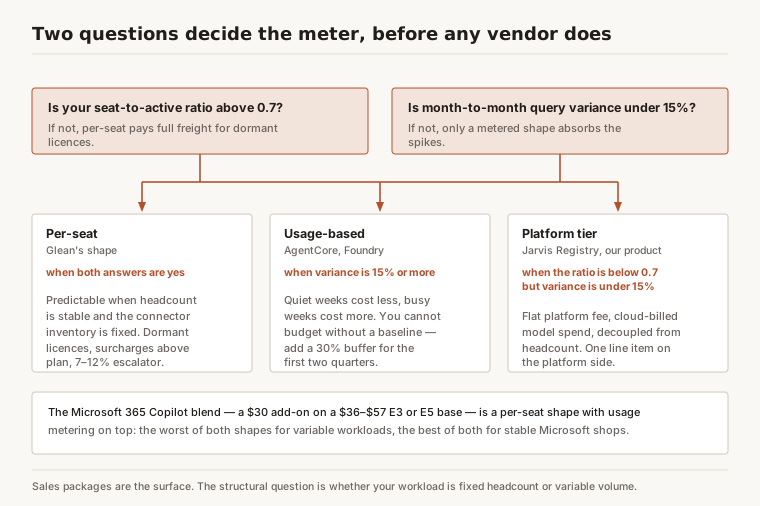
Per-seat or usage-based? A decision tree. The three shapes above are sales packages. The structural question underneath is whether your workload looks like a fixed-headcount knowledge surface or a variable-volume agent workload. The two shapes price very differently as you scale.
Per-seat (Glean's shape) is predictable when headcount is stable, query volume per seat is moderate, and connector inventory is fixed. It punishes you on three vectors. Light users still pay full freight (a 1,500-seat firm where only 600 people actively query the assistant is paying for 900 dormant licenses). FlexCredits and Work AI surcharges fire when query volume above plan or unconnected sources show up [2]. A 500-seat firm running 4 connectors and 12% query volume above plan will hit the FlexCredits upcharge in month 3, on the third-party reporting. And the renewal escalator — 7-12% on year two per Vendr's marketplace data [3] — compounds across the contract.
Usage-based (AgentCore, Foundry consumption) inverts that. Quiet weeks cost less than a per-seat agreement would; busy weeks cost more. Treat it like a metered utility bill. The trap is variance. Without a usage baseline you cannot budget. AWS publishes per-invocation and per-tool-call rates on the AgentCore pricing page [8]; estimate your monthly volume before you sign and add a 30% buffer for the first two quarters while behaviour stabilises.
Platform tier (Jarvis Registry's shape) is the third structural option. The platform fee is flat; the variable cost is your cloud-billed model spend, which you already procure on the same paper as the rest of your AWS or Azure footprint. Predictable like per-seat, scalable like usage-based, and decoupled from headcount entirely. Choose it when the workload is heterogeneous (some heavy users, some light) and procurement wants one line item on the platform side.
Two practical questions narrow the choice. Is your seat-to-active ratio above 0.7? If yes, per-seat is honest; if not, per-seat is overpaying for inactive headcount. Is your query volume month-to-month variance under 15%? If yes, per-seat or platform-tier; if not, usage-based is the structural fit because it absorbs the spikes. The Microsoft 365 Copilot blend ($30 add-on + $36-57 E3/E5 base, rising July 1, 2026 [7]) is a per-seat shape with a usage-based agent metering layer on top — the worst of both shapes for variable workloads, the best for stable Microsoft shops.
Four-option pricing comparison
| Dimension | Glean | M365 Copilot | AWS AgentCore | Jarvis Registry (★) |
|---|---|---|---|---|
| Published list price? | No — quote-only | Yes — $30/user/mo add-on | Yes — consumption-based | Yes — $1,500 / $2,500 / Custom on AWS & Azure Marketplace |
| License model | ~$45-50/seat/mo base + $15 Work AI add-on (third-party reporting), 100-seat floor, $70K POC reported | Per-seat, requires M365 E3 ($36) or E5 ($57) baseline | Per invocation + per tool call (consumption) | Platform tier + cloud-billed model usage |
| Connectors out of the box | Leader — 100+ mature enterprise connectors, years of integration work | Microsoft estate (Graph, SharePoint, Teams, Outlook) plus growing third-party | AWS-native + open via MCP | MCP-native via the MCP Gateway; BYO connector inventory |
| Governance plane | Permission mirroring across federated index | Microsoft Purview integration | IAM-based, AWS-native | Governance-first design, audit logs, policy hooks |
| Best fit | 5,000+ seats, complex enterprise content sprawl, budget for opacity | Heavy M365 shops already on E3/E5 | Variable workloads, AWS-native estates | Mid-market through enterprise wanting transparent unit costs |
(★) Jarvis row published by ASCENDING. We're naming it so you can discount accordingly. Glean's connector breadth advantage is real — that's not a vendor concession, it's a market fact.
Methodology — where these numbers came from
Pricing-comparison content is only useful if you can audit the sources. So:
- Glean $45-80/seat/month base + ~$15/seat Work AI add-on: gosearch.ai's pricing teardown [1], Workativ's 2026 TCO write-up [2], and Vendr's procurement-marketplace listing [3]. Glean has not confirmed these figures publicly. Flex Pricing exists for shorter pilots per Glean's own docs [4] but no rate card is published. The 100-seat floor and the $70K POC fee are in the Workativ teardown [2]. Forrester's TEI for Glean's work-AI platform models a composite organization but does not publish the per-line rate card [5].
- M365 Copilot $30/user/month and the E3/E5 baselines: Microsoft's published pricing pages and licensing documentation, current as of Q1 2026. These are official.
- AWS AgentCore: AWS Marketplace listings and the AWS Bedrock pricing page following AgentCore's GA on October 13, 2025. Consumption rates change — check the live page before signing.
- Azure AI Foundry (referenced in passing): Azure pricing pages following GA on June 16, 2025.
- Salesforce Agentforce $2/action: Salesforce's published Agentforce pricing communications, fall 2024 onward. Action types vary.
- Jarvis Registry $1,500 / $2,500 / Custom: AWS Marketplace and Azure Marketplace public listings, ASCENDING's own pricing pages. These are first-party and verifiable.
- Moveworks acquisition $2.85B by ServiceNow in Q4 2025: ServiceNow press release and SEC filings. Included for market-context only.
Where we say "third-party reporting," we mean exactly that. If Glean publishes a rate card next quarter, this article gets a correction note.
The 1,500-seat scenario
Same company, four paths. Annual cost ranges only — we're skipping implementation services to keep the comparison clean.
"Don't sign anything per-seat for 1,500+ users without first quoting a platform-priced alternative on the same workload. The seat-license math collapses fast above 1,000 seats."
- Glean at $45-80/seat/month × 1,500 seats × 12 months = $810K - $1.44M/year [1][2]. Plus implementation, plus the $15/seat Work AI add-on when you enable it (another $270K at 1,500 seats), plus the agentic SKUs when they land, plus a 7-12% renewal escalator on year two [3]. The 100-seat floor doesn't matter at this scale but bites mid-market shops below 250 seats [2].
- M365 Copilot at $30/user/month × 1,500 seats × 12 = $540K/year just for Copilot, sitting on top of a $648K-$1.03M M365 baseline you may already be paying. If you're not, the all-in is $1.19M-$1.57M/year.
- AWS AgentCore consumption: genuinely depends on usage. A typical knowledge-agent workload at 1,500 seats with moderate query volume lands somewhere in the $200K-$600K/year band based on early customer data, but variance is high. Get a usage model before committing.
- Jarvis Registry Pro at $2,500/month flat = $30K/year platform, plus your cloud-billed model spend. Mid-volume model spend for 1,500 seats typically runs $100K-$300K/year on AWS or Azure depending on which models you route to. All-in $130K-$330K/year.
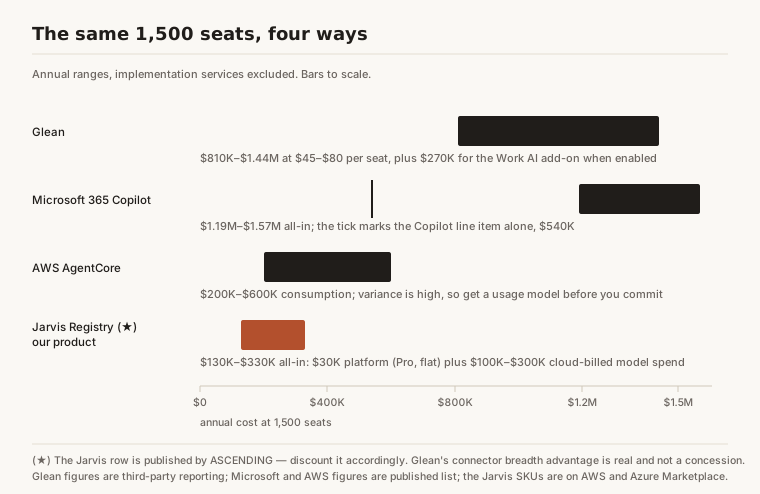
The Jarvis number is lower because it's structurally different — platform + variable model cost, not per-seat. That's not always the right shape. If you need 100+ federated connectors working on day 30, Glean's price is the price of getting there fast. If you can stage rollout, route through MCP, and accept that you'll own more of the integration glue, the math shifts hard.
Frequently asked
-
Does Glean publish official pricing anywhere?
No. As of May 2026, Glean has not published a price card on their website or any marketplace. All figures in circulation are third-party. -
Is the $45-80/seat/month band a reliable benchmark?
-
How does Microsoft 365 Copilot's $30 compare to Glean?
$30 is the Copilot add-on price; you also need E3 or E5 underneath. All-in per seat lands in the $66-$87 range, broadly comparable to the reported Glean band but with the M365 baseline included. -
Why does Jarvis Registry publish pricing when others don't?
Editorial choice by ASCENDING. We list on AWS and Azure Marketplace with three SKUs because buyers told us they were tired of quote-only sales cycles. Whether that's the right model for every vendor is a separate question. -
What's the single biggest hidden cost in any of these?
Connector maintenance and governance retrofit work. Plan for one FTE-quarter of internal effort per year on the connector layer regardless of which platform you pick. -
What's the all-in 3-year TCO for a ~500-seat Glean deployment?
Reporting clusters around $350K-$480K all-in over three years for a mid-market deployment near 500 seats [2][3]. That envelope assumes base license at $45-50/seat, the $15/seat Work AI add-on partially enabled, a 10% support fee, a 7-12% renewal escalator, around $10K/month of VPC and cloud-hosting cost, and one platform-admin FTE at $100K-$150K loaded. Implementation services and the $70K POC are separate.