
The Problem
Many organizations began their AI journey by connecting to powerful external models through cloud APIs — a fast, low-friction way to add natural language capabilities to existing workflows. It worked. Users loved asking questions in plain English instead of writing SQL. Data teams got relief. Stakeholders got faster answers. But as adoption scaled, a quieter problem was growing underneath the productivity wins.
Every query routed to an external AI provider is a data transfer. For companies handling sensitive customer records, industry-specific compliance requirements, or proprietary business metrics, that means confidential information is regularly leaving the organization's controlled environment and passing through third-party infrastructure. Under the GDPR that transfer is a regulated act in its own right, subject to principles of lawfulness, purpose limitation, data minimisation and storage limitation, with security measures such as encryption expected in proportion to risk [4]. Sensitive information disclosure also sits second on OWASP's 2025 risk list for LLM applications, ahead of supply chain and poisoning risks [10]. Leadership teams often don't realize this is happening until a compliance review or security audit makes it impossible to ignore.
The risk isn't hypothetical. When business-critical data — dealership performance metrics, customer interaction histories, campaign analytics — is processed outside your own infrastructure, you have no control over data residency, no guarantees about model behavior, and no recourse if the vendor changes their policies or experiences an outage. For regulated industries, that exposure isn't just a risk management concern. It can be a regulatory liability.
The Solution
Data-sovereign AI architecture solves this by keeping every layer of AI processing — the model, the query pipeline, the data retrieval, and the response generation — entirely inside your own cloud environment. Instead of calling out to a third-party API, the foundation models are accessed through a managed service hosted within your own cloud account (such as AWS Bedrock), meaning your data never leaves your infrastructure perimeter. The providers now document this boundary in their own words. AWS runs each model provider's inference software in a service-owned Model Deployment Account that the provider cannot reach, so providers "don't have access to Amazon Bedrock logs or to customer prompts and completions" [1]. Microsoft states that prompts, completions, embeddings and training data "are NOT available to other customers," "are NOT available to OpenAI or other providers," and "are NOT used to train any generative AI foundation models without your permission or instruction," that "The models are stateless: no prompts or completions are stored in the model," and that stored data sits at rest in the customer's own tenant within the designated geography, encrypted with AES-256 or a customer-managed key [2].
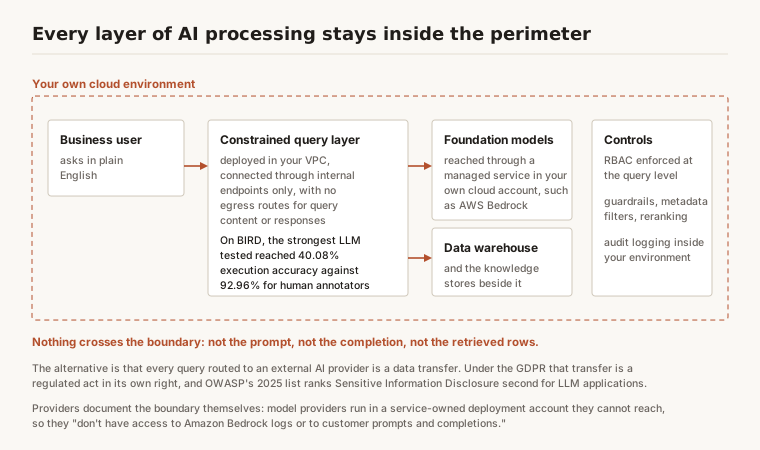
This approach pairs a private model layer with a natural language interface that connects directly to internal data warehouses and knowledge stores. Business users can still ask conversational questions — "How did our top accounts perform last month?" — and receive accurate, context-aware answers, without any data touching an external system. The hard part is the querying, not the hosting: on a text-to-SQL benchmark grounded in real database content, the leading model of its day reached 40.08% execution accuracy against 92.96% for human annotators, which is why production systems constrain the query surface rather than pointing a model at a raw schema [11]. Role-based access controls ensure users only query data appropriate to their role — the zero-trust framing NIST codified, where authentication and authorization are "discrete functions performed before a session to an enterprise resource is established" and the object of protection is the resource, not the network segment [3] — and all AI interactions remain logged and auditable within the organization's own environment [8].
Critically, this isn't a downgrade in capability. Modern foundation models accessible through private cloud deployments deliver sophisticated semantic understanding — handling follow-up questions, domain-specific terminology, and complex multi-step queries — with the same fluency users experienced with external tools.
ROI & Business Value
| Outcome | Impact |
|---|---|
| Data privacy & compliance | All AI processing contained within your own cloud — zero third-party data exposure |
| Time savings | Eliminates manual reporting cycles; teams reclaim significant analyst hours weekly |
| Self-service analytics | Business users query data independently, reducing dependency on technical staff |
| Cost reduction | Moves inference onto a published cloud rate card with on-demand, batch and provisioned-throughput options rather than an opaque external API line [12], and reduces bottlenecks that slow decision-making |
| Migration speed | Transitions of this type can be completed in days, not months, with zero disruption |
| Faster client servicing | Internal teams access insights faster, improving responsiveness and confidence |
The compounding effect matters most: when non-technical users can self-serve data queries securely, analysts shift from reactive report generation to proactive strategic work. That productivity reallocation drives value that extends well beyond any single dashboard.
Practical Implementation Guide
- Audit your current AI data flows. Map exactly what data is leaving your environment today — which queries, which systems, which users. This establishes your risk baseline and prioritizes what to migrate first.
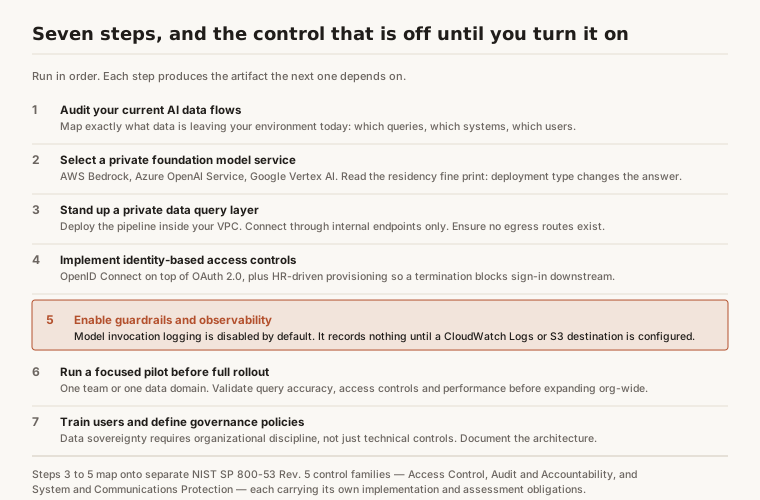
Select a private foundation model service. AWS Bedrock, Azure OpenAI Service, and Google Vertex AI all offer hosted model access within your cloud account. Choose based on your existing cloud footprint and compliance requirements — and read the residency fine print, because deployment type changes the answer: Microsoft documents that "Global" and "DataZone" deployments may process prompts and responses anywhere in the relevant geography or data zone, while data stored at rest stays in the customer-designated geography [2].
Stand up a private data query layer. Deploy the natural language-to-data pipeline inside your VPC. Connect it to your data warehouse or analytics layer using internal endpoints only. Ensure no egress routes exist for query content or responses. NIST's control catalogue is the checklist to map this against, with System and Communications Protection, Access Control and Audit and Accountability as distinct families each carrying their own assessment obligations [5].
Implement identity-based access controls. Integrate with your enterprise identity provider (Active Directory, Okta, AWS Cognito, etc.) to enforce role-based permissions at the data and query level — not just at the application layer. OpenID Connect is the interoperable layer for this, "a simple identity layer on top of the OAuth 2.0 protocol" that lets a client verify end-user identity from the authorization server's own authentication [6], and the lifecycle side should ride the same rails so an HR termination automatically blocks sign-in or removes the account downstream [7].
Enable guardrails and observability. Configure data classification rules to prevent accidental exposure of PII or restricted content in model responses — guardrails, metadata filters and reranking are separately configurable controls on a managed retrieval layer, not a single switch [9]. Set up audit logging for all AI interactions from day one, which means turning it on explicitly: model invocation logging is disabled by default and only starts recording once a destination is configured [8].
Run a focused pilot before full rollout. Start with one team or one data domain. Validate query accuracy, access controls, and performance before expanding org-wide. This limits risk and builds internal confidence.
Train users and define governance policies. Data sovereignty requires organizational discipline, not just technical controls. Define acceptable use policies, document the architecture, and train users on how the system works and what it protects.
FAQ
We have data-residency obligations. Does "inside your own cloud" actually satisfy them?
Not automatically — the deployment type decides it, and this is the fine print worth reading twice. Microsoft documents that Global and DataZone deployments may process prompts and responses anywhere in the relevant geography or data zone, while data stored at rest stays in the customer-designated geography [2]. AWS documents a different guarantee: model providers cannot reach the accounts running their inference software, and so have no access to logs, prompts or completions [1]. Those two statements answer two separate questions. Under the GDPR the transfer itself is a regulated act [4], so map the specific claim to your specific obligation rather than to the word "sovereign."
What does this cost compared with an external API?
No total is published here, and the change is more about which rate card you are on than a guaranteed reduction. Moving inference to a managed service in your own account puts it on published pricing with on-demand, batch and provisioned-throughput options, where batch runs at "50% lower price compared to on-demand inference pricing" and rates vary by modality, provider, model and Region [12]. Against that, you are now carrying costs the external API absorbed: the query layer running inside your VPC, log storage once you enable it [8], and the guardrail and retrieval tuning that used to be someone else's problem.
How long does the migration take, and what is the hardest part?
Transitions of this type can be completed in days rather than months, with no disruption to users — but that describes swapping the model layer, which is the easier half. The hard part is the querying, not the hosting. On a text-to-SQL benchmark grounded in real database content, the leading model of its day reached 40.08% execution accuracy against 92.96% for human annotators [11], which is why a production system constrains the query surface instead of pointing a model at a raw schema. Expect that constraint work, plus enforcing permissions at the data and query level rather than the application layer, to dominate the schedule.
What has to be in place before starting?
A cloud account you already operate, with a VPC that reaches your data warehouse over internal endpoints and no egress route for query content or responses — that perimeter is what the whole argument rests on. An enterprise identity provider such as Active Directory, Okta or Cognito, because permissions have to be inherited and enforced at the data layer rather than re-invented in the application. An honest inventory of what data leaves your environment today, which serves as both the risk baseline and the migration order. And a named owner for governance policy, since acceptable use and user training are organizational work no architecture supplies.
Where would this approach not work?
Where the model you need is only available through a public API rather than a service you can host in your own account — the design assumes the second is possible. Where there is no existing cloud footprint to deploy into, and standing one up costs more than the exposure it removes. And where the question surface is genuinely open-ended: if users must be able to ask anything of a raw schema, the accuracy gap above is your ceiling, and a constrained layer answering a defined set of questions well is the honest scope. Moving the model inside your perimeter also narrows sensitive information disclosure — second on OWASP's 2025 list for LLM applications [10] — without closing it.
References
- Amazon Bedrock deploys each model provider's inference and training software into a service-owned Model Deployment Account per Region and per provider; because "the model providers don't have access to those accounts, they don't have access to Amazon Bedrock logs or to customer prompts and completions" — Amazon Web Services (2026): https://docs.aws.amazon.com/bedrock/latest/userguide/data-protection.html
- Microsoft states that customer prompts, completions, embeddings and training data "are NOT available to other customers," "are NOT available to OpenAI or other providers of Models sold by Azure," and "are NOT used to train any generative AI foundation models without your permission or instruction"; that "The models are stateless: no prompts or completions are stored in the model"; that stored data "Is stored at rest in the Foundry resource in the customer's Azure tenant, within the same geography as the resource" and encrypted with AES-256 or a customer-managed key; and that Global and DataZone deployment types change where processing occurs while data at rest stays in the customer-designated geography — Microsoft (2026): https://learn.microsoft.com/en-us/azure/ai-foundry/responsible-ai/openai/data-privacy
- Zero trust moves defenses "from static, network-based perimeters to focus on users, assets, and resources," treats authentication and authorization as "discrete functions performed before a session to an enterprise resource is established," and prioritizes "protecting resources (assets, services, workflows, network accounts, etc.), not network segments" — NIST SP 800-207, Zero Trust Architecture (2020): https://csrc.nist.gov/pubs/sp/800/207/final
- The GDPR is Regulation (EU) 2016/679 of 27 April 2016 on the protection of natural persons with regard to the processing of personal data and the free movement of such data, requiring processing that is lawful, fair and transparent, data "adequate, relevant and limited to what is necessary," storage periods kept to "a strict minimum," and risk-proportionate security measures such as encryption — EUR-Lex (2016): https://eur-lex.europa.eu/legal-content/EN/TXT/?uri=CELEX%3A32016R0679
- NIST's security and privacy control catalogue spans 21 control families, including Access Control, Audit and Accountability, System and Communications Protection, and Supply Chain Risk Management, each requiring separate implementation and assessment — NIST SP 800-53 Rev. 5 (2020): https://csrc.nist.gov/pubs/sp/800/53/r5/upd1/final
- OpenID Connect Core 1.0 is "a simple identity layer on top of the OAuth 2.0 protocol" that "enables Clients to verify the identity of the End-User based on the authentication performed by an Authorization Server," adding the ID Token, standard claims and the UserInfo endpoint — OpenID Foundation (2023): https://openid.net/specs/openid-connect-core-1_0.html
- Microsoft documents HR-driven provisioning where a termination in the HR system automatically blocks sign-in or removes the account in Active Directory, Microsoft Entra ID and downstream applications, with SCIM as the connector protocol for applications holding their own user store — Microsoft (2026): https://learn.microsoft.com/en-us/entra/id-governance/what-is-provisioning
- Amazon Bedrock model invocation logging "is disabled by default"; once a CloudWatch Logs or Amazon S3 destination is configured it records the full request and response plus the caller's IAM/STS ARN, model ID, operation, timestamp and token counts — Amazon Web Services (2026): https://docs.aws.amazon.com/bedrock/latest/userguide/model-invocation-logging.html
- A managed retrieval layer exposes guardrails, manual and implicit metadata filtering, chunk counts, search type, reranking and query decomposition as independently configured controls — the mechanics behind "prevent accidental exposure of PII or restricted content" — Amazon Web Services (2026): https://docs.aws.amazon.com/bedrock/latest/userguide/kb-test-config.html
- The 2025 OWASP Top 10 for LLM Applications ranks Sensitive Information Disclosure second, after Prompt Injection and ahead of Supply Chain, Data and Model Poisoning, Improper Output Handling and Excessive Agency — OWASP GenAI Security Project (2025): https://genai.owasp.org/llm-top-10/
- On BIRD, a text-to-SQL benchmark grounded in large real-world database content, the strongest LLM tested reached 40.08% execution accuracy against 92.96% for human annotators — the reason natural-language querying over a warehouse needs a constrained query layer rather than raw schema access — Li et al. (2023): https://arxiv.org/abs/2305.03111
- Amazon Bedrock publishes on-demand, batch and provisioned-throughput pricing per model, with batch inference at "50% lower price compared to on-demand inference pricing" and rates that vary by modality, provider, model and Region — Amazon Web Services (2026): https://aws.amazon.com/bedrock/pricing/