
The Problem
AI adoption in the enterprise is accelerating — but security and compliance teams are hitting the brakes. And for good reason. Most AI tools are built for speed-to-market, not for the rigorous data governance requirements that enterprises operate under. The result is a growing tension between business units eager to unlock AI productivity and IT and security leaders responsible for protecting sensitive data, maintaining regulatory compliance, and preserving customer trust.
The core fear isn't unfounded. Many AI platforms process and store data on shared infrastructure, use customer conversations to improve their models, and require broad permissions that exceed what users actually need. OWASP's current risk list for LLM applications names exactly these failure modes — sensitive information disclosure, excessive agency, and prompt injection sit at the top of the 2025 catalogue [3]. For organizations operating in regulated industries — finance, healthcare, government, legal — this isn't just a policy concern. It's a disqualifying risk.
What makes this particularly frustrating is that the business value of enterprise AI is real and measurable. The problem isn't the technology itself. It's the architecture. Organizations shouldn't have to choose between AI capability and security posture — but without a deliberate governance framework, that's exactly the tradeoff being forced on them.
The Solution
The answer lies in a security-first AI architecture that treats data sovereignty, identity, and access control as foundational — not afterthoughts bolted on post-deployment.
Data Residency by Design Rather than sending data to external servers or shared cloud infrastructure, a governed AI deployment runs entirely within the customer's own environment. Conversations, documents, and model outputs stay inside the organization's cloud account — never leaving the perimeter. This isn't a configuration option; it's the default architecture. The hyperscaler model layers now document this boundary explicitly: AWS states that model providers have no access to the deployment accounts and therefore "don't have access to Amazon Bedrock logs or to customer prompts and completions" [11], and Microsoft states that prompts, completions, embeddings and training data "are NOT available to other customers," "are NOT available to OpenAI or other providers," and "are NOT used to train any generative AI foundation models without your permission or instruction" [13].
Identity Provider Integration Governed AI connects to your existing identity infrastructure — SSO, SAML, OIDC — so user provisioning and deprovisioning happens automatically through the same workflows already managing access across the enterprise. OpenID Connect is the layer that makes this portable: "a simple identity layer on top of the OAuth 2.0 protocol" that lets clients verify end-user identity from the authorization server's authentication [4], while SCIM standardizes the create/update/delete provisioning calls that ride behind it [6]. There are no separate user directories to maintain, no orphaned accounts to audit. When an employee offboards, their AI access revokes in lockstep with everything else — the documented behavior in a mainstream identity platform is that an HR termination automatically blocks sign-in or removes the account across the directory and downstream applications [7].
Access Parity Across Integrations
When AI connects to third-party systems — CRMs, data warehouses, ERPs, collaboration tools — it inherits the exact permissions the user already holds in those systems. Nothing more, nothing less. A user who can read-only a Salesforce record cannot write to it through an AI interface. This is the same principle NIST codifies in zero trust: authentication and authorization are "discrete functions performed before a session to an enterprise resource is established," and the object of protection is the resource rather than the network segment [1]. This principle of access parity ensures that connecting an AI layer to existing systems doesn't create a new privilege escalation vector.

Encryption and Zero Data Leakage All tokens and conversation data are encrypted at rest in the customer's own database. Critically, data is never used to train external models — a non-negotiable requirement for enterprises handling proprietary, confidential, or regulated information.
ROI & Business Value
| Outcome | Business Impact |
|---|---|
| Eliminated shadow AI risk | Reduces unauthorized AI tool adoption by giving teams a sanctioned, secure alternative |
| Accelerated security review cycles | Governed architecture shortens procurement and security approval timelines |
| Regulatory compliance confidence | Data residency and audit trails support HIPAA [8], SOC 2, GDPR [10], and similar frameworks |
| Reduced IAM overhead | IdP integration means no separate AI user management burden on IT |
| Zero privilege escalation surface | Access parity eliminates a new class of security vulnerability |
| Faster AI ROI realization | Teams can deploy AI use cases without waiting months for security sign-off |
Practical Implementation Guide
Follow these steps to deploy enterprise AI within a governed security framework:
Map your data classification tiers first. Before deploying any AI tool, identify which data categories (PII, financial, IP, confidential) will potentially interact with AI workflows. This determines your compliance requirements upfront.
Select a deployment model that keeps data in your environment. Prioritize architectures that run within your existing cloud account (AWS, Azure, GCP) rather than third-party SaaS infrastructure. Validate where conversation history and embeddings are stored.
Connect to your existing Identity Provider before onboarding users. SSO integration should be the first configuration step — not an optional feature added later. This ensures access governance is enforced from day one.
Establish OAuth-governed integration connections. When connecting AI to business systems, use OAuth flows that inherit existing user permissions. OAuth 2.0 exists precisely to let a third-party application "obtain limited access to an HTTP service" on a resource owner's behalf, with the access token carrying a specific scope and duration [5]. Audit the permission scopes being granted and document them for compliance review.
Implement PII detection and data guardrails. Configure automated scanning of inputs and outputs to detect and redact sensitive data before it reaches language model APIs. Treat this as a mandatory control, not a nice-to-have — sensitive information disclosure is the second-ranked risk on OWASP's 2025 list for LLM applications [3].
Define role-based access policies for AI capabilities. Not every user should have access to every AI tool or knowledge source. Map AI access tiers to existing organizational roles using the same RBAC model you apply elsewhere; NIST's control catalogue keeps Access Control as a distinct family with its own assessment obligations [2].
Enable audit logging from the start. Every AI interaction should produce a tamper-evident log tied to a specific user identity, timestamp, and data source accessed. This is essential for compliance investigations and incident response — and it is opt-in, not automatic: Amazon Bedrock's model invocation logging is disabled by default and only begins retaining request and response bodies once a customer explicitly configures a CloudWatch Logs or S3 destination [12]. HIPAA makes the corresponding obligation explicit, requiring mechanisms "that record and examine activity in information systems that contain or use electronic protected health information" [8] and procedures to "regularly review records of information system activity" [9]. The EU AI Act names "logging of activity to ensure traceability of results" as a standing high-risk obligation [15].
Run a security review against your existing frameworks. Bring your CISO or security team into the deployment process with documented evidence of data residency, encryption standards, and access controls — treat it like any other enterprise software procurement. The UK NCSC and its international partners frame this as a lifecycle discipline across secure design, development, deployment, and operation and maintenance, published jointly in November 2023 [14].
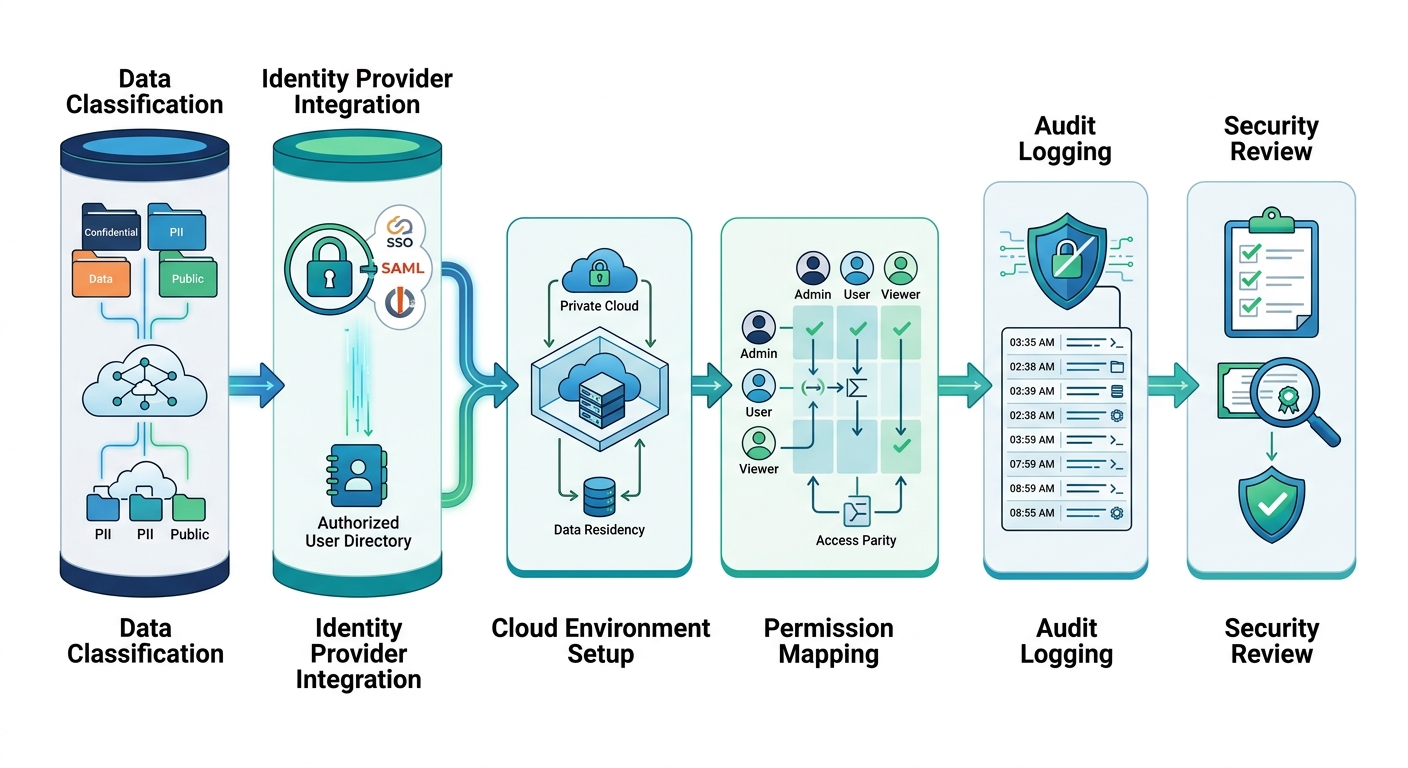
A sequential workflow diagram starting with data classification and identity provider integration, moving through cloud environment setup and permission mapping, and concluding with audit logging and final security review.

FAQ
What is a governed AI deployment?
It is an AI architecture that treats data sovereignty, identity, and access control as foundational rather than as controls bolted on after go-live. The deployment runs inside the customer's own cloud account, authenticates through the identity infrastructure already in place, inherits each user's existing permissions in every connected system, and encrypts tokens and conversation data at rest in the customer's own database.
What does "access parity" mean for AI integrations?
It means the AI inherits exactly the permissions the user already holds in a connected system — nothing more, nothing less. A user with read-only rights on a Salesforce record cannot write to that record through an AI interface. Access parity is the principle that stops an AI layer from becoming a new privilege escalation vector across CRMs, data warehouses, ERPs, and collaboration tools.
Why do security teams block AI tools outright?
Because many AI platforms process and store data on shared infrastructure, use customer conversations to improve their models, and request permissions broader than the user actually needs. For organizations in finance, healthcare, government, and legal, that combination is not a policy concern to be negotiated down — it is a disqualifying risk, so the review stops there rather than continuing to terms.
Should identity integration come before or after user onboarding?
Before. SSO integration belongs in the first configuration step rather than arriving later as an optional feature, so access governance is enforced from day one. Connecting the identity provider up front also means provisioning and deprovisioning ride the workflows already managing enterprise access: when an employee offboards, their AI access revokes in lockstep with everything else, and no orphaned accounts accumulate.
Does a governed architecture actually speed anything up?
Yes, at the review gate. The slow part of enterprise AI is rarely the build — it is waiting months for security sign-off before a use case can ship. Arriving at that review with documented data residency, encryption standards, access parity, and tamper-evident audit logging turns the conversation into a normal enterprise software procurement instead of an open-ended risk assessment.
What has to be logged for compliance?
Every AI interaction should produce a tamper-evident log tied to a specific user identity, a timestamp, and the data source accessed. That record is what compliance investigations and incident response actually run on, which is why audit logging belongs in the deployment from the start: a log that was never enabled cannot be reconstructed after the fact when an investigator asks for it [12].
References
- Zero trust moves defenses "from static, network-based perimeters to focus on users, assets, and resources," treats authentication and authorization as "discrete functions performed before a session to an enterprise resource is established," and prioritizes protecting resources rather than network segments — NIST SP 800-207, Zero Trust Architecture (2020): https://csrc.nist.gov/pubs/sp/800/207/final
- NIST's security and privacy control catalogue spans 21 control families, including Access Control and Audit and Accountability as separate families requiring their own implementation and assessment — NIST SP 800-53 Rev. 5 (2020): https://csrc.nist.gov/pubs/sp/800/53/r5/upd1/final
- The 2025 OWASP Top 10 for LLM Applications ranks Prompt Injection (LLM01), Sensitive Information Disclosure (LLM02), Supply Chain (LLM03), Data and Model Poisoning (LLM04), Improper Output Handling (LLM05), Excessive Agency (LLM06), System Prompt Leakage (LLM07), Vector and Embedding Weaknesses (LLM08), Misinformation (LLM09) and Unbounded Consumption (LLM10) — OWASP GenAI Security Project (2025): https://genai.owasp.org/llm-top-10/
- OpenID Connect Core 1.0 is "a simple identity layer on top of the OAuth 2.0 protocol" that "enables Clients to verify the identity of the End-User based on the authentication performed by an Authorization Server," adding the ID Token, standard claims and the UserInfo endpoint — OpenID Foundation (2023): https://openid.net/specs/openid-connect-core-1_0.html
- The OAuth 2.0 framework "enables a third-party application to obtain limited access to an HTTP service, either on behalf of a resource owner... or by allowing the third-party application to obtain access on its own behalf," with access tokens representing a specific scope and duration of access — IETF RFC 6749 (2012): https://datatracker.ietf.org/doc/html/rfc6749
- SCIM defines the HTTP protocol for creating, modifying, retrieving and deleting identity resources such as Users and Groups across domains, to "reduce the cost and complexity of user management operations" — IETF RFC 7644 (2015): https://datatracker.ietf.org/doc/html/rfc7644
- Microsoft documents HR-driven provisioning where a termination in the HR system automatically blocks sign-in or removes the user account in Active Directory, Microsoft Entra ID and downstream applications, with SCIM as the connector protocol for applications holding their own user stores — Microsoft (2026): https://learn.microsoft.com/en-us/entra/id-governance/what-is-provisioning
- The HIPAA Security Rule's technical safeguards require access control limiting systems "to allow access only to those persons or software programs that have been granted access rights," audit controls that "record and examine activity in information systems that contain or use electronic protected health information," person-or-entity authentication, and transmission security — 45 CFR 164.312, via Cornell Legal Information Institute: https://www.law.cornell.edu/cfr/text/45/164.312
- HIPAA's administrative safeguards require procedures to "regularly review records of information system activity, such as audit logs, access reports, and security incident tracking reports," procedures for terminating access when employment ends, and a periodic technical and non-technical evaluation of security policies — 45 CFR 164.308, via Cornell Legal Information Institute: https://www.law.cornell.edu/cfr/text/45/164.308
- The GDPR is Regulation (EU) 2016/679 of 27 April 2016 on the protection of natural persons with regard to the processing of personal data, requiring processing that is lawful, fair and transparent, data "adequate, relevant and limited to what is necessary," storage periods kept to "a strict minimum," and security measures such as encryption appropriate to the risk — EUR-Lex (2016): https://eur-lex.europa.eu/legal-content/EN/TXT/?uri=CELEX%3A32016R0679
- Amazon Bedrock runs each model provider's inference software in a Model Deployment Account owned by the Bedrock service team; because providers have no access to those accounts, "they don't have access to Amazon Bedrock logs or to customer prompts and completions" — Amazon Web Services (2026): https://docs.aws.amazon.com/bedrock/latest/userguide/data-protection.html
- Amazon Bedrock model invocation logging "is disabled by default"; once enabled it writes full request and response data plus metadata to CloudWatch Logs or Amazon S3, with each record carrying the calling principal's ARN, model ID, operation and token counts — Amazon Web Services (2026): https://docs.aws.amazon.com/bedrock/latest/userguide/model-invocation-logging.html
- Microsoft states that customer prompts, completions, embeddings and training data "are NOT available to other customers," "are NOT available to OpenAI or other providers of Models sold by Azure," and "are NOT used to train any generative AI foundation models without your permission or instruction," that the models are stateless with no prompts or completions stored in the model, and that stored data sits at rest in the customer's Azure tenant encrypted with AES-256 or a customer-managed key — Microsoft (2026): https://learn.microsoft.com/en-us/azure/ai-foundry/responsible-ai/openai/data-privacy
- The Guidelines for Secure AI System Development, published 27 November 2023 and aligned with NIST's Secure Software Development Framework and CISA's Secure by Design principles, structure security across four lifecycle stages — secure design, secure development, secure deployment, and secure operation and maintenance, the last covering logging and monitoring, update management and information sharing — UK National Cyber Security Centre (2023): https://www.ncsc.gov.uk/collection/guidelines-secure-ai-system-development
- The European Commission's AI Act summary requires high-risk providers to deliver "logging of activity to ensure traceability of results," detailed technical documentation, human oversight and robustness, with general application from 2 August 2026 — European Commission (2026): https://digital-strategy.ec.europa.eu/en/policies/regulatory-framework-ai