
What a guardian agent actually is
The phrase is Gartner's, but the pattern is older. Every production agent deployment eventually grows a second agent (or a chain of guardrails) that watches the first. Gartner's framing divides guardian agents into three primary functions [1]: Reviewers identify and review AI-generated output for accuracy and acceptable use; Monitors observe and track AI actions for human or AI follow-up; Protectors adjust or block AI actions and permissions automatically during operations. Prompt injection, ranked LLM01 on the OWASP Top 10 for LLM Applications 2025 [2], is the attack class most guardian products are built to intercept.
- 01
Prompt-injection guards (Protectors)
Classifiers (sometimes small purpose-trained models, sometimes rule-plus-LLM hybrids) that inspect incoming prompts and tool outputs for injection patterns. Open-source baselines include NVIDIA NeMo Guardrails (v0.20.0 as of January 2026) [3], Llama Guard (Meta), and Lakera's commercial offering.
- 02
Output-schema validators (Reviewers)
Agents that check the structured output of another agent against a schema before the output is accepted. Useful when the downstream tool will behave badly on malformed input. Guardrails AI is the most widely-deployed open-source implementation.
- 03
Policy-check agents (Protectors)
Agents that refuse to invoke specific tool combinations. "The ticketing tool and the refund tool must not be called in the same turn" is a one-line policy that prevents a wide class of failure modes. Most MCP gateways now ship this capability natively.
- 04
Red-team orchestrators (adversarial Monitors)
Microsoft PyRIT (Python Risk Identification Toolkit, MIT-licensed) orchestrates multi-modal, multi-turn attacks against agents to surface injection and data-leak vulnerabilities before deployment [4]. Not strictly a runtime guardian, but an essential companion.
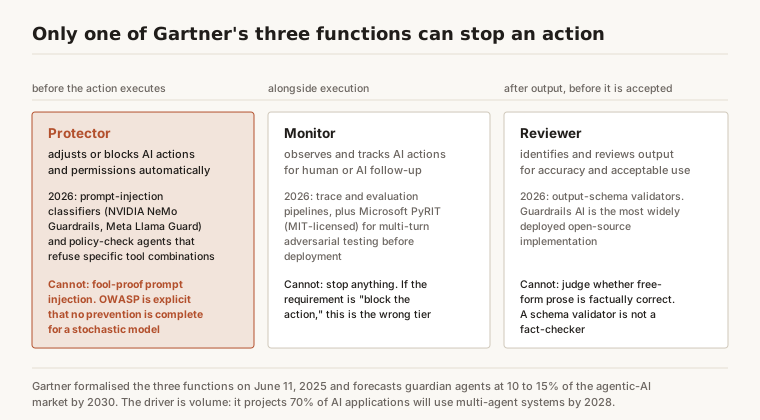
| Function (Gartner) | Intervention point | What it looks like in 2026 | What it cannot do |
|---|---|---|---|
| Reviewer | After the agent produces output, before that output is accepted downstream | Output-schema validators. Guardrails AI is the most widely deployed open-source implementation | Judge whether free-form prose is factually correct. A schema validator is not a fact-checker, and vendors who blur the two are selling |
| Monitor | Alongside execution. Observes and escalates; holds no veto | Trace and evaluation pipelines, plus Microsoft PyRIT (MIT-licensed) for multi-turn adversarial testing before deployment [4] | Stop anything. If your control requirement is "block the action," a Monitor is the wrong tier |
| Protector | Inline, before the action executes | Prompt-injection classifiers (NVIDIA NeMo Guardrails, Meta Llama Guard) and policy-check agents that refuse specific tool combinations | Fool-proof prompt injection. OWASP's LLM Top 10 2025 guidance is explicit that no prevention is complete given the stochastic nature of language models [2] |
How to evaluate one
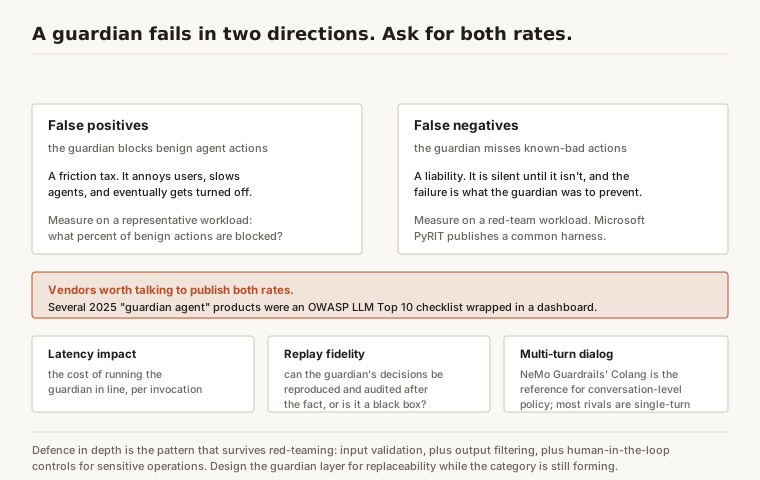
The honest evaluation question for a guardian agent is what happens when the guardian is wrong, and that question has two shapes. A guardian that raises only false positives is a friction tax: it annoys users, slows agents, and eventually gets turned off. A guardian that raises only false negatives is a liability: it is silent until it isn't, and the failure mode is what the guardian was supposed to prevent. Vendors worth talking to publish both rates.
This term is often misused. For example, several 2025 "guardian agent" products are OWASP LLM Top 10 checklists wrapped in a dashboard. The OWASP guidance itself is clear that there is no fool-proof prevention for prompt injection given the stochastic nature of language models [2]; any vendor claiming otherwise is selling something. Defence in depth (input validation plus output filtering plus human-in-the-loop controls for sensitive operations) is the pattern that survives red-teaming.
- False-positive rate on a representative workload: what percent of benign agent actions does the guardian incorrectly block?
- False-negative rate on a red-team workload: of known-bad actions, what percent does the guardian miss? Microsoft PyRIT publishes a common red-team harness worth asking about.
- Latency impact per invocation: the cost of running the guardian in line.
- Replay fidelity: can the guardian's decisions be reproduced and audited after the fact, or is it a black box? This is where OpenTelemetry GenAI observability integration pays off.
- Multi-turn dialog handling: NeMo Guardrails' Colang language is the reference for conversation-level policy; most alternatives are single-turn only.
Where the market is in April 2026
The Gartner 10–15% projection is for 2030, not now. In 2026, the category is still emerging: most organizations with production agents use open-source guardrail frameworks (NVIDIA NeMo Guardrails for runtime protection plus Colang dialog control [3], Guardrails AI for schema validation, Microsoft PyRIT for red-teaming [4], and Meta's Llama Guard for content classification) rather than a dedicated commercial guardian product.
Gartner's June 2025 Security & Risk Management Summit research note names this as a category still forming; a webinar poll cited in the same research found 52% of agent deployments are for internal IT, HR, and accounting, 23% for customer-facing functions [1].
If you are architecting an agent program in 2026, our recommendation is to design for replaceability. Treat the guardian layer as an abstraction and pick an implementation you can swap in 18 months when the category matures. Locking into a proprietary guardian today is the same class of bet as locking into a proprietary observability vendor in 2014. The NIST AI 600-1 Generative AI Profile (July 2024) flags pre-deployment testing and incident disclosure as two of its four priority considerations [5]; any guardian investment should map to both.
Guardian agent, the common questions
-
What is a guardian agent?
An AI system whose job is to supervise, intervene in, or veto the actions of other AI systems. The phrase is Gartner's, formalised in a June 11, 2025 press release. Three functions inside the category. Reviewers, which inspect AI-generated output for accuracy and acceptable use. Monitors, which track AI actions for human or AI follow-up. Protectors, which adjust or block actions automatically during operations. The pattern predates the phrase; Anthropic's Constitutional AI research is the oldest foundational work people keep citing. -
How big will the guardian agent market be?
Gartner's number is 10 to 15 percent of the agentic-AI market by 2030. The driver is multi-agent adoption, not hype. Gartner also projects that by 2028, 70% of AI applications will use multi-agent systems. That is the volume line. Past that, runtime guardianship stops being optional for anyone shipping to regulated customers. The 2030 market projection is the downstream consequence, not the cause. -
What are the best open-source guardian agent tools in 2026?
Four worth evaluating. NVIDIA NeMo Guardrails (v0.20.0 as of January 2026; Colang dialog-flow control is the differentiator). Meta Llama Guard for content-safety classification. Guardrails AI for output-schema validation. Microsoft PyRIT for red-teaming and adversarial testing, MIT-licensed. Most production deployments combine two or three of these rather than betting on a single commercial product. The market is too young to pick one winner and the overlap is how you catch what the primary tool misses. -
How do I evaluate a guardian agent?
Four questions, asked in order. What is the false-positive rate on a representative workload? What is the false-negative rate on a red-team workload? What is the latency overhead per invocation? Are decisions replayable and auditable after the fact? A fifth one matters in any conversational product: does the tool handle multi-turn dialog? NeMo Guardrails' Colang is the reference on that; most alternatives are single-turn only, which you learn the hard way. -
Do guardian agents prevent prompt injection?
Reduce, not eliminate. That distinction matters. OWASP's LLM Top 10 2025 guidance is explicit that prompt injection cannot be fool-proofed, given the stochastic nature of language models. Any vendor claiming otherwise is selling. The production pattern that survives red-teaming is defence in depth. Input validation. Output filtering. Privilege restrictions. Human-in-the-loop controls for sensitive operations. Continuous red-teaming. Five layers, one of which catches what the other four miss. -
How do guardian agents relate to NIST AI RMF?
Runtime implementation of two things at once. The NIST AI RMF MANAGE function. And the GOVERN culture of continuous oversight. Pair them together and a guardian agent is what happens when the policy document has to make a decision in milliseconds instead of in a quarterly committee. They also map cleanly to the NIST AI 600-1 Generative AI Profile's priority considerations on pre-deployment testing and incident disclosure, which is the cite that makes most compliance teams sign off.