
The Problem
Every week, another executive team greenlights a GenAI initiative — and within months, many of those same teams are quietly asking where the budget went. The models are expensive to run, the use cases weren't quite right, and nobody agreed on what "success" looked like before the first line of code was written. This is not a technology failure. It's a planning failure.
The core issue is that GenAI adoption often starts in the wrong place. Teams get excited about a model, spin up a pilot, and only later discover that the workflow they automated wasn't the one generating business value — or that a less expensive model would have achieved the same result at a fraction of the cost. Without a structured starting point, companies are essentially making multi-six-figure bets on intuition.
For organizations migrating away from an existing GenAI solution, the challenge compounds. Switching costs, retraining overhead, and data migration complexity can quietly dwarf the original implementation expense. Whether you're brand new to GenAI or looking to evolve a deployment that isn't delivering, the absence of a rigorous upfront assessment is the single biggest driver of wasted investment in the space.
The Solution
A GenAI assessment is a structured, diagnostic process that answers three questions before any major commitment is made: Where should we apply GenAI? Which model is right for our needs? And what will it actually cost?
Use Case Analysis maps your existing systems, workflows, and data assets against the landscape of high-impact GenAI applications — enterprise knowledge bases built on retrieval-augmented generation [6], document intelligence that goes past OCR into forms, tables, handwriting and queries [7][8], data analytics automation, customer-facing chat, and more. The goal is to surface the two or three use cases with the highest return potential relative to implementation complexity, not just the ones that sound impressive in a board deck.
Model Evaluation benchmarks leading large language models against your specific tasks. Performance, latency, cost-per-token, and scalability all vary dramatically across models — published rate cards differ by an order of magnitude between a small and a frontier model from the same vendor, before cache-write, cache-read, batch and server-tool multipliers are applied [2], and the same model can carry different on-demand, batch and provisioned-throughput prices depending on where it is hosted and in which Region [1]. What works well for open-ended creative tasks may perform poorly — and cost far more — on structured enterprise Q&A: on a large-scale text-to-SQL benchmark grounded in real databases, the leading model of its day reached 40.08% execution accuracy against 92.96% for human annotators [4]. Objective benchmarking removes vendor bias from the equation and gives your team real data to act on.
Cost Estimation translates the technical findings into business language: projected implementation costs, ongoing inference and maintenance expenses, and realistic timelines. Two published levers belong in that model before anyone negotiates: batch processing carries a 50% discount on both input and output tokens [2][1], and a prompt-cache read is billed at a tenth of the standard input rate [2]. Knowing the numbers before the decision is made is the difference between a strategic investment and a budget surprise.
ROI & Business Value
A well-executed GenAI assessment pays for itself before deployment begins. Here's why:
| Value Driver | Business Outcome |
|---|---|
| Prioritized use cases | Resources focused on highest-ROI applications, not loudest requests |
| Objective model selection | Right-sized model choice reduces inference cost and avoids over-engineering |
| Transparent cost projections | Finance and leadership alignment before commitment, not after |
| Workflow fit analysis | Avoids automating processes that don't need automation |
| Migration readiness | Clear path for teams moving off underperforming GenAI deployments |
| Faster time to value | Teams start building the right thing on day one |
The organizations that see the strongest GenAI returns aren't necessarily the ones who moved fastest — they're the ones who aimed carefully before they moved.
Practical Implementation Guide
Any team can run a meaningful GenAI assessment by following these steps:
Inventory your workflows. Document the 10–15 processes in your organization that are most repetitive, knowledge-intensive, or bottlenecked by human availability. These are your candidate use cases.
Define success criteria upfront. For each candidate use case, specify what "good" looks like — accuracy thresholds, response time, cost per query, or reduction in manual effort. Vague goals produce vague results.
Map your data landscape. GenAI is only as useful as the data it can access. Identify where relevant documents, databases, and knowledge sources live, and flag any data governance or PII concerns early.
Benchmark at least two to three models. Run representative tasks through multiple models with realistic prompts and data volumes. Evaluate output quality, latency, and cost side by side — not on vendor demos, but on your actual workloads. Score on more than one axis: the standard academic benchmark reports seven metrics per scenario — accuracy, calibration, robustness, fairness, bias, toxicity and efficiency — across 42 scenarios, on the explicit argument that accuracy alone is not a measure of fitness [3]. And pick a benchmark that resembles your data; the earlier cross-domain text-to-SQL set of 10,181 questions over 200 multi-table databases held the best model of its day to 12.4% exact-match accuracy on an unseen-database split [5].
Build a cost model, not just a budget line. Estimate implementation cost, monthly inference cost at expected usage, and ongoing maintenance. Include the cost of human oversight and quality assurance — the EU AI Act makes "appropriate human oversight measures" a standing obligation for high-risk systems rather than an optional line item [12].
Prioritize ruthlessly. Score each use case on business impact, technical feasibility, and time-to-value. Pick one or two to pilot first. Resist the temptation to boil the ocean.
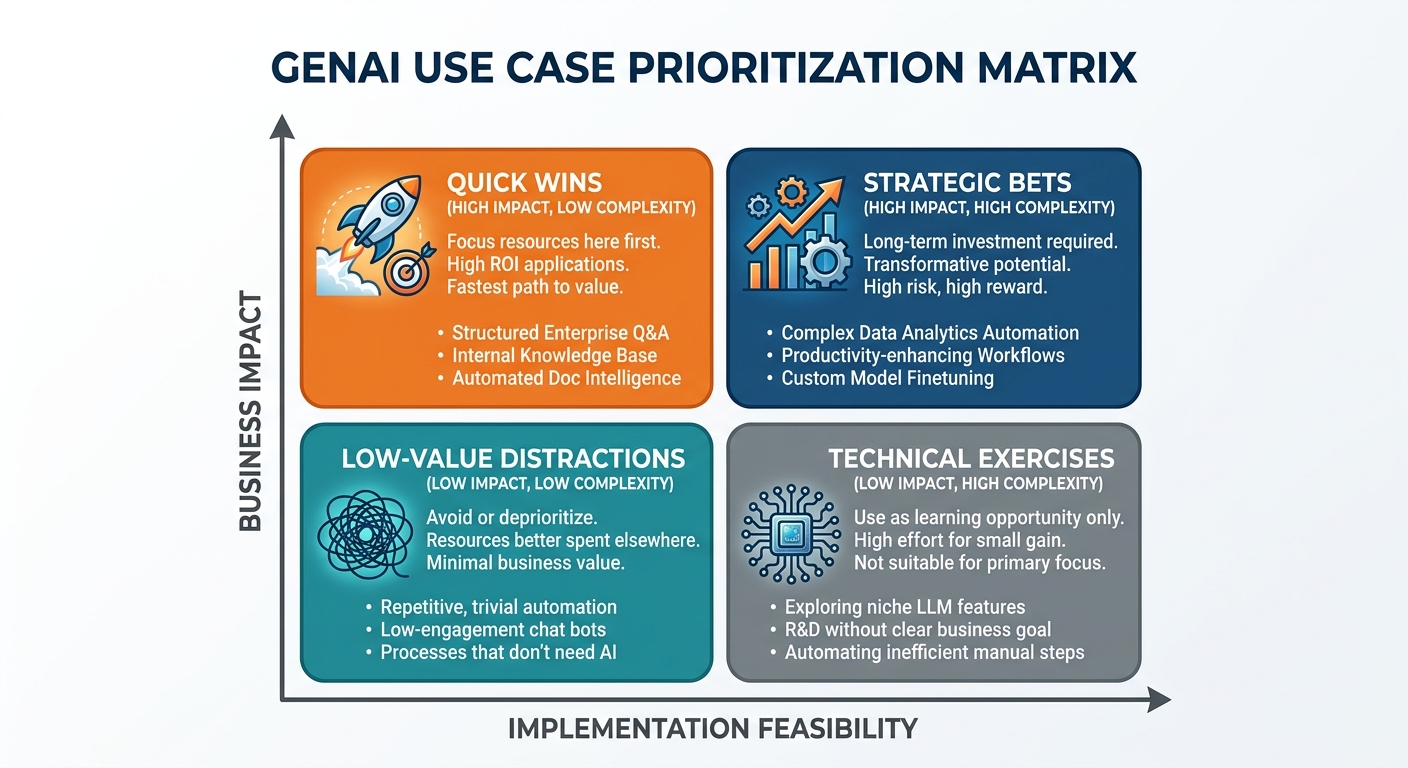
A 2x2 matrix plotting use cases on axes of 'Business Impact' and 'Implementation Feasibility' to identify high-ROI 'Quick Wins' versus low-value distractions. Document the governance requirements. Before any production deployment, identify who owns the AI outputs, how errors are handled, and what compliance or audit requirements apply to your industry. Three reference points cover most of the ground: NIST's AI Risk Management Framework organizes the work into Govern, Map, Measure and Manage [9] with a Generative AI Profile published as its companion [10]; ISO/IEC 42001, published December 2023, specifies a certifiable AI management system [11]; and OWASP's current risk list names the failure modes a review should actually test for, from prompt injection to excessive agency [13].


FAQ
What is a GenAI assessment?
A GenAI assessment is a structured, diagnostic process run before any major commitment is made, and it answers three questions: where GenAI should be applied, which model is right for the task, and what the whole thing will actually cost. It combines use case analysis against existing systems and workflows, objective model benchmarking on real tasks, and a cost model covering implementation, inference, and maintenance.
Why do GenAI pilots burn budget without producing value?
Because the sequence is inverted. Teams get excited about a model, spin up a pilot, and only later discover that the workflow they automated wasn't the one generating business value — or that a less expensive model would have achieved the same result at a fraction of the cost. Without a structured starting point, companies are making multi-six-figure bets on intuition.
How many models should we benchmark?
At least two to three, run on representative tasks with realistic prompts and data volumes rather than on vendor demos. Performance, latency, cost-per-token, and scalability all vary dramatically across models, and something that handles open-ended creative work well can perform poorly — and cost far more — on structured enterprise question answering. Objective benchmarking is what removes vendor bias from the decision.
What belongs in the cost model that budgets usually miss?
Three lines. Ongoing inference cost at expected usage, not just the implementation invoice. Ongoing maintenance. And the cost of human oversight and quality assurance, which does not disappear once the system ships. For organizations migrating off an existing GenAI deployment, switching costs, retraining overhead, and data migration complexity can quietly dwarf the original implementation expense.
How do we choose which use case to pilot first?
Score each candidate on business impact, technical feasibility, and time-to-value, then pick one or two. Start from an inventory of the 10–15 processes that are most repetitive, knowledge-intensive, or bottlenecked by human availability, define what "good" looks like for each in measurable terms — accuracy thresholds, response time, cost per query — and resist the temptation to boil the ocean.
Does running an assessment delay the project?
It reorders it. A thorough assessment takes weeks of focused effort, but the organizations that see the strongest GenAI returns aren't the ones who moved fastest — they're the ones who aimed carefully before they moved. Governance ownership, error handling, and industry audit requirements also get documented before production rather than discovered during it, which is where delay usually comes from.
References
- Amazon Bedrock publishes on-demand, batch and provisioned-throughput pricing that is "dependent on the modality, provider, and model," with batch inference at "50% lower price compared to on-demand inference pricing" and rates that differ by AWS Region — Amazon Web Services (2026): https://aws.amazon.com/bedrock/pricing/
- Anthropic publishes per-model prices in dollars per million tokens, with prompt-caching multipliers of 1.25x for a 5-minute cache write, 2x for a 1-hour cache write and 0.1x for a cache read, a 50% Batch API discount on both input and output tokens, and separate server-tool meters including web search at $10 per 1,000 searches and code execution at $0.05 per container-hour beyond 1,550 free hours — Anthropic (2026): https://platform.claude.com/docs/en/about-claude/pricing
- HELM evaluates 30 language models across 42 scenarios (16 core, 26 targeted) and reports seven metrics for each core scenario — accuracy, calibration, robustness, fairness, bias, toxicity and efficiency — lifting benchmark coverage from 17.9% to 96.0% of core scenarios under standardized conditions — Liang, Bommasani, Lee et al., Stanford CRFM (2022): https://arxiv.org/abs/2211.09110
- On BIRD, a large-scale text-to-SQL benchmark grounded in real database content, the strongest LLM tested reached 40.08% execution accuracy against 92.96% for human annotators — a 52.88-point gap on exactly the structured enterprise question-answering shape most business use cases resemble — Li et al. (2023): https://arxiv.org/abs/2305.03111
- Spider comprises 10,181 questions and 5,693 unique complex SQL queries over 200 multi-table databases across 138 domains, with train and test sets deliberately using different databases; "the best model achieves only 12.4% exact matching accuracy on a database split setting" — Yu, Zhang, Yang et al. (2018): https://arxiv.org/abs/1809.08887
- The paper introducing retrieval-augmented generation frames the enterprise problem directly: pre-trained models' "ability to access and precisely manipulate knowledge is still limited," and "providing provenance for their decisions and updating their world knowledge remain open research problems" — Lewis, Perez, Piktus et al., NeurIPS (2020): https://arxiv.org/abs/2005.11401
- Amazon Textract detects "typed and handwritten text in a variety of documents, including financial reports, medical records, and tax forms," extracts forms and tables through the Document Analysis API, supports a Queries feature for targeted extraction, and adds AnalyzeExpense and AnalyzeID for invoices, receipts and identity documents — Amazon Web Services (2026): https://docs.aws.amazon.com/textract/latest/dg/what-is.html
- Azure Document Intelligence is described by Microsoft as "a machine-learning based OCR and intelligent document processing service to automate extraction of key data from forms and documents," with Read (printed and handwritten text), Layout (text, tables and document structure), General document (text, structure and key-value pairs), and prebuilt models for invoices, receipts, contracts, bank statements, pay stubs, tax forms, mortgage forms, health insurance cards and identity documents — Microsoft (2026): https://learn.microsoft.com/en-us/azure/ai-services/document-intelligence/overview
- The NIST AI Risk Management Framework, released 26 January 2023, is voluntary guidance to "better manage risks to individuals, organizations, and society associated with artificial intelligence," structured around Govern, Map, Measure and Manage — NIST (2023): https://www.nist.gov/itl/ai-risk-management-framework
- NIST AI 600-1, the Generative AI Profile, published 26 July 2024, is "a cross-sectoral profile of and companion resource for the AI Risk Management Framework (AI RMF 1.0) for Generative AI" — NIST (2024): https://www.nist.gov/publications/artificial-intelligence-risk-management-framework-generative-artificial-intelligence
- ISO/IEC 42001:2023, edition 1.0, published 18 December 2023, specifies requirements for establishing, implementing, maintaining and continually improving an AI management system for any organization providing or using AI-based products or services — International Electrotechnical Commission (2023): https://webstore.iec.ch/en/publication/90574
- The European Commission's AI Act summary requires high-risk providers to deliver adequate risk assessment and mitigation, high-quality datasets, "logging of activity to ensure traceability," detailed documentation, "appropriate human oversight measures" and robustness, with general application from 2 August 2026 — European Commission (2026): https://digital-strategy.ec.europa.eu/en/policies/regulatory-framework-ai
- The 2025 OWASP Top 10 for LLM Applications ranks Prompt Injection, Sensitive Information Disclosure, Supply Chain, Data and Model Poisoning, Improper Output Handling, Excessive Agency, System Prompt Leakage, Vector and Embedding Weaknesses, Misinformation and Unbounded Consumption — the failure list a pre-production review should test against — OWASP GenAI Security Project (2025): https://genai.owasp.org/llm-top-10/