
Can an AI agent replace the staffer who spends her morning on hold with payers? The honest answer has three layers: what software can fully own, what needs a human in the loop, and what no clinic-side tool can fix.
The 45% problem: what eligibility verification actually costs a clinic
When MGMA asked 294 medical practices in March 2026 what actually consumes their staff's phone time, the answer wasn't scheduling. Eligibility and prior authorization came first at 45% — ahead of scheduling at 31%, intake at 9%, and prescription refills at 6% [1]. Nearly half of every hour a front-desk employee spends with a phone against her ear is spent asking insurance companies questions about coverage.
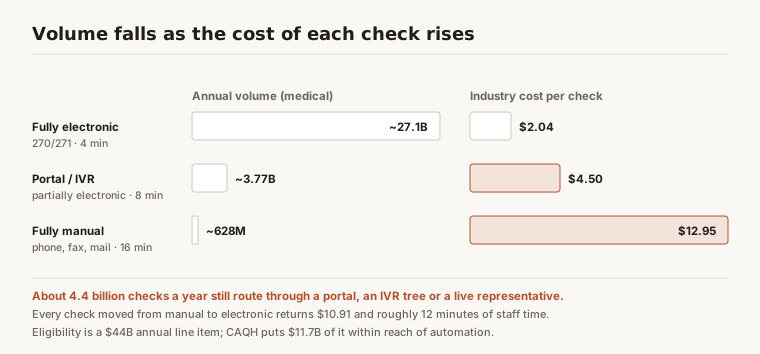
The per-check economics explain why that adds up so fast. CAQH's index — the closest thing US healthcare has to an official ledger of administrative transactions — puts a fully manual eligibility check at 16 minutes of staff time on average (range: 4 to 35 minutes) and $12.95 in industry cost. A portal or IVR check runs 8 minutes and $4.50. A fully electronic check over the X12 270/271 rail takes 4 minutes and $2.04 [2].
| Verification mode | Avg. staff time | Industry cost per check | Annual volume (medical) |
|---|---|---|---|
| Fully electronic (270/271) | 4 min | $2.04 | ~27.1B |
| Portal / IVR ("partially electronic") | 8 min | $4.50 | ~3.77B |
| Fully manual (phone, fax, mail, email) | 16 min (range 4–35) | $12.95 | ~628M |
Source: 2024 CAQH Index [2]
Multiply those unit costs by 31.5 billion eligibility verifications a year — 51% of all medical administrative transaction volume, the single largest transaction type — and eligibility becomes a $44 billion annual line item, 53% of all measured medical administrative transaction spend. CAQH estimates $11.7 billion of that is recoverable through automation, the largest savings opportunity of any transaction it tracks [2]. Every single check converted from manual to electronic returns $10.91 and roughly 12 minutes of staff time [2].
Here's the framing that matters for anyone evaluating AI agents: the problem is not the 27 billion checks that already run electronically. It's the roughly 4.4 billion that still route through a human — through a payer portal, an IVR tree, or a live representative — because the electronic rail couldn't answer the question the clinic actually had.
What the front desk is really asking payers
To judge what an agent can automate, you need the actual call script. A verification call at a typical outpatient clinic works through a standard question list [3]:
- Is the policy active, and what is the termination date?
- Policy and group number — do they match what the patient handed us?
- What are the copay and coinsurance for this service type?
- How much of the deductible has been met? How much remains?
- How many visits does the patient have left this year? (the question that dominates PT, OT, chiropractic, and behavioral health)
- Is a referral, prior authorization, or certificate of medical necessity required?
- Is this provider in-network for this specific plan?
- What documentation does the payer want with the claim?
And it isn't a one-time task. Standard practice is to initiate payer contact at least 72 hours before an initial visit, re-verify at check-in, and re-verify monthly for recurring-care patients, because coverage changes mid-episode — patients switch jobs, plans terminate, benefits reset [3].
Why does any of this happen by phone when 96% of medical health plans support fully electronic eligibility [2]? Because the electronic answer is routinely incomplete for exactly the questions that matter most. Payer portals carry outdated information; only a live representative can answer plan-specific questions about carve-outs, exclusions, and visits remaining [3]. CAQH's own provider interviews found behavioral-health benefits are "often poorly clarified/documented and may require more interaction with health plans to understand and confirm" [2]. One practice put the trust failure plainly: "When it comes to eligibility and benefits, I don't have an automated tool that I can trust, so I don't use it" [2].
The phone call, in other words, is not nostalgia or process inertia. It is the only channel that reliably answers questions the standard doesn't require payers to answer electronically. Any honest automation plan has to start from that fact.
The automation ladder: electronic sweep, portal agents, voice agents
The vendor landscape sorts into three rungs, each automating a different slice of the workflow. This maps to the pattern our agentic AI pillar keeps returning to: bounded workflows with rich evidence trails deploy first.
Rung 1: the batch 270/271 sweep. Software fires an X12 270 inquiry for every scheduled patient through a clearinghouse, and the payer's 271 response comes back in near-real time — CAQH CORE operating rules require a real-time response within 20 seconds [4]. This is mature, cheap ($2.04 per check), and supported by 96% of medical plans [2]. The catch is what the 271 does and doesn't carry: the envelope is standard, but most fields inside are optional, and payers fill them inconsistently. We unpack that paradox — why a 96%-electronic standard still makes clinics call payers — in our companion analysis of EDI 270/271 eligibility data gaps.
Rung 2: portal agents. Roughly 3.77 billion checks a year run through payer web portals and IVR lines [2] — the "partially electronic" middle where a human (or increasingly a browser-automation agent) logs into each payer's site and transcribes benefit screens. It exists because portals sometimes show detail the 271 omits. But it inherits the portals' problems: CAQH notes that "variations in portal requirements and formats add complexity" [2], and portal information can be stale [3]. Screen-scraping automation here is brittle by construction — every payer redesign breaks it.
Rung 3: voice agents that call the payer. The newest rung: AI systems that dial the payer, navigate the IVR, sit on hold, and interview the live representative with the same script your staff uses. This category is real, funded, and operating at multi-million-call scale — and it is also the rung where marketing most outruns the disclosed evidence. Our deep dive on voice AI agents for payer calls covers the vendor field, the accuracy claims, and the human-escalation architecture no vendor leads with.
A serious eligibility program uses all three rungs in order: electronic first, portal or phone only for what the wire can't answer.
What AI agents can fully own today
Three pieces of the workflow are, on the evidence, fully automatable now.
The systematic sweep. Batch-checking every scheduled patient 72 hours out and again at check-in is solved. At $2.04 and four minutes of residual touch per check [2], an agent can run the entire schedule daily, flag mismatches and terminations, and surface only exceptions to staff. No clinic should have a human initiating routine eligibility inquiries in 2026.
The structured core of the 271. For the fields payers reliably populate — active/inactive status, coverage dates, plan name, copay, coinsurance, deductible and out-of-pocket maximum (including remaining amounts, when the payer returns them) — the response is machine-readable and trustworthy enough to write directly into the PM system [5].
The mechanics of the phone call itself. Dialing, IVR navigation (2.78 minutes per call on average), and hold time (8.5 minutes per hold event) are exactly the work software does better than people, because software doesn't get bored and costs nothing to keep waiting [6]. Voice vendors run scripted representative interviews collecting 150+ data points per benefit-verification call [7], at real scale: Infinitus has logged over 4 million payer calls and raised a $51.5M Series C led by a16z on the strength of them [8]; SuperDial reports 5 million completed calls and a $15M Series A [9]. Payer calls average over 35 minutes [10] — an agent that absorbs that time is absorbing the single worst block of front-desk labor.
Here is the front-desk question list mapped against what the electronic rail actually answers — the boundary line for full automation:
| Front-desk question | Does the 271 answer it reliably? | Where the answer actually comes from |
|---|---|---|
| Is coverage active on the date of service? | Yes | 271 |
| Plan name and effective dates | Yes | 271 |
| Copay / coinsurance for the service type | Mostly | 271 |
| Deductible met / remaining | Usually — remaining amounts only when the payer returns them, and they lag claims adjudication | 271, confirmed by phone |
| Visits used / visits remaining this year | Rarely — payers don't include service history in eligibility responses | Phone call |
| Is prior auth / a referral required? | Not reliably — the indicator is optional | Phone call, payer policy documents |
| Is this provider in-network for this plan? | Mostly absent | Phone call, contract records |
| Which payer is primary (COB)? | Inconsistent — "not reliable" | Phone call |
Sources: Stedi's field-level analyses of 271 responses [5], [11]
Everything in the top half of that table an agent can own end to end. Everything in the bottom half is why the phone rung exists — and why the next section matters more than any vendor demo.
What still needs a human — and why it's structural, not a model problem
The gaps that remain are not gaps a better model closes. They come in three kinds.
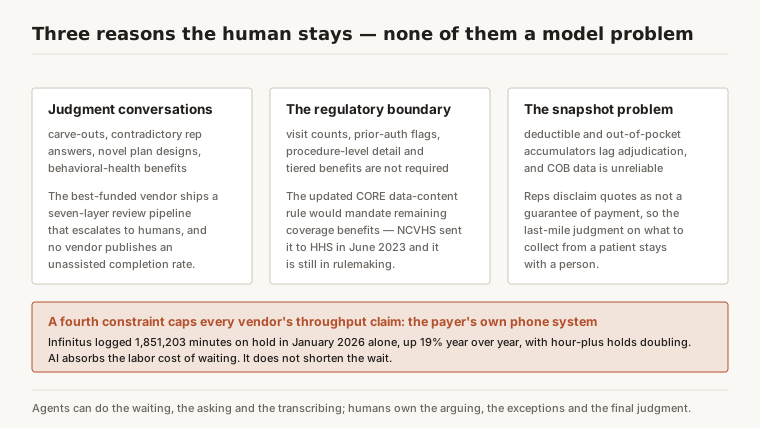
The human-in-the-loop frontier: judgment conversations. Plan-specific carve-outs, contradictory answers from a payer rep, novel plan designs, behavioral-health benefits that are "often poorly clarified" [2] — these calls require pushing back, re-asking, and judging which of two conflicting answers to believe. Look at how the best-funded vendor in the category actually engineers for this: Infinitus's published architecture is a seven-layer AI review pipeline — rule-based guardrails that "escalate complex scenarios to humans," automatic correctors, machine-learned quality classifiers at the call level and the per-field level, and expert human review for anything flagged [12]. Notably, no voice-AI vendor publishes an unassisted end-to-end completion rate [12]. Read that architecture correctly: human-in-the-loop is not a temporary limitation these companies are engineering away — it is the design that makes the product safe to sell. Clinics should treat mandatory escalation paths as a feature to demand, not a weakness to apologize for.
The structural gap: data the payer never exposes. Remaining visit counts, prior-authorization indicators, procedure-level detail, and tiered benefits are not federally required in a 271 today. The updated CORE data-content rule that would, for the first time, require payers to return "remaining coverage benefits" and prior-auth information was recommended to HHS by NCVHS in June 2023 — and is still in rulemaking [2]. Until it lands, the most capable agent on earth can only do what your staff does: call the payer and ask. This is a regulatory boundary, not a technology one, and no clinic-side purchase moves it.
The snapshot problem: even a perfect answer is provisional. Deductible and out-of-pocket accumulators lag claims adjudication, so a "remaining deductible" figure can be stale the moment it arrives [5]. Coordination-of-benefits data in 271s is unreliable [5]. And payer representatives routinely disclaim benefit quotes as "not a guarantee of payment." Final financial certainty exists only at claim adjudication — which means the last-mile judgment about what to collect from a patient stays with a human who can weigh a disclaimed quote against the clinic's risk tolerance.
There's a fourth constraint worth naming because it caps every vendor's throughput claims: the payer's own phone infrastructure. Infinitus logged 1,851,203 minutes on hold in January 2026 alone — up 19% year over year — and calls with holds over one hour doubled [6]. AI absorbs the labor cost of waiting; it does not shorten the wait. If a payer takes 90 minutes to answer, your verification takes 90 minutes, agent or no agent.
The defensible claim, stated once: AI agents can now do the waiting, the asking, and the transcribing. Humans still own the arguing, the exceptions, and the final financial judgment. Any vendor who promises more than that is selling around their own escalation architecture.
The denial math: why earlier, systematic checks pay for themselves
If full automation isn't on the table, what justifies the investment? Not headcount replacement — denial prevention.
Registration and eligibility errors are the single largest cause of claim denials, at roughly 27% — and about 49.7% of all denials originate in front-end processes, with 86% of denials rated potentially avoidable [13]. Each denied claim costs an average of $25.20 to rework at the practice level, before any write-off [13]. And the trend is the wrong direction: in Experian Health's 2025 survey of RCM decision-makers, 41% of providers reported claims denied 10% of the time or more — up from 30% in 2022 — with missing or inaccurate data the most-blamed cause at 50% [14].
That's the ROI frame that survives contact with a CFO. An eligibility agent's value is not "we freed up 0.7 FTE" — it's "we verified every patient on the schedule, three days early and again at check-in, and our eligibility-attributed denial rate moved." The method comes straight from our AI agent ROI playbook: pick one named workflow, attach one tracked number, and measure the delta. For eligibility, that looks like:
- Pull 90 days of denials and isolate the ones coded to registration/eligibility.
- Multiply by $25.20 rework plus your actual write-off rate — that's the baseline leak.
- Deploy the sweep plus an exception queue; hold the escalation rules constant.
- Re-measure the same denial category over the next 90 days.
The per-check savings compound underneath: every check the agent moves from manual to electronic returns $10.91 [2], and the checks it moves from "never happened" to "happened 72 hours early" are the ones that prevent the $25.20-plus events. A clinic running this honestly will usually find the denial delta dwarfs the labor line.
A governed rollout path for clinics
If you deploy this, you won't be early — more than 50% of health plans and 25% of provider organizations already use AI tools in administrative workflows, per the 2025 CAQH Index [15]. The differentiator now is not adoption but governance: rolling out in a sequence that keeps humans at the judgment points and evidence under every write-back.
Start with the sweep, not the phone. The batch 270/271 check is bounded, cheap, and audit-friendly — the profile of workflow that deploys first. Wire it to run against the full schedule at 72 hours and at check-in.
Route everything through an exception queue. The agent auto-files clean, high-confidence responses; anything ambiguous — an AAA rejection, a missing deductible field, a plan type your rules don't recognize — queues for a human. This is the same extract-with-citations, human-review, then write-back shape that worked in our insurance defense legal intake case study: the agent drafts, a person confirms, the system records both.
Get the compliance architecture right before PHI flows. An eligibility agent handles patient name, DOB, and member ID by definition, which makes its vendor a HIPAA business associate and puts its LLM subprocessors inside your BAA chain. The control detail — minimum necessary applied to prompts, per-tool-call audit logs, retention — is its own discipline, covered in our guide to HIPAA-compliant AI agent architecture.
Put a gateway between the model and every payer-facing tool. The architectural mistake to avoid is letting an agent hold raw credentials to clearinghouse APIs, portals, or the PM system. The pattern that scales is a policy and audit layer in the middle — one credential broker, one tool allowlist, one log. The grounded example from our own shop (disclosure: Explore Agentic is published by ASCENDING, which builds Jarvis AI) is Jarvis Registry, a universal MCP and agent gateway with governance and observability included: the shared Governed AI Layer applies PII detection and DLP, role-based access control, SSO/SAML/OAuth, and audit logs identically across chat, agents, and MCP tool calls, and private VPC deployment in your own AWS account is what ASCENDING describes as the path for healthcare, "where data leaving your boundary is a contracting blocker." To be equally clear about what that is not: Jarvis is not a voice-calling product and ships no prebuilt payer connectors — it's the governance layer an eligibility stack runs through. The full wiring diagram, from clearinghouse API to audit log, is in our eligibility-verification agent reference architecture on MCP.
Evaluate before you scale. Vendor accuracy claims in this category are self-reported [7], so run your own: sample the agent's extracted fields against source-of-truth calls, score per-field accuracy, and gate expansion on the numbers — the discipline laid out in our guide to AI agent evaluation and testing. Then phase the rollout payer by payer rather than flipping the whole schedule, the crawl-walk-run shape of our enterprise AI adoption framework.
Clinics that already run governed data agents have a head start here — the same evidence-trail muscles transfer directly, as the healthcare data NLQ agent case study shows on the analytics side of the same buyer's house.
The through-line: every checkpoint above is a place where a human decision is designed in, not papered over. That's what separates a governed eligibility program from a demo.
FAQ
Can AI fully automate insurance eligibility verification?
No — and the vendors' own architectures say so. AI agents can fully own the batch 270/271 sweep, the structured fields payers reliably return (active status, dates, copay, coinsurance, deductible), and the mechanics of the phone call — dialing, IVR navigation, holds, scripted questioning. But judgment-heavy payer conversations run through mandatory human-escalation layers at every production vendor, and no vendor publishes an unassisted completion rate. Some data — visits remaining, prior-auth indicators — isn't automatable from the clinic side at all, because payers aren't yet required to return it electronically. Plan for a high-automation, human-in-the-loop program, not a hands-off one.
Is AI eligibility verification HIPAA-compliant?
It can be, but compliance attaches to the deployment, not the product category. Any vendor receiving patient name, DOB, or member ID to run checks or make calls is a HIPAA business associate and needs a signed BAA — and its LLM and speech subprocessors need downstream agreements. Minimum-necessary rules apply to what goes into prompts, and the Security Rule's audit-control standard translates to per-tool-call logging with multi-year retention. There is no AI-specific OCR guidance yet, so the general rules govern. Our guide to HIPAA-compliant AI agent architecture covers the BAA chain and control map in depth.
What can't a 271 eligibility response tell you?
The 271 reliably carries active coverage, plan name and dates, copay, coinsurance, and deductible/out-of-pocket figures. It does not reliably carry visit limits or visits used, prior-authorization and referral requirements, the provider's network status, or coordination-of-benefits primacy — most of those fields are optional, and payers omit or scatter them. Remaining-deductible figures also lag claims adjudication. The pending CORE data-content rule would mandate "remaining coverage benefits" for the first time, but it has been in rulemaking since NCVHS recommended it in June 2023. Until it lands, those questions get answered by phone.
How should a clinic measure ROI on eligibility automation?
Track denials, not headcount. Registration and eligibility errors cause roughly 27% of claim denials, each costing about $25.20 to rework before write-offs. Baseline 90 days of eligibility-attributed denials, deploy systematic 72-hour and check-in verification with a human exception queue, then re-measure the same category. Layer the per-check savings ($10.91 for every manual check converted to electronic) underneath. One named workflow, one tracked number — the denial-rate delta is the cleanest number in healthcare AI.
Where should an eligibility agent be deployed first?
Start with the batch 270/271 sweep, not the phone. The electronic check is bounded, cheap, and audit-friendly — the profile of workflow that deploys first — and it should run against the full schedule at 72 hours and again at check-in. Everything else routes through an exception queue: the agent auto-files clean, high-confidence responses, while an AAA rejection, a missing deductible field, or an unrecognized plan type queues for a human. Get the BAA chain and the gateway in place before any PHI flows.
References
- MGMA Stat — "Phones are still a backlog, costing medical practices time" (poll of 294 practices, March 10, 2026), MGMA, 2026: https://www.mgma.com/mgma-stat/phones-are-still-a-backlog-costing-medical-practices-time
- 2024 CAQH Index Report — transaction volumes, per-check time and cost, spend, savings opportunity, provider interviews, and CORE data-content rule status, CAQH, 2025: https://www.caqh.org/hubfs/Index/2024%20Index%20Report/CAQH_IndexReport_2024_FINAL.pdf
- "How to Verify Patient Insurance in Three Easy Steps" — the standard verification question list and re-verification cadence, WebPT, 2023: https://www.webpt.com/blog/how-to-verify-patient-insurance-in-three-easy-steps
- CAQH CORE Eligibility & Benefits (270/271) Infrastructure Rule vEB.2.0 — 20-second real-time response requirement, CAQH CORE: https://www.caqh.org/hubfs/43908627/drupal/CAQH%20CORE%20Eligibility%20%20Benefit%20(270_271)%20Infrastructure%20Rule%20vEB.2.0.pdf
- "What you can reliably get from a 271 eligibility response," Stedi, 2025: https://www.stedi.com/blog/what-you-can-reliably-get-from-a-271-eligibility-response
- "3.5 years on hold: 5 stats that defined blizzard season 2026," Infinitus, 2026: https://www.infinitus.ai/blog/3-5-years-on-hold-5-stats-that-defined-blizzard-season-2026/
- Infinitus benefit verification solution page — 150+ data points per call; accuracy claims are vendor-reported, Infinitus, 2026: https://www.infinitus.ai/solutions/benefit-verification/
- "Infinitus Systems Raises $51.5 Million Series C Funding on the Strength of AI Guardrails," PR Newswire, 2024: https://www.prnewswire.com/news-releases/infinitus-systems-raises-51-5-million-series-c-funding-on-the-strength-of-ai-guardrails-302283847.html
- "Voice AI company SuperDial picks up $15M Series A to automate insurance calls," Fierce Healthcare, 2025: https://www.fiercehealthcare.com/ai-and-machine-learning/voice-ai-company-superdial-picks-15m-series-automate-insurance-calls
- "TrialCard Selects Infinitus Systems to Automate Payer Contact Center Activity" — average healthcare payer call over 35 minutes, PR Newswire, 2021: https://www.prnewswire.com/news-releases/trialcard-selects-infinitus-systems-to-automate-payer-contact-center-activity-301383851.html
- "How to deal with gaps in eligibility responses," Stedi, 2025: https://www.stedi.com/blog/how-to-deal-with-gaps-in-eligibility-responses
- "Guardians of healthcare calls: AI review in action" — the seven-layer review pipeline and human escalation, Infinitus engineering blog, 2024: https://www.infinitus.ai/blog/guardians-of-healthcare-calls-ai-review-in-action/
- "6 keys to addressing denials in your medical practice's revenue cycle" — citing the Change Healthcare Revenue Cycle Denials Index, MGMA, 2021: https://www.mgma.com/mgma-stats/6-keys-to-addressing-denials-in-your-medical-practice-s-revenue-cycle
- Experian Health State of Claims 2025 — denial-rate and root-cause survey of 250 RCM decision-makers, Experian Health, 2025: https://www.experian.com/blogs/healthcare/state-of-claims-2025/
- "2025 CAQH Index Shows U.S. Healthcare Avoided $258 Billion and Accelerated Automation, Interoperability and AI Adoption," CAQH (official Index announcement, Feb 19, 2026): https://www.dataspring.com/blog/2025-caqh-index-shows-u.s.-healthcare-avoided-258-billion-and-accelerated-automation-interoperability-and-ai-adoption