
The newest rung of the eligibility-automation ladder dials the payer, survives the IVR, and interviews the live rep — and every production vendor still architects for human escalation, because escalation is the design, not the gap.
The call is the product: anatomy of a payer phone call
There is now a category of software whose entire job is to make a phone call. Not to route one, not to summarize one afterward — to place an outbound call to an insurance payer, navigate the phone tree, sit on hold, and interview the human who eventually picks up. The fact that this category exists, is venture-funded, and holds a dedicated slot in health-IT market maps tells you something structural about US healthcare administration: the phone call is still load-bearing. In the automation ladder for insurance eligibility verification, voice AI is the top rung — the one that only exists because the rungs below it can't finish the job.
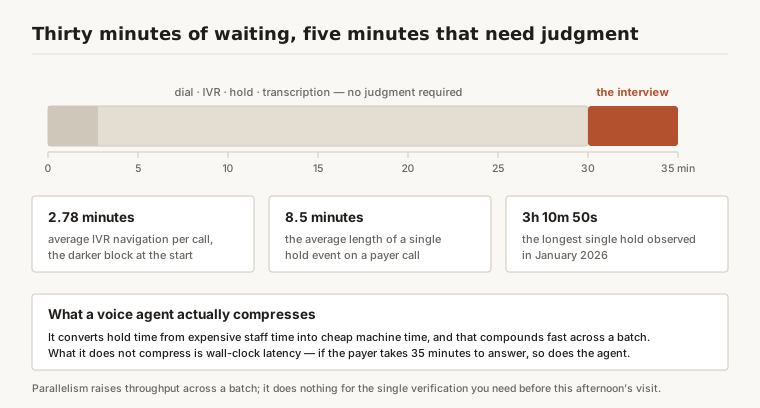
Start with what the call costs. An MGMA Stat poll of 294 practices found that eligibility and prior authorization consume 45% of medical-practice staff phone time — the single largest category, ahead of scheduling at 31% [1]. A fully manual eligibility check averages 16 minutes of staff time, against 4 minutes for a fully electronic one, and carries $12.95 in industry cost per check versus $2.04 electronic [2]. The call itself is worse than those averages suggest. Production data from Infinitus, the largest vendor in the category, puts the average healthcare payer call at over 35 minutes, with 2.78 minutes spent navigating the IVR and hold events averaging 8.5 minutes each; the longest single hold it observed in January 2026 ran 3 hours, 10 minutes, and 50 seconds [3].
Why does anyone still place these calls when 96% of medical health plans answer eligibility electronically in real time [2]? Because the electronic answer is incomplete by design. A 271 response reliably carries active coverage, plan dates, copay, coinsurance, and deductible — and unreliably carries the things front desks actually need to ask about: visits remaining on a therapy benefit, whether prior authorization or a referral is required, the provider's network status, and which payer is primary [4]. Why the 270/271 rail can't answer those questions is its own analysis; the short version is that the fields are optional, payers populate them inconsistently, and the operating rule that would mandate remaining-benefit data is still in rulemaking. Until that changes, somebody has to call and ask.
Which makes the payer call a strange, almost perfect automation target. The work is high-volume, procedurally scripted, and mostly waiting. It demands no judgment for the first thirty minutes — just persistence through an IVR and a hold queue — followed by roughly five minutes of structured Q&A. Software doesn't get bored, doesn't multitask through the hold, and can run dozens of calls in parallel. The interesting questions are what happens in those last five minutes, and what happens when the conversation goes off script. That's where this vendor category earns — or fails to earn — its claims.
How a voice agent actually works a call
Mechanically, every vendor in the category runs a version of the same pipeline. Verification tasks arrive in bulk — a portal upload or an API submission of tomorrow's schedule [5]. The agent dials the payer, navigates the IVR, and detects the difference between hold music and a live human. When the rep picks up, it runs a scripted but adaptive interview: policy status, benefit details, auth requirements, network status, coordination of benefits. Infinitus reports collecting more than 150 data points on a single benefit-verification call, spanning plan details, prior-auth requirements, specialty-pharmacy rules, and buy-and-bill status, and says its agent can push back on or correct bad data from a rep — and escalate to a human operator when it can't resolve the conflict [5]. The call audio then passes through extraction and quality review, and the structured result is written back into the practice-management or RCM system of record [6].
| Call stage | What the agent does | Evidence / typical scale |
|---|---|---|
| Intake | Accepts verification tasks in bulk via portal or API | Batched ahead of scheduled visits [5] |
| Dial + IVR | Navigates the payer phone tree | 2.78 minutes of IVR per call on average [3] |
| Hold | Detects hold vs. human, waits | 8.5 minutes per hold event on average [3] |
| Rep interview | Runs a scripted, adaptive benefits Q&A; challenges inconsistent answers | 150+ data points per benefit-verification call [5] |
| Extraction + review | Converts audio to structured fields, scores confidence, flags doubtful outputs | Low-confidence results routed to human review [14] |
| Write-back | Pushes results into the PM/RCM system with recording and transcript | Structured record plus provenance [6] |
Two design details matter more than the demo. First, the phone is not always the right rail even for these vendors: SuperDial runs in two modes, conversing with the payer's human rep when it must and bypassing the phone entirely via payer API where one exists [6]. The call is the fallback, not the preference — a point that matters when you architect around this category rather than for it. Second, the write-back is where the value lands or leaks. A verified benefit that sits in a vendor dashboard, unreconciled with the PM system, hasn't reduced anyone's work; it has added a swivel-chair step.
Seen from a distance, this is a textbook instance of the pattern the agentic AI pillar keeps returning to: the workflows that deploy first are bounded, repetitive, and leave a rich evidence trail — here, a full call recording, a transcript, and per-field extractions that can be audited after the fact.
The vendor field: who sells this, at what scale
The category is established enough that Elion, the health-IT market map, maintains a dedicated "Payer-Facing AI Phone Calls" product category [7]. Four names come up in nearly every evaluation.
| Vendor | Funding | Scale (vendor-reported) | Positioning |
|---|---|---|---|
| Infinitus | $51.5M Series C led by a16z (Oct 2024); $102.9M total [8] | 4M+ payer calls behind its knowledge graph; serves 44% of the Fortune 50 [8] | Multimodal voice AI with human-in-the-loop guardrails; calls 500+ payers and PBMs [5] |
| SuperDial | $15M Series A (2025); $20M+ total [11] | 5M+ completed calls; claims 67% cost savings and 4x team productivity [6] | Outbound calls for benefit verification, prior auth, claim follow-up, credentialing; API bypass where available [6] |
| Outbound AI | $16M seed co-led by Madrona and SpringRock [12] | — | "Human-agent teaming software that augments existing staff"; PayerVA Console for phone-based claims work [12] |
| Opkit | YC-backed [13] | — | Benefit-verification, prior-auth, and claim-status calls for telehealth companies and clinics [13] |
Sources: [5], [6], [8], [11], [12], [13]
Infinitus is the reference point for scale. It crossed 2.5 million lifetime calls and 46 million minutes of processed audio by early 2024 [9], and its Series C press materials describe a knowledge graph built from more than 4 million payer calls, 44% of the Fortune 50 as customers, and roughly 50% ROI versus manual calling [8]. Its June 2025 Salesforce partnership is the clearest signal of where the category sits architecturally: Agentforce and MuleSoft workflows can now trigger an Infinitus voice call to a payer for benefit verification or prior-auth status when no API exists [10] — the phone call institutionalized as the fallback rail inside an enterprise agent platform.
SuperDial is the volume story at the clinic end of the market: five million completed calls, HIPAA and SOC 2 Type 2 attestation, and named customers with concrete numbers — West Coast Dental across 70,000+ claims, United Medical Monitoring reporting 5,400+ hours saved in three months [6], [11]. Outbound AI and Opkit round out the field at smaller scale, and the niche keeps producing new entrants below them.
Read the table again and notice what every impressive number has in common: the vendor reported it. That's not an accusation — it's the procurement problem this category creates, and it deserves its own section.
The accuracy question: vendor claims vs. verifiable evidence
The headline accuracy claim in this category belongs to Infinitus: 10% higher data accuracy than manual calling [8]. It is plausible — humans transcribing a 35-minute call while juggling a front desk make mistakes — but it is vendor-reported, the methodology is unpublished, and no independent audit of it exists. SuperDial's 67% cost savings and 4x productivity figures have the same status [6]. The one thing in most vendor trust centers that is third-party verified — a SOC 2 Type 2 report [6] — attests to security and availability controls, not to whether the deductible field came back correct.
| Claim | Who reports it | Independently verified? |
|---|---|---|
| "10% more accurate than manual calling" | Infinitus press release [8] | No — methodology unpublished |
| "67% cost savings, 4x team productivity" | SuperDial site [6] | No |
| Call volumes (4M+, 5M+) | Vendor-reported, echoed in funding coverage [8], [11] | Not audited |
| HIPAA + SOC 2 Type 2 | Third-party attestation [6] | Yes — but attests controls, not extraction accuracy |
| Unassisted end-to-end completion rate | Published by no vendor | — |
So how would a clinic actually evaluate one of these tools? The same way you evaluate any agent whose output you intend to bill against: with a gold set. Run 50–100 verifications in parallel — the vendor's agent and your own staff on the same patients and payers — then adjudicate both against the eventual claim outcome, which is the only ground truth that matters. Score per field, not blended: an agent can be excellent on copay and deductible and mediocre on visits-remaining and auth requirements, and a blended "98% accurate" hides exactly the fields that cause denials. This is the domain-specific-baseline discipline that AI agent evaluation and testing lays out in general form; payer-call extraction is about as concrete a worked example as the field offers.
And the evaluation doesn't end at purchase. Payers change IVR trees, scripts, and plan structures continuously, which means extraction quality drifts — quietly, per payer, per field. Treat the vendor's output like any production LLM system and instrument it accordingly; the tracing and drift-detection patterns in LLM observability apply directly to a pipeline whose input is a phone call and whose output is a claim you intend to submit.
Human-in-the-loop by design: inside the seven-layer review
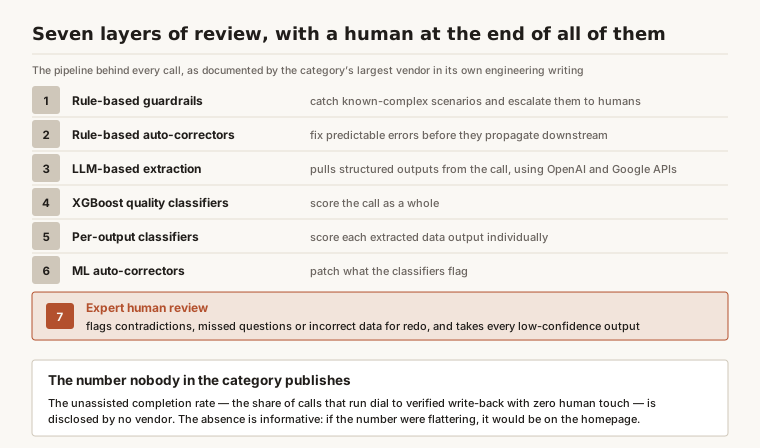
The strongest evidence about how this category really works comes from Infinitus's own engineering blog, which documents the review pipeline behind every call — seven layers deep [14]. Rule-based guardrails catch known-complex scenarios and escalate them to humans. Rule-based auto-correctors fix predictable errors. LLM-based extraction — using OpenAI and Google APIs — pulls structured outputs from the conversation. XGBoost quality classifiers score the call as a whole; a second set scores each extracted data output individually. ML auto-correctors patch what the classifiers flag. And at the end of the line sits expert human review: the pipeline "identifies contradictions, missed questions, or incorrect data and flags calls for redo," routing flagged calls and low-confidence outputs to people [14]. The company's own framing is unambiguous: "AI augments human intelligence, it doesn't replace it" [14].
Two readings of that pipeline, both correct. The first is architectural: this is a guardian-agent pattern executed seriously — independent layers whose only job is to check the worker agent's output, with a human backstop for everything the layers can't resolve. If you're building any agent that touches money or patient data, the shape is worth copying. The second reading is commercial: the best-funded vendor in the category, holding more payer-call data than anyone on earth, has concluded that human review is permanent infrastructure, staffed and process-managed — not a temporary crutch to be optimized away next quarter. Outbound AI reached the same conclusion and made it the brand, positioning its product as "human-agent teaming software that augments existing staff" rather than replacement [12].
Here is what no vendor in the category discloses: the unassisted completion rate — the percentage of calls that go end-to-end, dial to verified write-back, with zero human touch. Not Infinitus, whose blog describes the escalation machinery in detail but never quantifies it [14]; not SuperDial; not anyone. The absence is informative. If the number were flattering, it would be on the homepage.
None of this is a scandal, and the honest version of this article refuses to treat it as one. A benefits conversation can go genuinely off-script: a rep gives two contradictory answers about a carve-out, a plan design doesn't match the knowledge graph, a behavioral-health benefit is — as CAQH's provider interviews put it — "often poorly clarified" and requires extra back-and-forth with the plan to confirm [2]. Escalating those calls to a human is the correct engineering decision, made by people who have watched millions of calls fail in every possible way. The buyer implication is equally unglamorous: price this category as labor compression with a human QA layer attached — and ask the vendor, directly, how large that layer is for accounts like yours. The answer you get, and whether you get one, tells you a lot.
What voice AI can't fix: the payer's own phone system
There is one cost the best voice agent cannot compress: the payer's willingness to answer the phone. Infinitus logged 1,851,203 minutes on hold in January 2026 alone — a 19% increase over January 2025. Calls with holds exceeding one hour doubled year over year. PBM benefit-verification hold times rose 2.5x. Even IVR navigation time grew by more than a minute and a half per call [3].
Those numbers describe a bottleneck moving in the wrong direction, and they define the boundary of what this category sells. A voice agent converts hold time from expensive staff time into cheap machine time — that's real, and at 8.5 minutes per hold event it compounds fast. What it does not do is compress wall-clock latency. If the payer takes 35 minutes to answer a benefits question, the answer arrives in no less than 35 minutes, whether a human or an agent asked it. Parallelism raises throughput across a batch; it does nothing for the single stat verification you need before this afternoon's visit. And the answer itself carries the same caveat it always has: payer reps routinely disclaim benefit quotes as not a guarantee of payment, and an AI transcribes that disclaimer as faithfully as it transcribes the copay [4].
It's worth being precise about what would actually fix this, because it isn't better voice AI. Hold-time inflation is what you'd expect from payers under-staffing phone lines while their electronic channels answer the easy questions — leaving the phone queue selecting for exactly the hard, data-gap-driven calls that take longest. The structural fix is payers exposing the missing data on the electronic rail, which is a standards and rulemaking story, not a vendor story. Until it lands, voice AI is the tax-efficient way to pay an unavoidable tax.
A clinic buying checklist
Treat procurement here the way you'd treat hiring an outsourced call center that happens to be staffed by software with a human QA desk — because operationally, that is what you're buying. The checklist below is the set of demands that separates a defensible purchase from a demo-driven one.
| Checklist item | What to demand | Why it matters |
|---|---|---|
| BAA + subprocessor chain | A signed BAA that names every LLM and speech subprocessor, each covered by a downstream agreement | Business-associate status attaches automatically once PHI flows to the vendor [15]; Infinitus, for example, discloses OpenAI and Google APIs inside its pipeline [14] |
| SOC 2 Type 2 + HIPAA attestation | The current report, not the badge — and AI-specific evidence in scope | Third-party verified controls are the floor; remember they attest security, not accuracy [6] |
| Per-field provenance | Call recording, transcript, and a mapping from each extracted field to the utterance that produced it | This is your appeal evidence when a payer denies against its own rep's quote |
| Escalation SLA | Written triggers for human review, turnaround times, and how you're notified | The human layer exists at every vendor [14]; unmanaged, it becomes an invisible queue your staff discovers at denial time |
| Accuracy evaluation rights | Contractual right to run a gold-set parallel evaluation; per-field accuracy reporting, per payer | Vendor-reported blended accuracy is not a basis for revenue-cycle decisions [8] |
| Write-back verification | Exactly how results land in your PM/RCM system, and who reconciles mismatches | Value leaks at the swivel chair; a dashboard is not an integration [6] |
The compliance rows compress a much longer story — minimum-necessary applied to prompts, audit-trail retention, what the BAA must say about training data. HIPAA-compliant AI agent architecture covers that control detail requirement by requirement; bring it to the security-review meeting rather than reconstructing it from vendor collateral.
On ROI, resist the vendor's number and name your own. The method in the AI agent ROI playbook — one named workflow, one tracked number — fits this purchase exactly: pick cost per completed verification, or the eligibility-denial rate on the payer cohort you automate, measure it for a quarter before the pilot, and make the vendor beat your baseline on your payers. A 67% savings claim from someone else's call mix [6] is a hypothesis, not a projection.
One disclosure before the last word, because this page will be read by buyers comparing vendors: Explore Agentic is published by ASCENDING, which builds Jarvis AI. Jarvis is not a voice-calling product — nothing in its documentation claims telephony capability, and this article won't imply one. The reason it belongs anywhere near this topic is the row of the checklist that outlives the vendor choice: whatever collects the benefit data — a voice agent, a clearinghouse API, or both — the results need the same governed write-back path into your systems, with scoped credentials, per-call policy, and one audit log. That gateway pattern, including where Jarvis fits in it, is the subject of the eligibility-verification agent reference architecture, and it deserves to be evaluated on its own terms rather than smuggled into a voice-vendor comparison.
FAQ
Can AI really call insurance companies and talk to live reps?
Yes, at production scale. Infinitus reports more than 4 million payer calls behind its platform and SuperDial more than 5 million completed calls; both navigate IVR trees, wait on hold, and run structured benefits interviews with live payer reps — Infinitus additionally reports its agent can push back on inconsistent answers. What no vendor offers is fully unattended operation: every production system escalates complex scenarios and low-confidence outputs to human reviewers, and none publishes the percentage of calls completed without any human touch.
How accurate are AI-run payer calls?
The honest answer is that the public numbers are vendor-reported. Infinitus claims 10% higher data accuracy than manual calling, but the methodology is unpublished and no independent audit exists; SOC 2 attestations verify security controls, not extraction accuracy. A clinic that wants a real number should run a parallel evaluation — the same 50–100 verifications through the vendor and its own staff, adjudicated against actual claim outcomes — and demand per-field accuracy reporting, because performance on copay and deductible tells you nothing about performance on visits-remaining or prior-auth requirements.
Do AI calling vendors replace verification staff?
No vendor in the category positions itself that way, and the architecture explains why. Outbound AI describes its product as "human-agent teaming software that augments existing staff," and Infinitus's own seven-layer review pipeline routes flagged calls to expert human reviewers as a permanent design feature. The realistic operating model is labor compression: the agent absorbs the dialing, the IVR, the hold time, and the transcription — roughly thirty of a thirty-five-minute call — while staff shift to escalations, contradictory-answer resolution, and the judgment calls that determine whether a patient gets scheduled.
Why do clinics still need phone calls if eligibility checks are electronic?
Because the electronic rail answers a narrower question than the front desk asks. A 271 response reliably returns active coverage, copay, coinsurance, and deductible, but visits remaining, prior-auth and referral requirements, network status, and coordination-of-benefits primacy are optional fields that most payers omit or populate inconsistently — and the operating rule that would mandate remaining-benefit data is still in rulemaking. Until payers must publish that data electronically, the only way to get it is to ask a human at the payer, which is precisely the job this vendor category automates.
What should a clinic ask a voice AI vendor before signing?
Ask for per-field accuracy reporting rather than one headline number, because performance on copay and deductible tells you nothing about performance on visits-remaining or prior-auth requirements. Ask what percentage of calls complete without any human touch — no vendor in the category publishes it. Ask which payers and call types are actually in scope for your specialty. And run a parallel evaluation before you commit: the same 50–100 verifications through the vendor and through your own staff, adjudicated against actual claim outcomes.
References
- MGMA Stat — "Phones are still a backlog costing medical practices time" — poll of 294 practices; eligibility/prior auth at 45% of staff phone time (2026): https://www.mgma.com/mgma-stat/phones-are-still-a-backlog-costing-medical-practices-time
- CAQH — 2024 CAQH Index Report — per-check time and cost by mode, 96% electronic adoption, and provider interview findings (published 2025): https://www.caqh.org/hubfs/Index/2024%20Index%20Report/CAQH_IndexReport_2024_FINAL.pdf
- Infinitus — "3.5 years on hold: 5 stats that defined blizzard season 2026" — 35-minute call averages, IVR and hold-event data, year-over-year hold inflation (2026): https://www.infinitus.ai/blog/3-5-years-on-hold-5-stats-that-defined-blizzard-season-2026/
- Stedi — "What you can reliably get from a 271 eligibility response" (2025): https://www.stedi.com/blog/what-you-can-reliably-get-from-a-271-eligibility-response
- Infinitus — Benefit verification solution page — 500+ payers/PBMs, 150+ data points per call, escalation to human operators (2026): https://www.infinitus.ai/solutions/benefit-verification/
- SuperDial — product site — call types, PM/RCM write-back, 5M+ completed calls, cost-savings claims, HIPAA + SOC 2 Type 2 (2026): https://www.superdial.com/
- Elion — "Payer-Facing AI Phone Calls" product category (2025): https://elion.health/categories/payer-facing-ai-phone-calls/products
- PR Newswire — "Infinitus Systems raises $51.5 million Series C funding on the strength of AI guardrails" (2024): https://www.prnewswire.com/news-releases/infinitus-systems-raises-51-5-million-series-c-funding-on-the-strength-of-ai-guardrails-302283847.html
- Infinitus — "Benefit verification, IVR hold times, and reverification season" — 2.5M lifetime calls and 46 million minutes of processed audio by early 2024 (2024): https://www.infinitus.ai/blog/benefit-verification-ivr-hold-times-reverification-season/
- PR Newswire — "Infinitus deepens partnership with Salesforce to accelerate AI agent adoption in healthcare and life sciences" (2025): https://www.prnewswire.com/news-releases/infinitus-deepens-partnership-with-salesforce-to-accelerate-ai-agent-adoption-in-healthcare-and-life-sciences-302490302.html
- Fierce Healthcare — "Voice AI company SuperDial picks up $15M Series A to automate insurance calls" (2025): https://www.fiercehealthcare.com/ai-and-machine-learning/voice-ai-company-superdial-picks-15m-series-automate-insurance-calls
- Outbound AI — company site — PayerVA Console and "human-agent teaming" positioning (2024): https://outbound.ai/
- Opkit — insurance-verification launch announcement (2023): https://www.linkedin.com/posts/opkit_exclusive-opkit-launches-insurance-verification-activity-7039659328164765696-z_EY
- Infinitus — "Guardians of healthcare calls: AI review in action" — the seven-layer AI-review pipeline, OpenAI/Google API usage, and human escalation design (2024): https://www.infinitus.ai/blog/guardians-of-healthcare-calls-ai-review-in-action/
- Foley & Lardner — "HIPAA compliance and AI: What digital health privacy officers need to know" (2025): https://www.foley.com/insights/publications/2025/05/hipaa-compliance-ai-digital-health-privacy-officers-need-know/