
Field notes on why agent loops don't cost like chatbots, and the four levers that actually move a Claude-on-Bedrock bill.
The first time you move a Claude agent from a prototype to a real Bedrock workload, the bill doesn't grow with the number of tasks. It grows with the number of steps inside each task — and that's a different curve entirely. If you model Claude-on-Bedrock spend off a chatbot mental model, you will under-forecast, then spend a tense afternoon explaining the variance to finance.
Here is the thing most cost models miss: the per-token rate you pay for Claude does not change because you route through Bedrock. The channel you bill through is not a cost lever. The levers that actually move spend are batch, prompt caching, model routing, the size of the context you carry, and governance. This piece breaks down where the tokens go inside an agent loop and how to keep agentic token cost predictable before it surprises you.
Agent token economics differ from chat: context accumulates per step
A chat turn is roughly stateless from a billing view: one prompt in, one completion out, and the next turn re-sends a modest history. An agent is not one call. It's a loop — reason, call a tool, read the result, reason again — and on every iteration the entire accumulating context is re-sent as input.
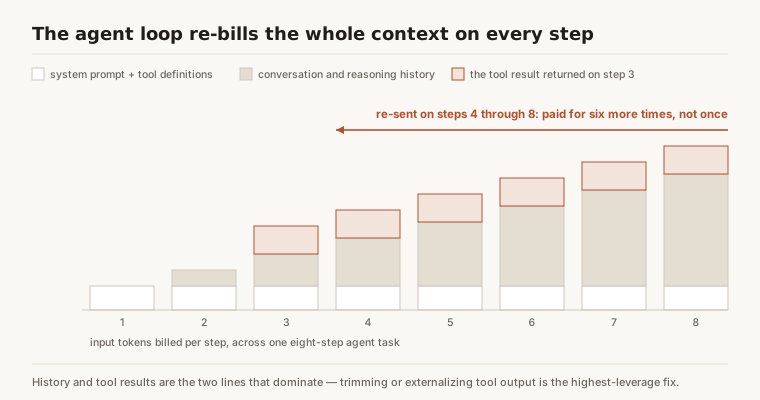
That changes the shape of the bill. In chat, cost scales roughly linearly with conversation length. In an agent, cost scales with the area under the context curve: each step pays for the system prompt, the tool definitions, the full history so far, plus whatever the last tool dumped into context. Spend grows non-linearly with turns because the input on step 10 includes everything from steps 1 through 9.
This is why the same Claude model can feel cheap in a chat product and expensive in an agent fleet. It isn't a different rate. It's a different access pattern. Output is priced at five times input across the current model line, but in agent loops the silent budget killer is usually input, re-sent over and over.
Anatomy of an agent loop's bill: the same context, re-sent each turn
Break one agent task into its billable parts and the picture gets concrete. A single agentic task that runs, say, eight tool-calling steps pays input tokens roughly like this on every step:
| Component | Sent each step? | Why it accumulates |
|---|---|---|
| System prompt / instructions | Yes | Fixed, but re-sent every iteration |
| Tool definitions (schemas) | Yes | Grows with how many tools you load |
| Conversation + reasoning history | Yes, growing | Each prior step is appended |
| Latest tool result | Yes | Can be large (a doc, an API payload) |
| Model's new output | Once per step | Priced at five times input |
The two lines that quietly dominate are history and tool results. A verbose tool that returns a large JSON blob on step 3 keeps getting re-sent on steps 4 through 8 — you pay for that payload six more times, not once. This is the agentic equivalent of leaving the lights on. Trimming, summarizing, or externalizing tool output is one of the highest-leverage things you can do.
It also means which model runs which step matters enormously. Running a cheap planner on routine steps and reserving the expensive model for hard reasoning compounds savings across every iteration of the loop.
Bedrock pricing reality: per-token parity, so the channel isn't the lever
Be blunt about a thing procurement teams hope isn't true: moving Claude to Bedrock does not lower the per-token price. Per-token Claude rates are the same whether you call the first-party API or run through AWS [1]. The billing path and unit of measure change; the underlying rate does not.
So the channel decision is about consolidation and control, not unit price: one AWS bill, IAM, VPC, CloudWatch, and your existing AWS commitments. For reference, here is the current list-price ladder you're paying against either way [1]:
| Model | Input $/MTok | Output $/MTok |
|---|---|---|
| Claude Haiku 4.5 | $1 | $5 |
| Claude Sonnet 4.6 | $3 | $15 |
| Claude Opus 4.8 (and 4.7, 4.6) | $5 | $25 |
| Claude Fable 5 | $10 | $50 |
| Claude Opus 4.1 (prior gen) | $15 | $75 |
That last row is worth a pause. The prior-generation Opus listed at $15/$75; the current Opus tier sits at $5/$25 — a real generational price drop. The lesson for FinOps: don't model agent cost off last year's rate card, and don't assume the channel is where savings hide. Savings come from discounts and optimization, applied on top of parity rates. The next four sections are those levers.
Lever 1 — Prompt caching: cache reads at roughly a tenth of base input
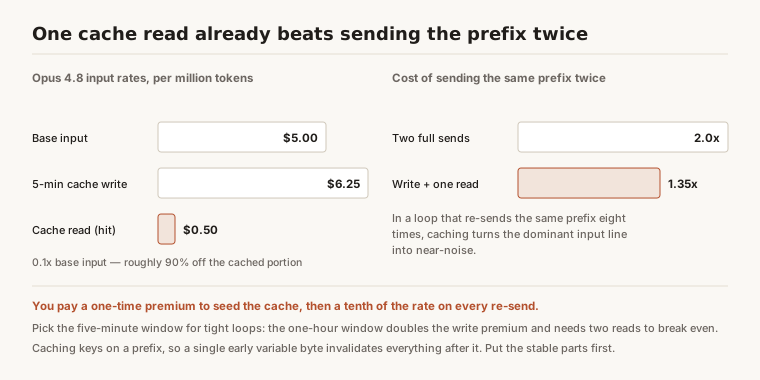
This is the single most important lever for agent workloads, precisely because agents re-send the same context every step. With prompt caching, a cache read (hit) is billed at about one-tenth of the base input rate — roughly 90% off the input rate for the cached portion. The write side carries a premium: a five-minute cache write costs about 1.25 times base input, and a one-hour cache write costs about two times base input [1].
On Opus 4.8, against the $5 base input rate, that math works out to roughly a $6.25 five-minute write versus a $0.50 read [1]. You pay a one-time premium to seed the cache, then pay a tenth of the rate every subsequent time that stable prefix is re-sent.
Agent loops are the ideal shape for this. Your system prompt, tool definitions, and early stable context don't change between steps — so cache them once and read them at the discounted rate for the rest of the task. The break-even is fast: with the five-minute TTL a single read already beats paying full price twice (a 1.25x write plus a 0.1x read is 1.35x, versus 2.0x for two full sends); the one-hour TTL (2x write) breaks even after two reads. In a loop that re-sends the same prefix eight times, caching turns the dominant input line from full price into near-noise.
Two operational notes. First, cache TTL matters: pick the five-minute window for tight loops and the one-hour window only when a task genuinely spans that long, because the doubled write premium needs more reads to amortize. Second, structure your prompt so the stable parts come first — caching keys on a prefix, so a single early variable byte can invalidate everything after it.
Lever 2 — Batch inference: 50% off for non-time-sensitive jobs
If a workload doesn't need an answer now, batch it. Batch processing takes 50% off both input and output [1]. On Opus 4.8 that's $2.50/$12.50; on Sonnet 4.6, $1.50/$7.50; on Haiku 4.5, $0.50/$2.50.
Half off is the steepest single discount on the menu — but interactive agent workloads are exactly where it's most often unavailable. Batch is for non-time-sensitive, fire-and-forget jobs: overnight enrichment, bulk classification, backfills, eval runs. It is asynchronous by design — most batches complete within an hour, with a 24-hour ceiling — so it does not fit a live, latency-sensitive agent session.
The practical pattern is to split the portfolio. Interactive agent loops stay on-demand and lean hard on caching. Anything that can run on a schedule — document pipelines, periodic re-summarization, offline evaluations — moves to batch and immediately costs half. Don't try to force a live agent into batch to chase the discount; you'll break the UX and the workload won't qualify anyway.
Lever 3 — The 1M-token window at standard rates, and the tokenizer caveat
The large context window is genuinely useful for agents that carry a lot of state, and the pricing is friendlier than people expect: the 1M-token context is billed at standard per-token rates — there is no long-context premium — for Fable 5, Opus 4.8/4.7/4.6, and Sonnet 4.6 [1]. You don't pay a surcharge to use the big window; you just pay for the tokens you actually put in it.
That last clause is the trap. "No premium per token" is not "no cost." If your agent fills a 1M window and re-sends it each step, you are paying standard rates on an enormous, growing input — and that's exactly the non-linear curve from the top of this piece. The window being cheap per token makes it easier to be wasteful with it. Caching and aggressive context pruning matter more, not less, when the window is large.
There's a second caveat that surprises teams mid-quarter: Opus 4.7 and later count tokens differently from Opus 4.6, and the same input text produces a higher token count [2]. The per-token rate is unchanged, but the same document now counts as more tokens — so effective cost-per-task can rise even though nothing on the rate card moved. If you upgraded Opus and saw spend tick up with no traffic change, this is very likely why. Re-baseline your cost-per-task estimates against the new model with a token-counting pass rather than assuming the old token counts carry over.
Lever 4 — Capacity-based pricing for steady fleets
On-demand pricing is the right default while volume is spiky or still being discovered. Once you have a steady, high-volume agent fleet, Bedrock offers capacity-based options — Provisioned Throughput and reserved capacity — that trade flexibility for a committed rate.
Be honest about the figures: these capacity options are priced via your AWS account team, not a public per-token rate card. So the decision can't be made off a list price — it's a commitment-versus-flexibility call, and you model it against your own measured steady-state throughput.
The mental model is the same logic as reserved compute: a fixed, predictable rate on capacity you commit to. It is worth pricing out when your agent fleet runs a stable, high floor of tokens-per-minute around the clock. If your usage is bursty or still growing unpredictably, on-demand plus caching plus batch will usually beat a commitment you can't fill. Get the numbers from your account team and compare against your real utilization before signing a term.
Governing agent spend on Bedrock: attribution, budgets, model access
Optimization levers reduce the rate you pay. Governance controls whether the spend should have happened at all — and in agent fleets, where one misconfigured loop can re-send a huge context thousands of times, that's the difference between a forecast and a fire drill.
Three controls to treat as non-negotiable on Bedrock:
- Cost attribution. Tag invocations by team, app, and use case so you can answer "which agent caused the spike" without guessing. Because Bedrock runs through AWS billing, you can lean on Cost Explorer and the tag-based allocation you already operate.
- Budgets and alarms. Set AWS Budgets with thresholds and automated alerts. An agent that loops longer than expected is a runaway-context problem; a budget alarm is how you catch it on day one instead of at month-end.
- Model-access control. Gate which models which workloads can invoke. You don't want a background classification job quietly calling the most expensive model when Haiku would do. Model routing is a cost decision as much as a quality one, and it belongs in policy, not just code.
This is where the platform layer earns its keep. ASCENDING is an AWS Premier Consulting Partner and Anthropic partner, and its governance reference for Claude on Amazon Bedrock covers the attribution and access-policy patterns above in more depth.
Disclosure: Explore Agentic is published by ASCENDING, which builds Jarvis AI on Claude and Amazon Bedrock; we have a commercial interest in the partner-led path described here. The pricing facts above come from Anthropic's and AWS's published documentation regardless.
A worked mental model: estimating cost-per-task before you ship
Don't ship an agent without a back-of-envelope cost-per-task. Here is a model you can run in plain terms rather than chasing a single magic number.
Take your average task: how many steps does the loop run? For each step, estimate the input it carries — stable prefix (system prompt plus tool defs) plus the growing history plus the latest tool result — and the output it generates. Sum input across all steps, sum output across all steps. Multiply each by the model's rate from the ladder above. That raw figure is your un-optimized cost-per-task, and it's almost always higher than people expect because the stable prefix and tool results get counted on every step.
Then apply the levers in order:
- Caching. Move the stable prefix to a cache read for every step after the first. For a loop of more than a few steps, this alone cuts a large slice off the input total.
- Routing. Assign cheaper models to routine steps. A planner on Haiku and a hard-reasoning step on Opus is a very different bill than Opus-everywhere.
- Context hygiene. Trim or summarize fat tool results so you're not re-sending a large payload on every subsequent step.
- Batch (if applicable). If the task is offline and asynchronous, halve input and output.
Re-baseline that estimate whenever you change models — especially across the Opus 4.6-to-4.7 tokenizer boundary, where the same text counts as more tokens [2]. The goal isn't a perfect number; it's a defensible range you can put in front of finance, plus the knowledge of which lever to pull when actuals drift.
The bottom line
Agentic workloads cost more than chat for a structural reason, not a pricing one: every step re-sends an accumulating context, so spend grows non-linearly with turns. On Bedrock the per-token rate matches the first-party API [1], so the channel is not where you save. The levers that move the bill are prompt caching (cache reads at roughly a tenth of base input) [1], batch for offline jobs (50% off) [1], model routing, disciplined context, and — for steady high-volume fleets — capacity-based pricing via your AWS account team. Model cost-per-task before you ship, re-baseline after the Opus 4.7 tokenizer change [2], and wrap the whole thing in attribution, budgets, and model-access policy. Do that and Bedrock spend stays predictable instead of becoming a quarterly surprise.
FAQ
Why does my agent's Claude bill grow faster than the number of tasks?
Because an agent is a loop, not a single call. On each step it re-sends the entire accumulating context — system prompt, tool definitions, the full history so far, and the latest tool result — so cost scales with the area under the growing context curve rather than with the task count. A task that runs eight steps pays for early tool results and history many times over. Trimming context and caching the stable prefix are the most direct fixes.
Does running Claude on Bedrock lower the per-token price?
No. Per-token Claude rates are the same whether you call the first-party API or run through AWS, so the channel itself is not a discount. Savings come from optimization and any negotiated discounts applied on top of those parity rates, not from switching to Bedrock.
Can prompt caching and batch both be used in an agent workload?
They apply to different parts of the workload. Prompt caching is ideal for interactive agent loops because it lets you re-read the stable prefix at roughly a tenth of base input every step. Batch gives 50% off input and output but is asynchronous and suited to non-time-sensitive jobs, not live agent sessions. The common pattern is caching on live loops and batch on offline pipelines.
Does the 1M-token context window cost extra on Bedrock?
There is no long-context premium — the 1M-token window is billed at standard per-token rates for Fable 5, Opus 4.8/4.7/4.6, and Sonnet 4.6. That said, "no premium" is not "no cost": if your agent fills the window and re-sends it each step, you pay standard rates on a very large, growing input. The big window makes caching and context pruning more important, not less.
Why did my Claude bill rise after upgrading to a newer Opus?
Opus 4.7 and later count tokens differently from Opus 4.6, and the same text produces a higher token count. The per-token rate is unchanged, but the same documents now count as more tokens, so effective cost-per-task can rise even with identical traffic. Re-baseline your cost estimates against the new model with a token-counting pass rather than assuming old token counts carry over.
When is capacity-based pricing worth it for agent workloads?
When you have a steady, high floor of tokens-per-minute running around the clock, rather than bursty or still-growing usage. Provisioned Throughput and reserved capacity trade flexibility for a fixed, committed rate, similar to reserved compute. These options are priced via your AWS account team rather than a public rate card, so get the numbers from them and compare against your measured steady-state utilization before committing to a term.
References
- Claude Developer Platform — pricing (model list rates; channel parity for Claude on AWS; prompt-caching read and write multipliers; batch 50% discount; 1M context at standard rates): https://platform.claude.com/docs/en/about-claude/pricing
- Claude models — migration guide (Opus 4.7+ token-counting change: same input text yields a higher token count than Opus 4.6): https://platform.claude.com/docs/en/about-claude/models/migration-guide