
There is no single "Claude price" for an organization — there are three procurement paths that differ on billing unit and what usage is included, not on the per-token rate.
When someone asks me "what does Claude cost for our company?", the honest answer is a question back: which way are you buying it? Because Claude enterprise pricing is not one number — it's three procurement paths that look similar on a spec sheet and behave very differently on an invoice. You can buy through the direct Anthropic API (pay-per-token), through Amazon Bedrock or Claude Platform on AWS (per-token, billed in consumption units on your AWS bill), or through Team and Enterprise seats. The trap most FinOps and procurement readers fall into is comparing the per-token rate across these paths. That's the one dimension where they're essentially identical. The real differences are the billing unit, what usage is bundled in, and how you negotiate a discount.
This is a field guide to all three. I'll walk the published list prices, the discount levers that actually move spend, and the agentic wrinkle that makes seat-based plans look cheap until autonomous agents start multiplying metered usage behind each seat.
The three paths at a glance
Here's the shape of the decision before we get into each path. The columns that matter are the billing unit, whether usage is included, and how discounts work — not the headline rate.
| Direct Anthropic API | Bedrock / Claude Platform on AWS | Team / Enterprise seats | |
|---|---|---|---|
| Billing unit | Per token (USD) | Per token, rated to CCUs at $0.01/CCU on AWS Marketplace [3] | Per seat/month |
| Usage included? | No — metered | No — metered | Team: included (1.25x Pro). Enterprise: not included — at API rates [5][6] |
| Per-token rate | List [1] | Parity with direct API [3] | Team: bundled. Enterprise: same API list |
| Discount path | Case-by-case volume deal [4] | AWS Marketplace private offer [3] | Seat price negotiated; usage at API rates |
| Best fit | Developers, product teams shipping on the API | Teams standardized on AWS IAM/billing | Knowledge workers using the Claude app |
The headline takeaway: comparing Claude enterprise pricing across these paths is not a rate comparison. It's a packaging comparison. Let's take each in turn.
Path 1 — Direct Anthropic API: pay-per-token, batch and caching, case-by-case volume discounts
The direct API is the rawest form of the product: you pay for input and output tokens at published list prices, with no seat, no minimum, and no bundled allowance. This is what most product teams build on. The list ladder, per million tokens (MTok), looks like this:
| Model | Input $/MTok | Output $/MTok |
|---|---|---|
| Claude Haiku 4.5 | $1 | $5 |
| Claude Sonnet 4.6 | $3 | $15 |
| Claude Opus 4.8 (and 4.7, 4.6) | $5 | $25 |
| Claude Fable 5 | $10 | $50 |
Source: [1]
Two things are worth flagging for a budget owner. First, output is priced at 5x input across the current lineup — so the shape of your workload (read-heavy retrieval versus generation-heavy drafting) matters more than the model tier alone. Second, the gap between tiers is large: Haiku lists at $1/$5 and Opus at $5/$25, a 5x spread per token [1]. That spread is the single biggest lever you have, and it's the reason I tell teams to re-baseline cost assumptions whenever they pin a different model rather than carrying forward last year's spreadsheet.
The direct API is also where the optimization levers live. Batch processing runs non-latency-sensitive jobs at 50% off both input and output — Opus 4.8 batch lands at $2.50/$12.50, Sonnet 4.6 at $1.50/$7.50, Haiku 4.5 at $0.50/$2.50 [2]. Prompt caching reads cached prefixes at 0.1x base input — roughly 90% off the cached portion — against a 1.25x write premium for the 5-minute cache (2x for the 1-hour tier) [2]. I'll come back to these in the levers section, because they apply on Bedrock too.
On discounts: Anthropic negotiates volume and enterprise deals case-by-case. There are no published discount tiers and no committed-spend percentage schedule you can plan against [4]. Plan your budget against list, then treat any negotiated rate as upside.
Path 2 — Amazon Bedrock and Claude Platform on AWS: per-token parity, CCU billing, private offers, one AWS bill
This is the path I work in most, and it's the one with the most folklore. The single most important fact about Claude on Amazon Bedrock pricing: the per-token rates are identical to the direct Anthropic API. There is no Bedrock discount and no Bedrock surcharge on the rate itself — it's parity [3]. The reasons to be here are AWS-native IAM and access control, a consolidated AWS bill, and your existing AWS procurement relationship — not the rate card.
The billing mechanics are where it differs. Claude Platform on AWS bills through AWS Marketplace in Claude Consumption Units (CCUs) at $0.01 per CCU, so 100 CCU equals $1.00. Your usage is rated in USD at standard API rates, and any negotiated discount is applied before the conversion to CCUs [3]. The CCU is a billing wrapper, not a separate pricing model; the discount math happens in dollars first.
A couple of practitioner notes that have cost real teams real money:
- Bedrock private-offer discounts are not retroactive. They cannot apply to usage incurred before the offer is accepted [3]. If you're mid-negotiation and burning tokens, that spend is at list. Close the offer before you ramp.
- Capacity tiers are quoted, not published. Amazon Bedrock offers Provisioned Throughput and a Reserved Tier for Claude (currently Opus 4.5 and Haiku 4.5), billed per 1,000 tokens-per-minute on 1- or 3-month terms [7]. There are no public dollar figures — these are priced via your AWS account team.
- Compliance is model-specific. Claude in Amazon Bedrock is authorized for FedRAMP High and DoD IL4/IL5 in AWS GovCloud (US) for specific models, not the entire Claude lineup [8]. If a compliance boundary is driving your path choice, verify the exact authorized model against the authorization.
One clarification that trips people up: "Claude on Bedrock" (partner-operated by AWS, with anthropic.-prefixed model IDs and a feature subset) and "Claude Platform on AWS" (Anthropic-operated, with AWS IAM and Marketplace billing and full API parity) are two different things that share the AWS billing surface. The per-token economics are the same; the feature availability and operating model differ. If you're running governed, agentic workloads at scale, this distinction shapes both your cost controls and your tooling.
Path 3 — Team and Enterprise seats: what the seat covers, included versus API-rate usage
The third path is the one your finance team probably already understands, because it looks like normal SaaS: you buy seats. But "seat" means something different at the Team tier than at Enterprise, and that difference is the single most misunderstood line item in all of Claude enterprise plan pricing.
| Plan | Price | Members | Usage |
|---|---|---|---|
| Pro (context) | $17/mo annual ($20 monthly) | individual | Included consumer allowance [6] |
| Team Standard | $20/seat/mo annual ($25 monthly) | 5–150 | Included (1.25x Pro allowance); overage as credits [5] |
| Team Premium | $100/seat/mo annual ($125 monthly) | 5–150 | 6.25x Pro usage [5] |
| Enterprise | Custom: seat + usage at API rates | Not published | Not included — billed at API rates [6] |
Team Standard is the clean, predictable option: $20 per seat per month on annual billing ($25 monthly), 5 to 150 members, and usage is included — each standard seat gets roughly 1.25x the Pro allowance, with any overage handled as credits [5]. For a team of knowledge workers using the Claude app for writing, analysis, and coding assistance, this is genuinely all-in. You can forecast it as a flat per-head cost.
Enterprise is a different animal, and it gets its own section, because the structure is where people get burned.
The line that confuses everyone: Enterprise is seat plus usage at API rates; Team includes usage
Here's the distinction to put on your procurement checklist:
- Team includes usage. The seat price bundles a usage allowance.
- Enterprise does not. Enterprise is custom-priced as a seat fee plus usage billed at API rates — the usage is not bundled into the seat [6].
With Team, a seat is a ceiling (within the allowance). With Enterprise, a seat is a floor — you pay the seat and then you pay for what each seat consumes at metered API rates. There is no published Enterprise seat price and no published seat minimum [6]; both are negotiated as part of the custom deal. If you see a specific Enterprise dollar-per-seat or seat-minimum figure quoted secondhand, treat it as unverified. The verifiable fact is the structure: seat plus metered usage.
Why does this matter for budgeting? Because two organizations on Enterprise with the same seat count can have very different bills depending on how their people use Claude. A team that mostly chats interactively looks like Team-plus-a-bit. A team running heavy document workflows or agents (next section) can see usage dwarf the seat fee. If you're weighing the two tiers, the decision hinges entirely on usage intensity.
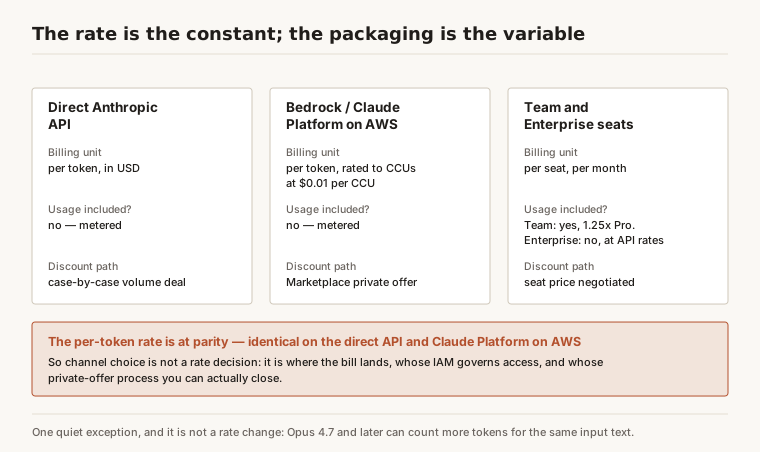
Per-token rate is the constant: why parity reframes the decision
Let me state the parity fact plainly, because it reframes the whole exercise: per-token Claude rates are identical across the direct Anthropic API and Claude Platform on AWS [3]. The savings do not come from "switching to Bedrock." They come from discounts and optimization that apply regardless of channel.
Once you internalize parity, channel choice stops being a cost-of-tokens decision and becomes an operations decision: Where do you want the bill? Whose IAM governs access? Which procurement relationship do you already have? Whose private-offer process can you actually close? The rate is a constant; everything else is variable.
There's one quiet exception worth knowing, and it's not a rate change — it's a token-count change. Opus 4.7 and later use an updated tokenizer that can produce a higher token count for the same input text [1]. The per-token rate is unchanged, but your effective cost-per-task can rise simply because the same prompt now counts as more tokens. Re-baseline your token counts when you adopt a newer Opus — by re-running token counting against the new model on representative prompts — rather than assuming your old spreadsheet's token estimates carry forward.
One more thing parity does not change: the 1M-token context window is billed at standard rates, with no long-context premium [1]. Large-context workloads don't get a surcharge; they get billed at the same per-token list price as everything else.
Where the savings actually live: batch, caching, routing, partner-negotiated volume
If parity means you can't save on the rate, here's where you actually save. This is the lever stack I work through with every team, and it applies on both the direct API and Bedrock.
| Lever | Effect | Notes |
|---|---|---|
| Batch API | 50% off input and output [2] | For non-latency-sensitive jobs. |
| Prompt caching (read) | 0.1x base input (~90% off cached portion) [2] | 5-minute cache write is 1.25x; 1-hour write is 2x. Pays off across repeated prefixes. |
| Model routing | Up to 5x cheaper per tier [1] | Route simple work to Haiku ($1/$5), reserve Opus ($5/$25) for hard tasks. |
| 1M-token context | No long-context premium [1] | Billed at standard rates. |
| Negotiated volume deal | Case-by-case [4] | No published tiers. On Bedrock, via a private offer (not retroactive). |
Two practitioner cautions. First, prompt caching only pays off if your prefixes stay byte-identical — a single changed timestamp or reordered tool list invalidates the cache and you pay full input price on the next request [2]. Second, model routing is usually the biggest lever in practice: the gap between Haiku and Opus is up to 5x per token, and most production workloads have a meaningful share of work that Haiku handles fine [1]. Get routing right before you spend a quarter negotiating a few points off the rate.
The agentic wrinkle: seats look cheap until agents multiply metered usage
This is the section I most want a FinOps reader to take away. Seat-based plans are priced for humans — a person typing into a chat box generates a bounded amount of usage per day. Agents break that assumption.
When a seat sits behind an Enterprise plan (seat plus usage at API rates [6]) and that seat starts running agentic workflows, the seat fee becomes a rounding error. The mechanism is structural, not a single benchmark: an agent loop re-sends an accumulating context on every turn — the prompt, the prior tool calls, the prior results, the growing scratchpad. So spend grows with the number of turns, not linearly with the number of users. A single human "seat" can launch an agent that does the token-equivalent of many humans' worth of work in an afternoon. The seat count on your invoice didn't change. The usage line did.
Two compounding factors make this sharper:
- The updated tokenizer inflates the count. Opus 4.7 and later can count more tokens for the same text [1], and an agent loop re-processes that context every turn.
- Caching helps only if your prefixes are stable. Cache reads at 0.1x [2] are a huge win for agents — if the agent's context prefix stays byte-identical across turns. A timestamp or a reordered tool list in the prefix silently invalidates the cache, and you pay full freight on every turn.
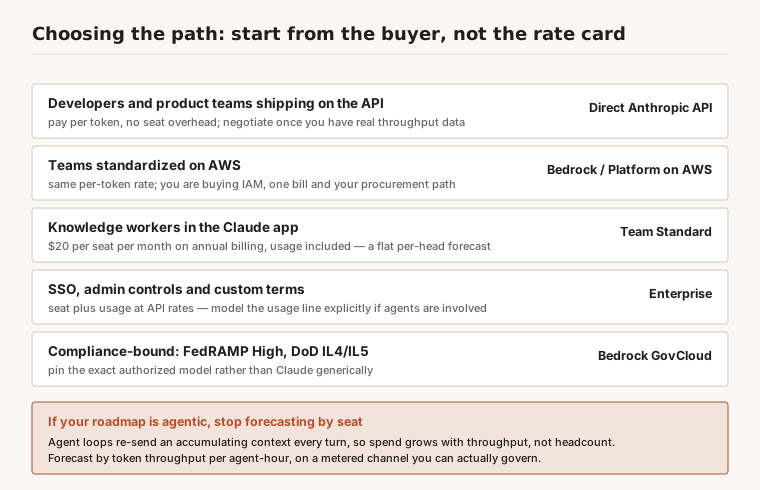
The practical implication: if your workloads are agentic, stop forecasting by seat and start forecasting by token throughput per agent-hour. Put the spend on a channel where you can govern it — which for most enterprises means metered usage on Bedrock or the direct API with caching and routing enforced, not a pile of Enterprise seats whose usage line nobody is watching. Cost control and access control become the same control surface once agents are in the loop.
How to choose your path: a checklist by buyer
A quick decision guide by who's asking and what they're running.
- Developers and product teams shipping on the API. Direct Anthropic API. Pay-per-token, no seat overhead, full access to batch, caching, and routing. Negotiate a volume deal once you have real throughput data [4].
- Teams standardized on AWS. Claude on Amazon Bedrock or Claude Platform on AWS. Same per-token rate as direct [3]; you're buying AWS IAM, consolidated billing, and your existing procurement path. Close any private offer before you ramp — it's not retroactive [3].
- Knowledge workers using the Claude app, predictable usage. Team Standard. $20/seat/mo annual with usage included [5]. The flat per-head forecast is the whole appeal.
- Large org needing SSO, admin controls, and custom terms, with heavy or agentic usage. Enterprise — but go in knowing it's seat plus usage at API rates [6], and model the usage line explicitly, especially if agents are involved.
- Compliance-bound (FedRAMP High, DoD IL4/IL5). Bedrock GovCloud — but pin the exact authorized model, not "Claude" generically [8].
Working with a partner on Bedrock governance
There is no single "Claude price" for an organization. There are three procurement paths that differ on the billing unit, on what usage is bundled, and on how you negotiate a discount — but not on the per-token rate, which is at parity across the direct API and Claude Platform on AWS [3]. Team bundles usage into a flat seat; Enterprise charges a seat plus metered usage at API rates [6]. The per-token rate is the wrong thing to optimize — the savings live in batch, caching, routing, and case-by-case negotiated deals [2][4].
The part that keeps me up at night for clients is the agentic case: seat-based plans hide usage, and agents multiply it. If your roadmap is agentic, forecast by token throughput, not by headcount, and govern the spend on a metered channel where you can actually see and shape it. ASCENDING is an AWS Premier Consulting Partner and Anthropic partner, and that governance-and-cost intersection is where most of this work lands — for the operational details on the Bedrock path specifically, see governing Claude spend on Amazon Bedrock.
Disclosure: Explore Agentic is published by ASCENDING, which builds Jarvis AI on Claude and Amazon Bedrock; we have a commercial interest in the partner-led path described here. The pricing facts above come from Anthropic's and AWS's published documentation regardless.
FAQ
Is Claude cheaper on Amazon Bedrock than on the direct Anthropic API?
No. The per-token rates for Claude are identical across the direct Anthropic API and Claude Platform on AWS — it's parity, with no Bedrock discount and no Bedrock surcharge on the rate. The reasons to choose Bedrock are AWS-native IAM, a consolidated AWS bill, and your existing AWS procurement relationship, not a cheaper rate. Savings come from optimization levers like batch and prompt caching, which apply on both channels.
Does the Claude Enterprise seat fee include token usage?
No. Claude Enterprise is custom-priced as a seat fee plus usage billed separately at API rates — the usage is not bundled into the seat. This is the key difference from Team Standard, where usage is included in the seat price. Two Enterprise customers with the same seat count can have very different bills depending on how intensively their seats consume tokens.
What is the difference between Claude on Bedrock and Claude Platform on AWS?
Claude on Amazon Bedrock is partner-operated by AWS, uses provider-prefixed model IDs, and exposes a subset of features. Claude Platform on AWS is Anthropic-operated, uses AWS IAM and Marketplace billing, and offers full API parity with the first-party API. Both share the AWS billing surface and both have per-token rate parity with the direct Anthropic API; the difference is the operating model and feature availability.
Can I get a volume discount on Claude, and how?
Yes, but it's negotiated case-by-case, with no published discount tiers or committed-spend schedule. On the direct Anthropic API you negotiate a volume or enterprise deal directly. On Bedrock you accept an AWS Marketplace private offer, which is applied in dollars before conversion to consumption units — and note that private-offer discounts are not retroactive, so close the offer before you ramp usage.
What is the minimum number of seats for Claude Enterprise?
There is no published seat minimum for Claude Enterprise, and no published per-seat price — both are negotiated as part of the custom deal. By contrast, Team Standard has a published range of 5 to 150 members at $20 per seat per month on annual billing. If you see a specific Enterprise seat minimum quoted secondhand, treat it as unverified; the verifiable structure is a seat fee plus usage at API rates.
Which buying path is best if my workloads are agentic?
For agentic workloads, lean toward metered usage on Bedrock or the direct API rather than stacking Enterprise seats, because seat plans hide usage that agents multiply across turns. Agent loops re-send an accumulating context every turn, so spend grows with throughput, not with headcount. Forecast by token throughput per agent-hour and enforce prompt caching and model routing to control cost.
References
- Claude pricing (models, list rates, tokenizer, long-context) — per-MTok input/output and rate notes: https://platform.claude.com/docs/en/about-claude/pricing
- Claude pricing (batch and prompt caching) — batch 50% off, cache read 0.1x base input, write premiums: https://platform.claude.com/docs/en/about-claude/pricing
- Claude on Amazon Bedrock — per-token parity, CCU billing at $0.01/CCU, private offers (non-retroactive): https://platform.claude.com/docs/en/build-with-claude/claude-on-amazon-bedrock
- Claude pricing (volume/enterprise discounts) — negotiated case-by-case, no published tiers: https://platform.claude.com/docs/en/about-claude/pricing
- Claude Team plan — $20/seat/mo annual, 5–150 members, usage included (1.25x Pro): https://support.claude.com/en/articles/9266767-what-is-the-team-plan
- Claude pricing (plans) — Enterprise custom: seat + usage at API rates, no published seat price/minimum: https://claude.com/pricing
- Amazon Bedrock Reserved Tier for Claude — priced per 1,000 tokens-per-minute, monthly terms: https://aws.amazon.com/about-aws/whats-new/2026/01/amazon-bedrock-reserved-tier-claude-opus-haiku/
- Claude in Amazon Bedrock FedRAMP High — FedRAMP High and DoD IL4/IL5 in GovCloud for specific models: https://www.anthropic.com/news/claude-in-amazon-bedrock-fedramp-high