
The SageMaker vs Bedrock decision is a consumption-model decision, not a feature comparison. Amazon Bedrock is a serverless API that bills per token — Claude Sonnet 4.6 runs $3 per million input tokens and $15 per million output (verified July 2026) — so an agent that sits idle all weekend costs $0. Amazon SageMaker AI serves models on endpoints billed per instance-hour — a single ml.g5.12xlarge costs about $7.09 an hour in us-east-1, roughly $5,176 a month, whether it handles one request or ten million. Agent traffic is bursty almost by definition. That one difference settles most platform choices before anyone opens a feature matrix.
The short version of the framework: Bedrock, plus its AgentCore services, is where hosted agent loops on managed frontier models belong. SageMaker AI is for custom and fine-tuned inference you cannot get behind a token API. The direct Anthropic API is the honest third option when you need neither AWS-native controls nor custom weights. And the mature answer for a lot of programs is a hybrid — Bedrock runs the agent loop, and a SageMaker endpoint serves one fine-tuned model as a tool.
We keep meeting the same instinct in platform reviews: "we're a serious ML shop, so the agent program goes on SageMaker." The first time we re-priced one of those pilots both ways, the endpoint bill came out 51% higher than the token bill — and the instance had sat idle for roughly 70 of every 100 hours the team paid for. Nobody had done the arithmetic. This article is that arithmetic, plus the two questions that actually decide the platform: what shape is your traffic, and where does your model come from.
What "Bedrock" and "SageMaker" Actually Name in 2026
Naming first, because AWS moved the labels around and half the comparison posts you will find are comparing services that no longer exist under those names.
Amazon Bedrock: a token API that grew an agent platform
Bedrock is the managed, serverless path to foundation models — Anthropic's Claude, Amazon's Nova, Meta's Llama, Mistral, and dozens more — behind one API, priced per token on demand. No instances, no containers, no capacity planning. Since 2025 its surface has grown well past model serving: AgentCore for hosting and operating agents, Custom Model Import for bringing your own fine-tuned weights into token-style serving, Guardrails, Knowledge Bases. Bedrock stopped being "the model API" and became AWS's opinionated home for the whole agent stack.
Amazon SageMaker AI: the platform formerly known as SageMaker
The service most people mean when they say "SageMaker" — notebooks, training jobs, the JumpStart model catalog, inference endpoints — was renamed Amazon SageMaker AI at re:Invent 2024. Capabilities unchanged: the full-control ML platform where you pick the instance, own the container, and run the serving stack.
"Amazon SageMaker" now means the unified data platform
The plain name now belongs to AWS's next-generation data platform built around SageMaker Unified Studio, which pulls analytics, data engineering, and AI tooling into one environment. It matters here as disambiguation: when a 2026 document says "SageMaker," check which one it means. The decision in this article is Bedrock vs SageMaker AI.
The Decision Axis That Matters: Tokens vs Instance-Hours
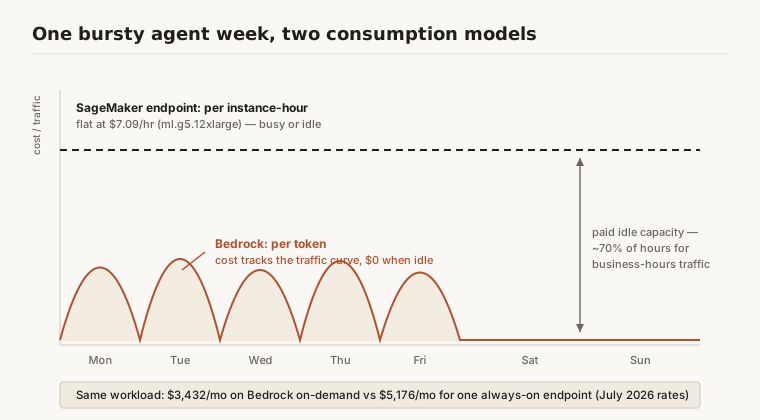
Strip away the model catalogs and the two services charge you for different things. Bedrock meters tokens. SageMaker AI meters hours of provisioned hardware. Everything else in this comparison is a footnote to that sentence.
Bursty traffic punishes always-on endpoints
A real-time SageMaker endpoint bills for every hour it exists, and agent traffic is lumpy in ways batch ML never was. Internal agents work business hours. Customer-facing agents spike with a product launch and go quiet at 2am. A pilot does 40 sessions on Tuesday and 900 the week the VP demos it.
Auto-scaling narrows the waste between a floor and a peak, but the floor is never zero for interactive work. SageMaker's newer inference components can scale an endpoint down to zero instances, but the reactivation cold start is measured in minutes — fine for overnight batch scoring, unusable mid-conversation. So you provision for something near peak and eat the idle hours.
The serverless rebuttal has a 6 GB ceiling
The obvious counter — "just use SageMaker Serverless Inference" — dies on two documented limits: serverless endpoints cap at 6,144 MB of memory and do not support GPUs. That is a hard no for anything LLM-shaped; a quantized 7B model already wants more than double that ceiling. Serverless Inference is the right home for the scikit-learn fraud model. It cannot serve the language model running your agent loop.
Steady high volume flips the math
Be honest about the reverse case. Run an endpoint hot around the clock — a narrow model at high utilization, 24/7 — and the flat hourly rate becomes an asset, because the marginal request is free while token pricing charges the millionth call the same as the first. That is exactly the shape of a high-volume classifier, extractor, or reranker. It is almost never the shape of an agent loop.
Bedrock's own answer to guaranteed capacity is Provisioned Throughput — model units billed hourly, with no-commitment, 1-month, and 6-month terms. The structural difference stands, though: on Bedrock, dedicated capacity is something you graduate into once traffic justifies it. On a SageMaker endpoint it is the entry price. Current rates and the $/task framing live in our Amazon Bedrock pricing guide.
Where Agents Live: AgentCore vs a Platform You Build
The 2023 version of this comparison argued about model catalogs. The 2026 version is about the layer above the model, because an agent program needs sessions, memory, tool access, identity, and tracing before it needs anything else.
Bedrock's managed agent stack
Amazon Bedrock AgentCore is now generally available and deliberately modular: Runtime for serverless, session-isolated agent execution; Memory for short- and long-term context; Gateway, which turns existing APIs and Lambda functions into MCP tools; Identity; Code Interpreter and Browser sandboxes; Observability on OpenTelemetry; and newer additions like Policy, Evaluations, and Registry. It is framework-agnostic — LangGraph, CrewAI, Strands Agents all run on it — and model-agnostic, including models outside Bedrock.
Its pricing follows the same consumption logic as the model API. Runtime bills $0.0895 per vCPU-hour and $0.00945 per GB-hour of active use, so an agent platform with no traffic costs close to nothing. We take AgentCore apart properly in the Strands Agents deep dive; for the platform decision, what matters is that the hosting layer exists, is GA, and is metered like the model layer.
Rolling your own on SageMaker endpoints
A SageMaker endpoint gives you a model behind an HTTPS endpoint. That's it. Session isolation, memory, tool authentication, sandboxing, trace collection — the entire agent runtime layer — is yours to design, build, and patch. Some teams genuinely need that control. Most teams that think they need it are signing up for months of platform engineering that AWS now sells by the vCPU-hour. And if your comparison set is cross-cloud rather than intra-AWS, that is a different axis entirely — see AWS AgentCore vs Azure AI Foundry.
The Model-Availability Reality Check
Consumption models decide cost. Model availability decides feasibility, and the facts here are blunt.
Claude is on Bedrock. It is not on SageMaker.
AWS's own decision guide states it plainly: Bedrock provides access to proprietary models — Anthropic's Claude among them — that are not available through SageMaker JumpStart. Still true as of July 2026. If your agents run on Claude and you want AWS-native serving, the platform question answers itself, and the remaining decision is which Claude tier the loop should call — a cost lever we work through in Haiku vs Sonnet.
Custom weights default to SageMaker
If the model is your own — a fine-tune trained on proprietary labels, an architecture Bedrock has never heard of, a research checkpoint — SageMaker AI is the default home. JumpStart catalogs the open-weights world (Llama, Mistral, Qwen, gpt-oss, hundreds more), and an endpoint will serve anything you can put in a container.
Custom Model Import is the gray zone
Bedrock's Custom Model Import blurs the old boundary. Bring fine-tuned weights in Hugging Face safetensors format for a supported family — Llama 2 through 3.3, Mistral and Mixtral, Qwen 2 through 3, Flan, GPTBigCode — and Bedrock serves them with token-API ergonomics. Billing is per Custom Model Unit per minute in 5-minute active windows, at $0.0785 per CMU-minute (a Llama 8B with 128K context needs 2 CMUs), plus $1.95 per CMU per month for storage. The import itself is free, and the model scales to zero between bursts.
Two caveats: the architecture list is finite, and the region list is short — check the documentation before you design around it. But for a bursty fine-tuned model in a supported family, this one feature removes the strongest classic argument for standing up a SageMaker endpoint.
SageMaker vs Bedrock Cost: One Bursty Agent Workload, Priced Both Ways
The workload
An internal operations agent: 400 sessions per business day across 22 business days — 8,800 sessions a month. Each session averages 10 model calls, and agent loops are input-heavy, so call it 8,000 input and 1,000 output tokens per call: 80K in, 10K out per session. Traffic lives inside a 10-hour weekday window and dies outside it.
Priced on Bedrock on-demand (Claude Sonnet 4.6)
- 704M input tokens at $3 per million: $2,112
- 88M output tokens at $15 per million: $1,320
- Monthly total: $3,432 — and nights, weekends, and the dead week in August cost $0
That is before prompt caching, which is close to free money for agent loops that resend the same system prompt and tool definitions on every call; the mechanics and TTL math live in the prompt caching guide.
Priced on a SageMaker endpoint (70B-class open-weights fine-tune)
Serving something in Sonnet's weight class from open weights means multi-GPU hardware. An ml.g5.12xlarge (4x A10G) at $7.09 per hour is a defensible floor with a quantized 70B model.
- One instance, always on: $7.09 x 730 hours = $5,176 a month
- Two instances for availability: $10,351
- Utilization: 220 traffic hours out of 730 paid — roughly 70% of the hours carry no requests
| Bedrock on-demand | SageMaker real-time endpoint | |
|---|---|---|
| Billing unit | Tokens | Instance-hours |
| Monthly bill | $3,432 | $5,176 (one instance); $10,351 with HA |
| Cost when idle | $0 | ~70% of the bill |
| Peak handling | Automatic, within account quotas | Capacity planning plus scaling policies |
| Serving stack | Managed | Yours: container, vLLM/TGI tuning, patching |
Two honest footnotes. First, the Bedrock number buys Sonnet 4.6 while the endpoint buys a fine-tuned 70B you fully control — different goods, and if the fine-tune is the point, the fair fight is Custom Model Import vs the endpoint, not Sonnet vs the endpoint. Second, invert the traffic shape — steady, high-volume, around the clock — and the endpoint's flat rate starts winning per call. The consumption model is the decision; the workload shape picks the winner. All rates verified July 2026; the full per-model table stays in the Bedrock pricing guide.
The Hybrid Pattern: Two Platforms, One Agent
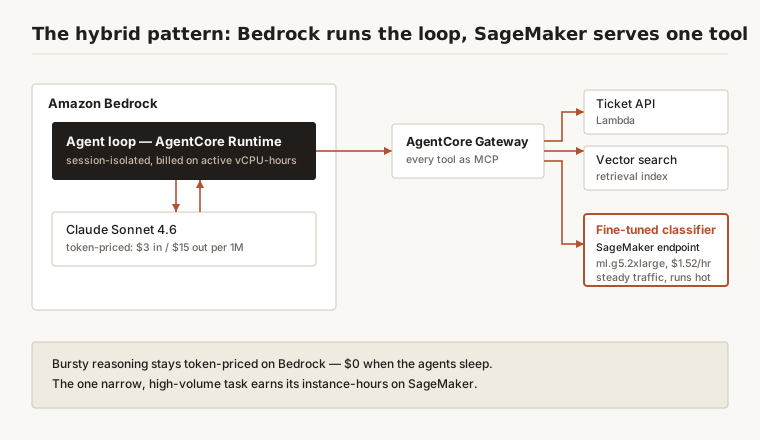
The pattern we see in mature programs is not either-or. A support-triage agent runs its loop on Bedrock — Claude on tokens, hosted in AgentCore Runtime — and one of its tools is a fine-tuned 8B classifier on a SageMaker ml.g5.2xlarge at $1.52 an hour. The classifier scores every inbound ticket for intent and routing, tens of thousands of calls a day at double-digit-millisecond latency. It sees steady traffic from every session, so it actually earns its hourly rate. The bursty, expensive reasoning stays token-priced. Retrieval sits alongside as another tool; the vector-storage half of that choice is its own decision, covered in S3 Vectors for enterprise RAG. The wiring is not exotic — AgentCore Gateway fronts the endpoint as an MCP tool, and to the agent it looks like any other tool call.
The rule of thumb for splitting across two platforms: the task must be narrow, high-volume, latency-sensitive, and worth a fine-tune. All four, not two. And run one test first — if the classifier's architecture is on the Custom Model Import list, import it into Bedrock and keep your operational surface to one platform.
The SageMaker vs Bedrock Decision Table — and the Third Option
| Your situation | Where it lives |
|---|---|
| Agent loop on Claude, Nova, or another managed frontier model | Bedrock |
| Agent hosting, memory, tool gateway, sandboxes | Bedrock + AgentCore |
| Fine-tuned open weights, bursty traffic, supported family | Bedrock Custom Model Import |
| Fine-tuned or custom model, steady high-volume traffic | SageMaker AI endpoint |
| Architecture Custom Model Import does not support | SageMaker AI endpoint |
| One narrow, high-volume tool inside an agent | Hybrid: SageMaker endpoint as a tool |
| No AWS-native requirements, newest features first | Direct Anthropic API |
When the direct Anthropic API beats both
If you have no AWS commitment to burn down, no VPC or IAM requirement, and you want new models and beta features the day they ship, the direct Anthropic API is less machinery than either AWS service. What Bedrock buys the AWS-committed enterprise is real: IAM-scoped access, PrivateLink, CloudTrail audit, and a bill that lands inside an existing AWS agreement — the path we map in Claude on Bedrock for agentic workloads. If that list reads like your security questionnaire, Bedrock. If none of it applies, do not add a platform layer for its own sake.
The platform question in 2026 is not which service has more features. It is what shape your traffic is and where your model comes from. Answer those two and the table does the rest.
Frequently Asked Questions
What is the difference between Amazon Bedrock and SageMaker?
Bedrock is a serverless API for foundation models, billed per token, with an agent-hosting layer (AgentCore) on top. SageMaker AI is a full-control ML platform where you deploy models on endpoints billed per instance-hour and manage the serving stack yourself. The practical difference for agent programs: Bedrock costs nothing when idle, while a real-time SageMaker endpoint bills every hour it exists.
Can I run Claude on SageMaker?
No. Claude is available on AWS only through Amazon Bedrock — AWS's own decision guide confirms proprietary models like Claude are not offered in SageMaker JumpStart. Teams committed to Claude who want AWS-native serving use Bedrock; the direct Anthropic API is the alternative outside AWS.
Is Bedrock cheaper than SageMaker?
For bursty agent traffic, usually yes. The workload we priced in this article costs $3,432 a month on Bedrock on-demand versus $5,176 for a single always-on ml.g5.12xlarge endpoint that sits idle 70% of its hours. Flip to steady, high-utilization, around-the-clock traffic on a narrow model and the endpoint's flat rate can win per call — the traffic shape decides, not the service.
What is Amazon Bedrock AgentCore?
AgentCore is Bedrock's modular agent-hosting stack: Runtime for session-isolated serverless execution, Memory, Gateway for turning APIs into MCP tools, Identity, Code Interpreter and Browser sandboxes, and Observability, plus newer services like Policy and Evaluations. It works with any framework and any model, and bills on consumption — $0.0895 per vCPU-hour for Runtime — rather than provisioned instances.
When should I use SageMaker instead of Bedrock for an agent program?
When the model itself is the differentiator and Bedrock cannot serve it: a custom architecture, a fine-tune outside Custom Model Import's supported families, or a narrow model running at steady high volume where flat instance pricing beats token pricing. Even then, the common pattern keeps the agent loop on Bedrock and uses the SageMaker endpoint as one tool.
Can I use Bedrock and SageMaker together?
Yes, and mature agent programs often do. The hybrid pattern runs the agent loop on Bedrock with Claude on token pricing, and exposes a fine-tuned SageMaker-hosted model as a tool through AgentCore Gateway. The high-volume, steady-traffic task earns its instance-hours; everything bursty stays token-priced.
References
- AWS Decision Guide — Amazon Bedrock or Amazon SageMaker AI? https://docs.aws.amazon.com/decision-guides/latest/bedrock-or-sagemaker/bedrock-or-sagemaker.html
- Amazon Bedrock pricing. https://aws.amazon.com/bedrock/pricing/
- Amazon SageMaker AI pricing. https://aws.amazon.com/sagemaker/ai/pricing/
- Amazon Bedrock AgentCore developer guide — components and capabilities. https://docs.aws.amazon.com/bedrock-agentcore/latest/devguide/what-is-bedrock-agentcore.html
- Amazon Bedrock — Custom Model Import supported architectures and requirements. https://docs.aws.amazon.com/bedrock/latest/userguide/model-customization-import-model.html
- Amazon SageMaker AI — Serverless Inference limits and feature exclusions. https://docs.aws.amazon.com/sagemaker/latest/dg/serverless-endpoints.html