
Codex and Claude Code can start at the same team seat price. The buying decision depends on the work the allowance covers, additional usage and the human effort required to accept the result. Price the plan your company can operate, then compare cost per accepted change on the same tasks before paying to switch.
Prices last checked: October 29, 2026. Figures below are published US-dollar list prices before tax. Annual rates are monthly equivalents of an annual commitment, not month-to-month prices. Existing contracts, regions and Enterprise agreements can differ.
The current team seat prices
OpenAI's Codex pricing documentation and Anthropic's current pricing page establish the base team comparison:
| US list price per user | ChatGPT Business, including Codex | Claude Team, including Claude Code |
|---|---|---|
| Base team seat, annual billing | $20/month equivalent | $20/month equivalent |
| Base team seat, monthly billing | $25/month | $25/month |
Both services document a two-seat minimum for these team plans. Claude also lists Premium Team seats at $100 per user per month on annual billing or $125 monthly. That higher-usage option is not assumed to have an equivalent OpenAI seat offer. The same dollar figure does not mean the same task capacity. Check the usage included with the exact seat type, model and billing route your developers will use.
For example, ten Standard seats at the annual rate allocate $200 per month, or $2,400 per year, for either base plan. For Claude Team, a mix of eight Standard and two Premium seats allocates $360 per month, or $4,320 per year. On monthly billing, that same mix is $450 per month. These are seat calculations only.
Claude's current Team offer includes Claude Code on every seat. Premium is a usage decision, not a prerequisite inferred from an old launch announcement. OpenAI's Codex pricing documentation also distinguishes included plan usage from API-key billing. Recheck these pages when approving the purchase.
Match the plan to the controls you need
A low-cost seat is not useful if it lacks a required control. Keep those requirements beside the cost comparison rather than discovering them after a pilot. Use the Claude Team vs Enterprise comparison to separate plan-control requirements from the cost of individual seats.
| Buying question | Codex / ChatGPT | Claude Code / Claude |
|---|---|---|
| Price per seat | Use the Business seat table above or your Enterprise agreement | Use the Team seat table above or your Enterprise agreement |
| Administration | Confirm the workspace roles, allowed features and spend controls required by your pilot | Confirm seat assignment, allowed features and spend controls required by your pilot |
| SSO and SCIM | Business documents SAML SSO; verify Enterprise requirements such as SCIM against the offer | Team lists SSO; verify Enterprise requirements such as SCIM against the offer |
| Audit and compliance evidence | Confirm that the selected plan exposes the records your reviewers need | Confirm that the selected plan exposes the records your reviewers need |
| MCP support | Test the required server, credentials and execution path; seat price is not evidence of compatibility | Test the same requirements in the selected Claude Code setup |
| What migrates | Keep an inventory of current instructions, integrations, skills and automations | Validate the supported import path and any rebuilds before treating a move as complete |
For Claude-specific seat and usage mechanics, use the existing Team and Enterprise pricing guide. This article adds the cross-product work comparison; it does not replace that guide or turn a Team rate into an Enterprise quote.
Keep three spending buckets separate
Use a ledger with the actual workspace, member or API project associated with each charge:
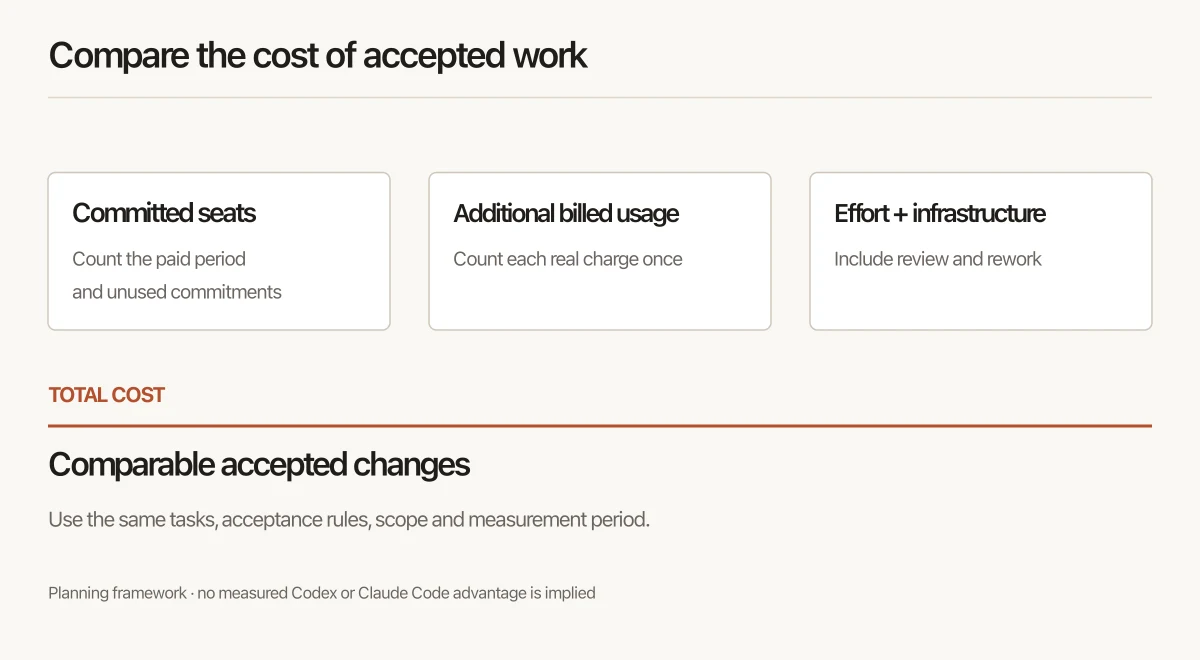
- Committed seats: seats paid for during the period, including unused capacity and any overlap while switching.
- Additional consumption: purchased credits, approved extra usage, or separately billed API/cloud-provider calls. Count the actual billed amount once.
- Operating effort: code review, fixing rejected work, test infrastructure, administration and any workflow-specific service costs.
Do not treat every locally displayed token estimate as an extra invoice. Anthropic's cost-management documentation explains that its local session dollar figure is an estimate; authoritative charges come from the appropriate billing system. Subscription usage and API billing need different interpretations.
Similarly, the number of prompts typed is a poor common denominator. A long-running task, a larger codebase or a different model can consume a different share of a plan. Record the actual work and billing route rather than assuming equal message counts mean equal cost.
Compare accepted work with a small pilot
Choose a representative set of tasks from approved repositories: a defect fix, a test change, a documentation update and a bounded refactor, for example. Use the agent evaluation guide to define the same acceptance rules for both setups, while retaining your repository constraints. Use a fresh approved branch for each attempt.
Record whether the change passes tests and review, how much human correction it needs, the final accepted outcome, and any additional billed usage. Include failed attempts and retries in the cost of delivering the accepted work.
For one period:
Cost per accepted change = (allocated seats + additional billed usage + review/rework labor + test infrastructure) ÷ accepted changes.
The following illustrates the calculation. These are invented planning inputs for Setup A and Setup B, not measured Codex or Claude results. The labor rate is an internal cost assumption; it is not a vendor charge.
| Monthly-equivalent pilot input | Setup A | Setup B |
|---|---|---|
| Allocated annual seat commitment | $360 | $360 |
| Additional billed usage | $120 | $200 |
| Review and rework at an assumed $100/hour | 20 hours = $2,000 | 16 hours = $1,600 |
| Test infrastructure | $60 | $60 |
| Total | $2,540 | $2,220 |
| Accepted changes, same defined scope | 80 | 80 |
| Cost per accepted change | $31.75 | $27.75 |
This example shows why the extra-usage line cannot decide the purchase by itself. It does not prove either product saves time. Replace every assumption with your observations and check that the accepted changes are comparable in size and quality.
If a setup completes less of the required work, report that gap alongside the cost. Dividing by a convenient count should not hide failures, waived tests or extra manual implementation.
Include the cost of switching
Estimate the work to update instructions, replace integrations, recheck secrets and permissions, train users and keep both subscriptions running during a transition. Separate that one-time amount from the steady-state bill.
For illustration, 40 hours at an assumed $100/hour is $4,000 in switching effort. If a completed pilot later demonstrates $500 in monthly savings on comparable work, the simple payback period is eight months. If the $500 is only a guess, the payback is also only a scenario.
The existing Codex-to-Claude team assessment covers the inventory and acceptance checks behind that estimate. If you are evaluating Jarvis Crosswalk, confirm its current collection coverage, deliverables and delivery scope with ASCENDING. A cost comparison is not proof of an automated migration or guaranteed savings.
Make the purchase decision from the evidence
Keep the current tool when it meets the team's requirements and the alternative has not shown a worthwhile benefit after switching costs. Choose a mixed seat allocation when observed usage justifies it. Expand the pilot when the result is too small or too variable to support a decision.
The useful output is a short buying record: the plan and billing route, observed cost per accepted change, required controls, unresolved gaps and the cost of changing. That is stronger evidence than a claim that either product is always cheaper.
FAQ
What does Codex cost compared with Claude Code for a team?
On the official US list prices checked October 29, 2026, Codex Business and Claude Team both start at $20 per user per month billed annually, or $25 billed monthly, with a two-seat minimum. Claude Team also lists a higher-usage Premium seat. Included usage and how it is consumed differ, so equal base seat prices do not establish equal operating costs.
Do we need Premium Claude seats to use Claude Code?
The current Claude Team pricing page includes Claude Code with every Team seat. Premium adds higher usage. Older material that describes Claude Code as Premium-only should not be used to price a new Team purchase; confirm the current offer and any existing contract terms.
Is API usage included in the subscription price?
Separate the included subscription allowance from extra usage and any API-key or cloud-provider billing. Record which identity and billing route each workflow actually uses. Do not add a token-based estimate to the subscription invoice as if it were automatically an additional charge.
Which is cheaper for a company?
There is no supported universal winner from the seat price alone. Compare the same accepted work over the same period, including extra usage, human review, infrastructure and switching costs. Use a pilot with your approved repositories and acceptance criteria.