
A Claude seat has a published list price and a metered second half — and since Anthropic stripped bundled tokens out of Enterprise seats in early 2026, the second half is the one that decides your invoice.
Publisher disclosure: This site is published by ASCENDING, which builds agentic systems on Anthropic models. Every price below comes from Anthropic's own pricing page, help center, or public documentation, cited inline and checked on 14 August 2026. Spend models are labeled as models.
Most pages that answer "what does a Claude seat cost" stop at the sticker. That was defensible in 2025, when an Enterprise seat came with a token allowance attached. It stopped being defensible in 2026: Anthropic now sells the Enterprise seat as pure access — the seat buys the login, and every token your people consume is billed separately at standard API rates on top of it [3].
So this page does two things and nothing else. First, the table: every current tier, its list price, and whether usage is included. Second, the arithmetic that turns that list price into a forecast you can hand to finance. Whether to buy seats at all versus the API or Amazon Bedrock is covered in the three buying paths; which of Team or Enterprise fits you is covered in Claude Team vs Enterprise.
The price table: every Claude tier, list price, and what usage it includes
Here is the whole answer in one pass. The column that matters most is the third one.
| Plan | List price | Billing | Usage included? | Seat range |
|---|---|---|---|---|
| Free | $0 | — | Basic consumer allowance | 1 |
| Pro | $17/mo billed annually, $20 monthly | Individual | Yes — the Pro allowance | 1 |
| Max 5x | From $100/mo | Individual, monthly | Yes — 5x Pro | 1 |
| Team — standard seat | $20/seat/mo billed annually, $25 monthly | Annual or monthly | Yes — 1.25x Pro per member | 2–150 |
| Team — premium seat | $100/seat/mo billed annually, $125 monthly | Annual or monthly | Yes — 6.25x Pro per member | 2–150 |
| Enterprise | $20/seat/mo, billed annually | Annual commitment | No — every token at API rates | 20 min self-serve, 50 min sales-assisted |
Four things in that table trip up buyers, and all four are worth stating plainly.
Monthly billing carries a 25% premium on Team. $25 versus $20 on standard seats, $125 versus $100 on premium [2]. On a 60-seat standard deployment that is $3,600 a year for the privilege of not committing.
Team's usage allowances are per member, not pooled. A standard seat gets 1.25x the Pro allowance and a premium seat 6.25x, measured per person against a weekly limit that resets on a fixed schedule tied to your account [2]. One heavy user cannot drain the team's budget, and one light user cannot subsidize a heavy one.
Enterprise and Team both list at $20 a seat, and they are not the same $20. The Team $20 buys a usage allowance. The Enterprise $20 buys access and nothing else [3]. Comparing the two numbers as if they were equivalent is the single most common budgeting error I see.
Prices exclude tax, and the pricing page says so in the fine print alongside "Usage limits apply" [1].
What each seat actually includes
Price is only half a comparison. Here is what the money buys, feature by feature, as published.
| Capability | Team standard | Team premium | Enterprise |
|---|---|---|---|
| Claude web, desktop, mobile | Yes | Yes | Yes |
| Claude Code and Claude Cowork | Yes | Yes | Yes |
| Claude Design, Claude Science | Yes | Yes | Yes |
| Enterprise search across the org | Yes | Yes | Yes |
| SSO, central billing, admin controls | Yes | Yes | Yes |
| No model training on your content by default | Yes | Yes | Yes |
| SCIM provisioning | — | — | Yes |
| Audit logs | — | — | Yes |
| Compliance API and Analytics API | — | — | Yes |
| Role-based access, fine-grained permissions | — | — | Yes |
| Custom data retention controls | — | — | Yes |
| Network-level access control, IP allowlisting | — | — | Yes |
| Customer-managed encryption keys (CMEK) | — | — | Yes |
| US-only inference | — | — | Yes |
| HIPAA-ready offering with BAA | — | — | Yes |
| Org and per-user spend limits | Yes | Yes | Yes |
| Usage included in the seat | 1.25x Pro | 6.25x Pro | None |
Two notes on this table. Claude Code is not premium-seat-only on the current pricing page — the Team card lists Claude Code and Cowork under the base bullet set, with premium seats buying more usage rather than different software [1]. That is a change from the August 2025 launch, when Claude Code arrived specifically as part of the premium seat upgrade [13]. If a vendor quote tells you Claude Code requires premium seats, check its date.
Second, the governance features are the real Enterprise line. Audit logs, the Compliance API, SCIM, custom retention, CMEK, and US-only inference cannot be bought at the Team tier at any seat count [3], and Anthropic states SOC 2, ISO 27001, GDPR and CCPA compliance plus a HIPAA-ready offering at Enterprise [12]. If your control framework requires exportable evidence of who asked the model what, that requirement — not headcount — is what puts you on Enterprise. What those APIs must emit is its own design problem, covered in COSO's GenAI control-evidence guidance.
What changed in 2026: Enterprise seats stopped bundling tokens
This is the wedge, and it is the reason a 2025 budget spreadsheet will underestimate a 2026 renewal.
Through 2025, an Anthropic Enterprise seat was a flat monthly fee that carried a token allowance with it. In April 2026 The Register reported that Anthropic had ejected those bundled tokens from the enterprise seat deal entirely. The transition began with contract renewals in November 2025; by February 2026 the company had introduced a single $20-per-employee monthly fee covering Claude, Claude Code and Cowork on a usage-based plan; and by 8 March 2026 the documentation said the legacy chat-only and standard/premium enterprise seats were no longer available [9].
Anthropic's own help center now states the new model without ambiguity: the seat fee only covers access to the platform and doesn't include any usage, and every token your team uses — in chat, Claude Code, or Cowork — is billed at standard API rates on top of your seat cost [3]. The billing article adds the line that closes the loophole: owners can set spend limits to "unlimited," but consumption is still billed, and you cannot disable billing for usage [4].
The headline seat price went down in that transition. It is the total that went up for anyone with real usage. Adrien Laurent, CEO of IntuitionLabs, put the shape of it to The Register: for some of their clients the base seat was only about 20 percent of their total bill, and the other 80 percent was already metered API usage [9].
The practical consequence for anyone renewing this year: your 2025 invoice is not a baseline. Pull actual token consumption from the Console before you model the renewal, because the allowance that was silently absorbing it is gone.
Seat price is not your bill: the two-part cost formula
Every Enterprise forecast is the same two-line equation, and only the first line is a published price.
Annual cost = (seats x seat price x 12) + (metered token spend at API list) + (server-tool and runtime charges)
Line one is trivial. One hundred seats at $20, billed annually, is $24,000 a year [3].
Line two is where the variance lives, and it is priced off the standard API rate card. As of August 2026: Claude Haiku 4.5 at $1 input / $5 output per million tokens, Claude Sonnet 5 at $2/$10, the Opus family (5, 4.8, 4.7, 4.6, 4.5) at $5/$25, and Claude Fable 5 at $10/$50 [10]. Output is priced at five times input across the whole lineup, so the shape of the work — reading versus generating — moves your bill as much as the model tier does.
Line three is the one nobody budgets. Web search inside a session bills at $10 per 1,000 searches on top of tokens [10]. Claude Managed Agents sessions add $0.08 per session-hour of running status, metered to the millisecond, on top of the tokens the session consumes [10]. Code execution outside of web-search contexts bills at $0.05 per container-hour after 1,550 free hours per organization per month [10].
Two rate modifiers cut the other way. Prompt caching reads cached prefixes at 0.1x the base input price against a 1.25x write premium for the five-minute cache or 2x for the one-hour tier, and batch processing takes 50% off both input and output for asynchronous work [10]. On a retrieval-heavy workload with a stable system prompt, caching alone changes the answer by a factor, not a percentage — the mechanics are in the prompt caching guide.
Worked example: what 100 Enterprise seats cost at three usage profiles
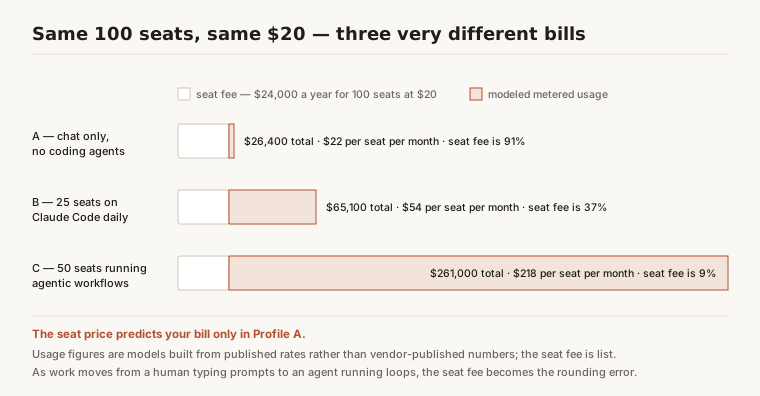
The seat fee is fixed. Everything else is behavioral. Here is the same 100-seat Enterprise deployment under three usage profiles, using the published rates above.
The usage figures below are my models, not vendor-published numbers. The rates they are built from are cited; the consumption assumptions are stated so you can substitute your own.
| Profile | Seat fee/yr | Modeled usage/yr | Total/yr | Effective $/seat/mo | Seat fee as % of bill |
|---|---|---|---|---|---|
| A — chat only, no coding agents | $24,000 | $2,400 | $26,400 | $22 | 91% |
| B — 25 seats on Claude Code daily | $24,000 | $41,100 | $65,100 | $54 | 37% |
| C — 50 seats running agentic workflows | $24,000 | $237,000 | $261,000 | $218 | 9% |
Profile A arithmetic. A knowledge worker running roughly 40 substantive Sonnet 5 sessions a month at about 15,000 input and 2,000 output tokens each consumes 600,000 input and 80,000 output tokens monthly. At $2 and $10 per million [10] that is $1.20 plus $0.80, or $2.00 a month — $24 a year, $2,400 across 100 people. The seat fee is 91% of the bill and the metered half rounds to noise.
Profile B arithmetic. A developer running Claude Code on Opus 5 through a working day is a different animal: call it 1.5 million input tokens with 70% served from cache, plus 150,000 output tokens, per day. That is 450,000 uncached input at $5/MTok ($2.25), 1.05 million cache reads at $0.50/MTok ($0.53), and 150,000 output at $25/MTok ($3.75) — about $6.53 a day, roughly $131 a month over 20 working days. Twenty-five such developers cost $39,300 a year; the remaining 75 chat-only seats add $1,800.
Profile C triples the per-developer intensity of Profile B across 50 seats, which is what happens when work moves from a human typing prompts to an agent running loops. At that point the seat fee is 9% of the invoice and the list price you negotiated so hard is a rounding error.
The lesson is not that Claude is expensive. It is that the seat price predicts your bill only in Profile A, and Profile A is not why most organizations are buying.
Where the metered half runs away: Claude Code, Cowork, and agentic loops
The three profiles differ by one variable: how much work happens per human keystroke. An interactive chat turn is bounded by a person's patience. An agentic loop is not. It re-reads context on every iteration, calls tools, retries, and spawns subagents, and each of those steps is billed input and output. The Managed Agents rate card makes the shape explicit — a one-hour Opus 5 session in Anthropic's own worked example consumes 50,000 input and 15,000 output tokens plus an hour of session runtime, for $0.705, and that is a single session [10]. Multiply by a team, a working day, and a retry policy.
Three specific multipliers to hold in the model:
- Cache reads are cheap but not free. At 0.1x base input [10], a long-lived agent that re-sends a 200,000-token working context on every turn still pays $0.10 per turn on Opus 5 just to re-read what it already knew. Fifty turns an hour is $5 an hour, per agent, before it generates anything.
- Server tools bill separately. Web search at $10 per 1,000 searches [10] is invisible in a token forecast and very visible on an invoice when a research agent runs unattended.
- Data residency and fast mode are multipliers, not line items. US-only inference applies 1.1x across input, output, cache writes and cache reads on Claude 4.6 and later, and fast mode on Opus 5 and Opus 4.8 prices at $10/$50 per MTok — double standard Opus rates [10]. Neither appears as a separate charge; both silently re-rate everything.
This is why teams running high-volume agentic AI workloads route that traffic through the API or Bedrock rather than through seats — the cost-control tooling is different there. That comparison is worked through in Claude on Bedrock for agentic workloads, and the model-selection lever in model routing and cost per task.
The seat-count mechanics that quietly cost money
Four contractual rules move real dollars and none of them appear in a price comparison.
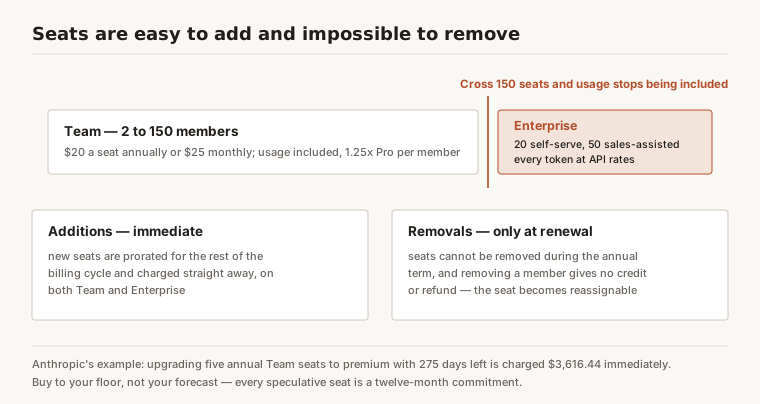
Minimums. Team requires a minimum of two members [2]. Enterprise requires 20 seats self-serve and 50 seats sales-assisted [3]. If you have 12 people who need audit logs, the Enterprise floor means you buy 20 seats, and eight of them are shelfware you still pay for.
The 150-seat ceiling. Team supports up to 150 seats [2]. Cross it and you are on Enterprise — where usage stops being included. That is not a 1.0x price change dressed as a tier upgrade; it is a change in billing model.
Additions are immediate and prorated; removals are not. New Enterprise seats are prorated for the remainder of the billing cycle and charged immediately, and seats cannot be removed during the annual term — reductions only take effect at renewal [5]. Team behaves the same way: added and upgraded seats are prorated and charged immediately, and removing a member produces no credit or refund; the seat just becomes reassignable [6][7].
Mid-term upgrades are priced on the full remaining term. Anthropic's own worked example: an annual Team plan that upgrades five standard seats to premium on 1 April with 275 days remaining is charged ($80 x 5 x 12) x (275/365) = $3,616.44, immediately [6]. The monthly equivalent — five upgrades on 15 January with 16 days left — is ($100 x 5 x 16) / 31 = $258.06 [6].
The operational conclusion is unglamorous but worth money: buy to your floor, not your forecast. Seats are trivially easy to add mid-term and impossible to remove mid-term, so every seat you buy speculatively is a twelve-month commitment.
Credits versus invoicing: self-serve and sales-assisted bill differently
Two organizations can be on Enterprise at the same $20 seat price and have completely different cash-flow profiles, because the usage half is billed two different ways.
Self-serve Enterprise runs on prepaid credits. Owners purchase credits upfront, they deplete as the team consumes tokens, billing is USD only, and when credits run out usage stops until an owner buys more [4]. That hard stop is either a safety feature or an outage depending on who you ask at 4pm on a deadline.
Sales-assisted Enterprise bills monthly in arrears on actual consumption, with continuous metering and no credit-depletion mechanism [4]. It also unlocks invoicing and multi-currency payment, where self-serve is card or ACH in USD only [3]. If you bought through AWS Marketplace, you are on the arrears model [4].
On the Team tier the equivalent mechanism is usage credits: owners pre-purchase credits that activate once a member hits their seat's included allowance, billed at standard API rates, with an auto-reload threshold you configure [8]. Team is therefore the only tier where a genuinely flat monthly bill is achievable — set no credits, and members simply hit their weekly limit.
Spend controls exist on both tiers. Admins can cap spend at the organization and individual user level [1][13], and on sales-assisted plans hitting a limit halts usage until the next cycle or an adjustment [4]. Configure these on day one. The default posture is "bill whatever is consumed."
The levers that actually change the number
The token-rate levers — batch, caching, model routing, negotiated volume discounts — are a separate discipline covered in how enterprises actually cut Claude spend. What follows are the levers specific to the seat half of the bill.
Annual commitment. The single largest published discount available to anyone: 20% off both standard and premium Team seats for committing annually [1][2]. Enterprise is annual by construction [4].
Seat mix. Team lets you mix and match seat types [1]. A premium seat costs 5x a standard seat and delivers 5x the usage (6.25x Pro versus 1.25x Pro) [2], so the mix is roughly usage-neutral — the reason to buy premium is to concentrate heavy usage in specific people without lifting the floor for everyone. Audit who actually needs it before renewal; upgrades mid-term are charged on the full remaining term [6].
Nonprofit pricing. Anthropic publishes a nonprofit rate of $8/user/month on Team and $10/user/month on Enterprise, minimum 2 seats for teams under 150, verified through its partner Goodstack in a two-to-three-minute form for Team [11]. Eligibility covers 501(c)(3) organizations, K–12 schools, and qualifying healthcare organizations; government agencies, political campaigns, higher education institutions, and healthcare systems are excluded [11]. That is a 60% cut on the seat half, and a surprising number of qualifying organizations never ask.
Marketplace procurement. Claude for Enterprise, including premium seats with Claude Code, is available through AWS Marketplace [3][14]. Whether that spend draws down an existing AWS committed-spend agreement is answered by your AWS contract, not Anthropic's price list — ask your account team before buying direct.
Spend caps as a negotiating artifact. Per-user and per-org limits [4] let you put a defensible ceiling in the business case. A forecast with a hard cap attached survives finance review; one without a cap gets sent back.
How to build the forecast before you sign
Six steps, in order. This is the sequence I would actually run.
- Count seats at your floor, not your ambition. Apply the minimums — 2 for Team, 20 or 50 for Enterprise [2][3] — and remember additions are easy and removals are impossible until renewal [5].
- Segment the population by workload, not by department. Chat-only, Claude Code, and agent-operator are three different cost objects. Profile A and Profile C differ by a factor of ten on the same seat price.
- Pull real token consumption from the Console for a representative two weeks per segment, then annualize. Do not use 2025 invoices — the allowance that absorbed that usage no longer exists [9].
- Rate it against the published card, per model, splitting input, output, and cache reads. Add web search at $10/1,000 and session runtime at $0.08/hour if agents are in scope [10].
- Add the modifiers you have already committed to. US-only inference is 1.1x on everything; fast mode doubles Opus rates. Subtract batch at 50% and caching at 0.1x reads where the workload genuinely supports them [10].
- Set spend caps before go-live, and decide deliberately between prepaid credits and monthly arrears — that choice determines whether an overrun is an outage or a surprise [4].
If step 4 produces a metered number larger than your seat fee, the seat conversation is the wrong conversation. Evaluate whether that traffic belongs behind a gateway with its own quota and routing controls — the argument is in agent gateway versus API gateway, with the AWS mechanics in the Bedrock pricing guide and the desktop-agent surface in Claude Cowork for enterprise.
FAQ
How much is a Claude Team seat per month?
A Claude Team standard seat lists at $20 per seat per month billed annually, or $25 per seat per month billed monthly. A premium seat lists at $100 per seat per month billed annually, or $125 monthly. Team plans require a minimum of two members and support up to 150 seats. Both seat types include usage: a standard seat gets 1.25x the Pro plan allowance per member and a premium seat gets 6.25x, measured per person against a weekly limit rather than pooled across the team. Prices exclude applicable tax. These figures are from Anthropic's published pricing page and help center as of August 2026.
Does a Claude Enterprise seat include any usage?
No. As of 2026 the Enterprise seat fee covers access to the platform only and does not include any token allowance. Every token consumed in chat, Claude Code, or Cowork is billed separately at standard API rates on top of the seat cost. This changed during 2026: renewals moved to the usage-based model starting November 2025, a flat $20-per-employee fee arrived in February 2026, and the legacy chat-only and standard/premium enterprise seats were withdrawn by 8 March 2026. Admins can set organization and per-user spend limits, but limits set to "unlimited" still bill consumption — usage billing cannot be disabled.
What is the minimum number of seats for Claude Enterprise?
Enterprise plans require a minimum of 20 seats when purchased self-serve (credit card or ACH, USD only) and a minimum of 50 seats when purchased sales-assisted, which unlocks invoicing and multi-currency payment. Both require an annual commitment. New seats added mid-term are prorated and charged immediately, but seats cannot be removed during the annual term — reductions only take effect at renewal. The practical implication is to buy to your confirmed headcount floor rather than your hiring forecast, since additions are trivial and reductions are locked until renewal.
Why is my Claude bill higher than seats times $20?
Because the seat fee is only the first of three lines. The second is metered token consumption at API list rates — $1/$5 per million for Haiku 4.5, $2/$10 for Sonnet 5, $5/$25 for the Opus family, $10/$50 for Fable 5. The third is server-tool and runtime charges: web search at $10 per 1,000 searches, Managed Agents session runtime at $0.08 per session-hour, and code execution at $0.05 per container-hour beyond 1,550 free hours monthly. Multipliers stack on top — US-only inference adds 1.1x, and fast mode on Opus doubles the rate. For agent-heavy teams the seat fee is routinely under 20% of the invoice.
Is annual billing worth it for Claude Team?
On list price, yes — annual billing is a flat 20% discount on both standard seats ($20 versus $25) and premium seats ($100 versus $125). The trade is flexibility: on an annual term, added seats are prorated and charged immediately, removed seats produce no credit or refund, and mid-term seat upgrades are charged against the full remaining term. Anthropic's published example charges $3,616.44 immediately to upgrade five annual standard seats to premium with 275 days left. Commit annually for the headcount you are certain of, and add monthly-equivalent capacity through seat additions rather than over-buying up front.
References
- Published list prices and feature bullets for Free, Pro, Max, Team standard and premium seats, and Enterprise, including the "$20/seat, usage at API rates" Enterprise line and the tax/usage-limits fine print — Anthropic (2026): https://claude.com/pricing
- Team plan seat prices for monthly and annual billing, the two-member minimum, the 150-seat maximum, and the 1.25x / 6.25x per-member usage multipliers versus Pro — Claude Help Center (2026): https://support.claude.com/en/articles/9266767-what-is-the-team-plan
- Enterprise plan definition: seat fee covers access only with no included usage, every token billed at standard API rates, 20-seat self-serve and 50-seat sales-assisted minimums, and the SCIM / audit log / Compliance API / CMEK / US-only-inference feature set — Claude Help Center (2026): https://support.claude.com/en/articles/9797531-what-is-the-enterprise-plan
- Enterprise billing mechanics: per-user-per-month priced and billed annually, self-serve prepaid credits versus sales-assisted monthly arrears, org and per-user spend limits, and the statement that usage billing cannot be disabled — Claude Help Center (2026): https://support.claude.com/en/articles/11526368-how-am-i-billed-for-my-enterprise-plan
- Enterprise seat management: 20-seat minimum, additions prorated and charged immediately, and seats not removable during the annual term — Claude Help Center (2026): https://support.claude.com/en/articles/13393991-purchase-and-manage-seats-on-enterprise-plans
- Team bill calculation with the annual and monthly proration formulas and the $3,616.44 and $258.06 worked upgrade examples, plus the no-refund-on-removal rule — Claude Help Center (2026): https://support.claude.com/en/articles/9267289-how-is-my-team-plan-bill-calculated
- Team seat purchase and management: new seats and standard-to-premium upgrades are prorated and charged immediately — Claude Help Center (2026): https://support.claude.com/en/articles/12004354-purchase-and-manage-seats-on-team-plans
- Usage credits for Team and seat-based Enterprise plans: credits activate at the seat's usage limit, bill at standard API rates, and support an auto-reload threshold on Team — Claude Help Center (2026): https://support.claude.com/en/articles/12005970-manage-usage-credits-for-team-and-seat-based-enterprise-plans
- Reporting that Anthropic removed bundled tokens from enterprise seat agreements — renewals from November 2025, a $20-per-employee usage-based fee introduced in February 2026, legacy chat-only and standard/premium enterprise seats withdrawn by 8 March 2026, and the practitioner observation that the base seat was ~20% of total bill — The Register (2026): https://www.theregister.com/2026/04/16/anthropic_ejects_bundled_tokens_enterprise/
- API list rates per million tokens for Haiku 4.5, Sonnet 5, the Opus family and Fable 5; the 50% Batch API discount; prompt-caching multipliers (1.25x/2x writes, 0.1x reads); web search at $10 per 1,000 searches; code execution at $0.05/container-hour after 1,550 free hours; Managed Agents session runtime at $0.08/session-hour with its worked example; and the 1.1x US-inference and fast-mode premiums — Anthropic (2026): https://platform.claude.com/docs/en/about-claude/pricing
- Nonprofit pricing of $8/user/month on Team and $10/user/month on Enterprise, the two-seat minimum for teams under 150, Goodstack verification, and the eligibility and exclusion lists — Anthropic (2026): https://claude.com/resources/tutorials/getting-started-with-claude-for-nonprofits
- Enterprise compliance posture: SOC 2, ISO 27001, GDPR and CCPA compliance plus a HIPAA-ready offering and Enterprise-only data retention controls — Anthropic (2026): https://claude.com/solutions/enterprise
- Original August 2025 announcement that Claude Code shipped as part of the premium seat upgrade on Team and Enterprise, with org-level and per-user spend limits — Anthropic (2025): https://anthropic.com/news/claude-code-on-team-and-enterprise
- Availability of Claude for Enterprise premium seats with Claude Code through AWS Marketplace, consolidating billing through an existing AWS relationship — Amazon Web Services (2025): https://aws.amazon.com/blogs/awsmarketplace/claude-for-enterprise-premium-seats-with-claude-code-now-available-in-aws-marketplace/