
Compare GitHub Copilot and standalone Claude Code on the work your team needs to complete. Start with Copilot if GitHub-based review and IDE integration are the priority. Test Claude Code when its agent controls or deployment options fill a specific gap. Use the same repositories and acceptance tests. Choosing the same Claude model doesn't make the two products share permissions or billing.
Last verified: November 3, 2026, against the linked vendor documentation. The pilot below is a proposed evaluation, not a customer benchmark.
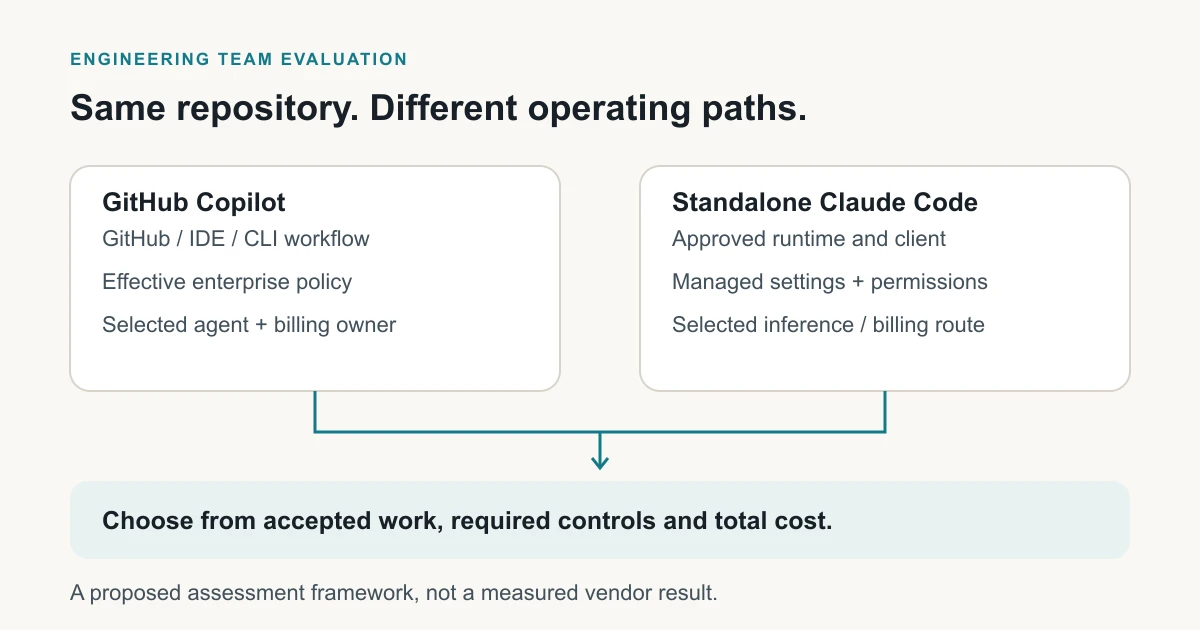
Compare the products and where they run
GitHub Copilot is GitHub's AI coding assistant, with IDE, command-line and GitHub workflows. GitHub's current cloud documentation describes repository questions, planned changes, code review and automation. It also distinguishes the new cloud experience from the older one.
Claude Code is Anthropic's coding agent. It reads code, edits files and runs commands through terminal, IDE, desktop and browser interfaces. Both products now cover more than one kind of coding work.
The boundary matters when an engineer says, "We already use Claude in Copilot." GitHub also offers third-party coding agents, currently in public preview. An agent launched through GitHub uses that integration's policies, billing and supported features. Managing that integration is different from managing standalone Claude Code.
Write the pilot configuration in full: product, plan, client, execution location, selected agent or model, repository access and billing owner. Compare that configuration with the alternative.
GitHub Copilot vs Claude Code for a company
Use the same six buying questions across your shortlist. SSO means single sign-on; SCIM automates account provisioning. MCP, the Model Context Protocol, connects AI clients to tools and context. Check each feature against the plan and client you will use.
| Buying question | GitHub Copilot | Standalone Claude Code |
|---|---|---|
| Price per seat | Use the current Business or Enterprise offer, included AI allowance and additional usage terms. Include the GitHub services used by the workflow. | Price the selected Team, Enterprise or usage-billed deployment. Keep subscription allowances and separately billed provider usage distinct. |
| Admin controls | Administrators enable third-party agents through account, organization or enterprise settings. Record which policies apply in each approved client. | Claude Code uses permission rules, modes and managed settings for supported actions. Record the settings loaded in the approved environment. |
| SSO and SCIM | Verify identity provisioning and offboarding against the GitHub organization, Enterprise setup and Copilot offer. | Verify identity provisioning against the Claude plan or inference-provider route; test removal from the actual runtime. |
| Audit and compliance APIs | Confirm which GitHub logs and usage exports cover the enabled actions; retain repository checks and review evidence separately. | Confirm available Claude administration or provider logs; correlate them with local execution and repository evidence where needed. |
| MCP support | The MCP servers in Copilot policy controls whether servers can run across Copilot clients. Approved-list controls and client support still need checking. | Claude Code has managed MCP configuration alongside its tool permissions. Validate the approved server, authentication and effective downstream access. |
| What migrates | Inventory instructions, custom agents, skills, integrations and automations. Test each proposed replacement. | Rebuild or validate the equivalent guidance, hooks, skills and integrations. A copied instruction file isn't proof of equivalent behavior. |
Use GitHub's plan documentation and Claude Code's enterprise deployment guide beside the quote. There is no useful universal price comparison without the plan, allowance, billing route and required controls.
For the broader category, our Codex alternatives guide covers the operating models. This page narrows the decision to Copilot versus standalone Claude Code instead of repeating that shortlist. The agentic AI guide provides the wider operating context.
Choose the workflow your team can support
Copilot is worth testing first when developers already depend on GitHub issues, pull requests and supported IDE integrations. Check whether administrators can manage the agent session through the team's existing process. It must still meet repository access and code-review requirements.
Standalone Claude Code is worth testing when the team needs its permission settings, integrations or a particular model-provider deployment. Anthropic documents direct subscriptions and routes through Amazon Bedrock, Google Cloud and Microsoft Foundry. The chosen route determines how the team signs in, pays and obtains administration records. Check which features that route supports.
For example, consider a platform team maintaining an internal service. Its work includes explaining unfamiliar code, adding regression tests and preparing bounded refactors. Run these pilot tasks through the proposed Copilot and Claude Code configurations. Comparing screenshots from different environments would not answer the team's buying question.
A mixed deployment can also work when the tools serve different needs. Assign access and cost owners, then weigh the added value against the effort of supporting two setups.
Test content restrictions and tool permissions separately
GitHub's content-exclusion documentation says the protection does not cover Edit and Agent modes in VS Code and other editors. It also describes limitations involving semantic context, symbolic links and remote filesystems.
Match the documented protection to the proposed mode. Use a harmless marker in an isolated test repository to check behavior, alongside a review of the policy and data path.
For Claude Code, permission rules and modes control supported tool actions. Record the configuration that actually loads. An instruction asking the agent to be careful does not enforce a restriction. A sandbox limits where the agent can act.
MCP adds another access path. GitHub documents company MCP policies, while Claude Code has its own managed configuration. The MCP server and connected business system still need appropriate authorization. An approved client doesn't grant an employee access to every record behind a tool.
For the pilot service, use a read-only test connection with synthetic records. Demonstrate an allowed operation and a denied one through each intended client. Keep the required pull-request checks outside the agent's instructions.
Use one repository and one acceptance record
The GitHub Copilot readiness assessment provides the rollout gates. Apply those gates to both candidates, then use the following procedure to make a buying decision:
- Choose comparable work. Use the same approved repository and bounded tasks, with a clean starting branch for each attempt.
- Define acceptance first. Keep the team's existing tests, security requirements and reviewer expectations. Don't loosen them for generated code.
- Record the whole attempt. Retain the configuration, accepted result, failed checks, retries and human corrections.
- Measure review effort. Count time spent understanding, correcting and validating the change, as well as the initial task time.
- Review exceptions. Explain tasks that couldn't run because of environment or policy constraints. Don't quietly remove them from the comparison.
- Make a scoped decision. Keep, expand, run both for separate purposes, or stop. Name the repositories and clients covered by that decision.
Usage dashboards can show adoption. They don't establish that an accepted suggestion improved delivery. Use the agent-evaluation guide to build a repeatable task record rather than treating generated lines as finished engineering work.
Compare the bill and the cost of changing
Record committed seats, additional billed usage and operating effort as separate costs. Include duplicated subscriptions during a transition and the time needed to rebuild configuration. Count an invoice once; don't add a local token estimate as another charge unless it represents separately billed usage.
The Codex-versus-Claude team-cost worksheet explains cost per accepted change. Apply that method to the selected Copilot offer too: use the same accepted work and measured review effort. A cheaper seat can still be an expensive operating choice if required tasks need repeated manual repair.
When evaluating a Copilot alternative, start with the missing requirement. Cursor may deserve a separate trial for an editor-centered workflow. Codex may deserve one for its supported local or hosted workflows. Our Cursor-versus-Codex team comparison covers that decision. Neither becomes the right alternative simply because it appears on a longer list.
Turn the pilot into a migration assessment
Before switching, inventory the instructions, skills, MCP connections, identities and automation your current workflow needs. Label each item keep, rebuild, replace or unresolved. An export or supported file format doesn't prove the replacement will behave the same way.
ASCENDING develops Jarvis Crosswalk for company AI-tool migration assessments. If you're evaluating that offer, confirm the current collection coverage, deliverables and service scope through ASCENDING's contact page. Bring the repository inventory and the pilot's unresolved gaps to that discussion.
The company migration assessment separates employee chat, API applications and coding tools. Use that separation when several groups share the same vendor contract. The engineering-client decision is one part of the wider move.
FAQ
Is Claude Code better than GitHub Copilot for teams?
Neither is a universal winner. Compare the intended client, execution environment, access controls and accepted work in your own repositories. Copilot can fit an established GitHub operating model; standalone Claude Code can fit its own configuration and deployment requirements. The pilot should decide which advantage matters for the team.
Can we use Claude through GitHub Copilot?
GitHub documents third-party coding agents, including Claude, as a public-preview integration. Check the current plan, administrator enablement and supported entry points. That GitHub-managed route is distinct from buying and administering standalone Claude Code, even when the agent uses Claude.
Which GitHub Copilot alternatives should we test?
Choose alternatives for a named unmet requirement. Claude Code, Cursor or Codex may fit different runtime, editor or administration needs. Test a small shortlist on comparable work instead of treating every coding assistant as interchangeable. The linked Codex alternatives guide covers the wider selection.
Can we migrate Copilot instructions directly to Claude Code?
Review each instruction, custom agent, skill and integration separately. Preserve the useful intent, translate where the instruction applies and test its behavior in the replacement. Credentials, permissions and automated workflows need their own checks; copying text doesn't transfer the original control boundary.