
ServiceNow closed the $2.85B Moveworks acquisition in December 2025 and had absorbed the product into a new brand called Otto by May 2026 — here is the verified timeline, and the decision it forces on anyone holding a contract or running an evaluation.
Publisher disclosure: This site is published by ASCENDING, which builds Jarvis AI — a competing platform. Every figure below comes from vendor press releases, official pricing pages, and product documentation, cited inline. The Jarvis row in the alternatives table is flagged, and its limits are stated.
Most pages ranking for this question were written before the product stopped existing under the name they use. Moveworks was acquired, rebranded, bundled, repriced, and folded into a different product name across eight months — each step changing a different part of the buying decision.
The verified timeline
Every row was checked against the vendor's own press release or documentation. Nothing here is reconstructed from secondary coverage.
| Date | What happened | Why a buyer cares |
|---|---|---|
| Mar 10, 2025 | ServiceNow announces intent to acquire Moveworks for $2.85B in cash and stock, closing expected H2 2025 [1] | The independent-vendor pitch has an expiry date |
| Dec 15, 2025 | Acquisition completes [2] — ServiceNow's largest at the time it closed, since surpassed by the $7.75B Armis deal that completed April 20, 2026 [19] | Counterparty, roadmap owner, escalation path all change |
| Feb 25, 2026 | Moveworks GovCloud achieves FedRAMP Moderate, on a dedicated AWS GovCloud (US) environment [3] | A genuine capability gain; opens federal buyers |
| Feb 26, 2026 | ServiceNow launches EmployeeWorks, combining Moveworks' conversational AI and enterprise search with its portal and workflows; Moveworks stays available standalone [4] | The product is now a component of a larger SKU |
| Mar 16, 2026 | Support migrates to Now Support. support@moveworks.ai stops accepting cases; open cases migrate, closed cases do not [5] | Operational proof the merge is real, not branding |
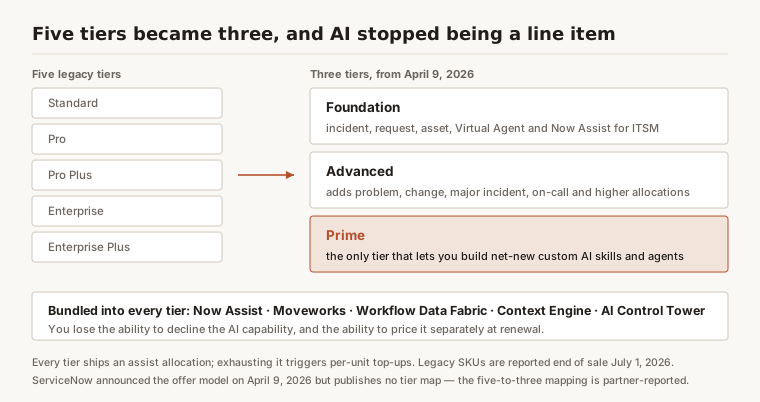
| Apr 9, 2026 | ServiceNow announces a new tiered offer model ending AI as a separate purchase, and unveils Context Engine [20]; partner and analyst readings put it as five legacy tiers replaced by three — Foundation, Advanced, Prime — with Now Assist, Moveworks, Workflow Data Fabric, Context Engine and AI Control Tower bundled into every tier [6][7][21] | Your AI line item stops being separately negotiable |
| Apr 30, 2026 | GovCloud tenants move to ServiceNow's HiWave instance; from this date new Moveworks cases are filed through the Now Support Portal [5] | Public-sector support path switches over |
| May 5, 2026 | ServiceNow Otto launches at Knowledge 2026 — "a new AI experience that combines the intelligence of Now Assist, Moveworks, and AI Experience" [8] | The name you evaluated is now a subsystem |
| Jul 1, 2026 | Legacy SKUs reach end of sale, per partner licensing analysis [7] | Renewals after this cannot revert to old packaging |
| Jul 22, 2026 | Q2 FY26: ServiceNow AI crosses $1B in annual contract value; 123 deals over $1M net-new ACV, up nearly 40% YoY [9] | The bundle works commercially; it will not be unwound |
Three things fall out. The product did not disappear — Moveworks is still sold standalone [4]. The center of gravity moved anyway. And the commercial model changed more than the technology did.
What actually changed in the product
Less than the branding suggests, and more than ServiceNow's reassurances suggest.
The engine is intact. ServiceNow bought a working front-end AI assistant, enterprise search, and reasoning engine, and did not gut them. EmployeeWorks is explicitly Moveworks' conversational AI and enterprise search wired to ServiceNow's portal and autonomous workflows [4]. The retrieval and language layers you evaluated are the ones now shipping inside it.
The packaging changed twice in ten weeks. February gave you EmployeeWorks. May gave you Otto, which subsumes EmployeeWorks, Now Assist, and AI Experience into one conversational surface reaching users through chat, search, voice agents, and a data explorer [8]. ServiceNow's framing is that Otto "can be first experienced in ServiceNow EmployeeWorks" and "will be rolled out across all products in the year ahead" [8]. Read that as: EmployeeWorks is the beachhead, Otto is the destination.
Support is fully absorbed. The most concrete evidence of integration, and the least discussed. As of March 16, 2026, Moveworks cases route through Now Support, the legacy support email is dead, and closed cases were not migrated — you have to request an export [5]. If you have a compliance obligation to retain support correspondence, that export is an action item.
What did not change: no published list price, and no public commitment to a standalone Moveworks roadmap beyond "continues to be offered" [4].
Three things the acquisition genuinely improved
Neutrality means saying this plainly, because most competitor-written pages on this topic will not.
One, federal and defense access. Moveworks GovCloud cleared FedRAMP Moderate on February 25, 2026 in a dedicated AWS GovCloud (US) environment [3]. That is a multi-quarter authorization program Moveworks alone was unlikely to fund at that speed — the clearest case where the acquisition made the product better rather than merely different.
Two, integration cost for existing ServiceNow shops. If your ITSM system of record is already ServiceNow, the largest hidden cost of a Moveworks deployment — keeping the assistant's view of tickets, catalog items, and CMDB objects in sync — drops toward zero [4].
Three, the end of the separate AI SKU negotiation. ServiceNow's April 9, 2026 announcement says "every ServiceNow customer now starts with a complete AI package — no separate purchase, no procurement project, and no integration required" [20]. Partner and analyst readings of the resulting packaging list Now Assist, Moveworks, Workflow Data Fabric, Context Engine, and AI Control Tower as bundled into all three tiers [7][21]. For buyers who spent 2025 negotiating AI add-ons line by line, that is a real simplification — and a real loss of leverage.
Weigh all three against one structural cost: you can no longer buy this capability without buying a position on ServiceNow's platform strategy. For a ServiceNow-standardized enterprise that is free. For everyone else it is the whole decision.
Your renewal just became a ServiceNow renewal
If your Moveworks contract renews in the next twelve months, treat it as a new platform negotiation, not a renewal.
The tier structure underneath you changed. ServiceNow's own announcement confirms a new tiered offer model but does not publish the tier map [20]. Partner and analyst accounts fill that gap consistently: five legacy tiers — Standard, Pro, Pro Plus, Enterprise, Enterprise Plus — became three, Foundation, Advanced and Prime [7][21]. A ServiceNow Community article written by an MVP contributor, not by ServiceNow, describes Foundation as incident, request, asset, Virtual Agent and Now Assist for ITSM; Advanced adding problem, change, major incident, on-call and higher assist allocations; and Prime as "the only tier that lets you build net-new custom AI skills and AI agents on the platform" [6]. Underline that last clause. If your Moveworks value came from custom-built agents and workflows, the equivalent capability now sits in the top tier. Get the mapping in writing before accepting a tier assignment.
Consumption replaced a flat AI line. Every tier ships a bundled assist allocation; exhausting it triggers top-up charges at a per-unit rate [7]. Per-seat licensing now sits alongside consumption metering, and the consumption curve is the one that surprises people, because successful adoption is what drives it.
Legacy packaging has a hard stop. Partner licensing analysis puts end of sale for legacy SKUs at July 1, 2026, after which legacy pricing cannot be reinstated [7]. That date is partner-reported rather than stated in ServiceNow's own release, so verify it with your account team — but if it holds, a 2026 renewal is a one-way door.
Five questions I would put in writing before signing:
- Which tier does our current Moveworks entitlement map to, feature by feature, and which capabilities move to Prime?
- What is the assist allocation for our headcount, what is the top-up rate, and what did our trailing twelve months of usage actually consume against it?
- What are the annual escalators, and are they applied to the seat component, the consumption component, or both?
- What is the committed support path and SLA now that cases run through Now Support [5]?
- If we do not standardize on ServiceNow for ITSM, what is the supported standalone Moveworks configuration and for how long?
Question five is the one that gets a vague answer. Vagueness there is itself the answer. The renewal-discipline mechanics generalize — the same signal-based approach in our enterprise search renewal checklist applies here almost line for line.
If you are mid-evaluation right now
The evaluation you scoped before December 2025 is measuring the wrong thing.
The independence criterion collapsed. If "not locked to one ITSM vendor" was a scored requirement, Moveworks no longer satisfies it, and no amount of standalone-availability language changes that. Re-score it honestly rather than quietly deleting the row.
The comparison set changed shape. You are no longer comparing an assistant against an assistant, but a platform commitment (ServiceNow, via Otto) against point solutions and against other platform commitments (Microsoft, Atlassian). That question belongs to your CIO, not your service-desk lead.
Reference calls need a date filter. A customer who deployed in 2024 is describing a company that no longer exists, a support organization since replaced [5], and a roadmap superseded twice. Ask for references who signed after December 15, 2025 and have been through the April 2026 repackaging.
Pilot scope should test the seam, not the demo. The demo will be excellent; it was excellent before the acquisition. What is unproven is how Otto arbitrates between the Moveworks-derived conversational layer and Now Assist's native summarization on the same request. Force that arbitration on your real ticket mix and instrument it — the discipline in AI agent evaluation and testing is the right frame, deflection-rate slides are not.
Post-acquisition roadmaps also generate claims about autonomous behavior that is still a workflow with a language model in front of it. The agent washing test — can it act unsupervised, does it recover from failure, is there a per-action audit record — separates the two faster than a feature matrix.
The pricing picture, and why nobody publishes one
Moveworks never published list pricing, and being acquired did not change that. ServiceNow does not publish Otto or EmployeeWorks list pricing either [8]. Every per-employee figure circulating in comparison posts is a third-party reconstruction, frequently published by a vendor selling against Moveworks. So: I am not going to give you a Moveworks per-seat number, because there is no primary source for one. The structure is more useful anyway.
| Cost component | How it now behaves | Negotiation implication |
|---|---|---|
| Platform seats | Per-user, tiered across Foundation / Advanced / Prime [6] | Tier assignment is the biggest single lever |
| AI capability | Bundled into every tier — no longer a separate add-on [7] | You lose the ability to decline it, and the ability to price it |
| AI consumption | Bundled assist allocation, then per-unit top-ups [7] | Model your trailing usage; adoption success raises cost |
| Packaging risk | Legacy SKUs end of sale July 1, 2026 [7] | Renewal timing is now a strategic variable |
The vendors that do publish are a useful sanity floor: Microsoft 365 Copilot at $30.00 per user/month paid yearly [10], Atlassian starting at $0.30 per assisted virtual-agent conversation beyond 1,000 free per month, with volume discounts [12], eesel at $0.40 per resolved task with no per-seat fee [13]. None are Moveworks equivalents, but they establish what per-unit employee-support automation costs when a vendor will say so. A deeper teardown of seat versus consumption pricing sits in our enterprise search pricing analysis.
The alternatives, scored on named criteria
Scored as of August 2026. "Independent" means not owned by a larger platform vendor. "Published price" means a number on the vendor's own site, not a marketplace reconstruction.
| Option | Independent? | Published price | Strongest where | Main limit |
|---|---|---|---|---|
| Moveworks / Otto (ServiceNow) | No — ServiceNow, Dec 2025 [2] | No | ServiceNow-standardized shops; federal via FedRAMP Moderate GovCloud [3] | Roadmap now serves platform strategy; standalone future unstated |
| Glean | Yes — $150M Series F at $7.2B, Jun 2025 [15] | No | Knowledge sprawl across many SaaS sources; search as the seam | No public pricing; assistance/ticket-resolution depth trails ITSM-native tools |
| Microsoft 365 Copilot | No — Microsoft | Yes, $30/user/mo annual [10] | Organizations already all-in on M365; Copilot Chat included at no extra cost [10] | Employee self-service runs on Copilot Studio, and its IT path hands off to ServiceNow |
| Microsoft Agent 365 | No — Microsoft | Yes, $15/user/mo annual [11] | Governing and observing agents across the estate | It is a control plane, not a service-desk assistant — different job |
| Atlassian (Service Collection + Rovo) | No — Atlassian | Yes, from $0.30/assisted conversation after 1,000/mo free, volume discounts [12] | Teams already on Jira Service Management; per-conversation and per-resolution economics | Virtual service agent requires Service Collection Premium or Enterprise [12] |
| Resolve (ex-Espressive Barista) | No — Resolve acquired Espressive, Sep 2025 [16] | No | Agentic service-desk automation with flat pricing structure | Barista brand retired; product lineage renamed |
| Aisera | No — Automation Anywhere, Nov 2025 [17] | No | ITSM-adjacent automation depth; deep ServiceNow integration | Mid-absorption into Automation Anywhere's platform |
| eesel | Yes | Yes, $0.40/task, $1,000/mo enterprise tier [13] | Tier-one deflection on an existing service desk, fast | Narrower scope than a full employee-assistant platform |
| Workativ | Yes | Yes, $99–$349/mo, session-based [14] | Small and mid-size teams; pay per session, not per headcount | Not positioned for large-enterprise governance requirements |
| Jarvis (our product — see disclosure) | Yes — ASCENDING | Yes, $18,000 / $30,000 / $60,000 per year on AWS Marketplace [18] | MCP-native gateway and governed multi-LLM layer at flat, published pricing | Not an ITSM-native ticket-resolution product; no FedRAMP or HIPAA certification claimed; far smaller reference base than any platform vendor above |
Two honest readings. If you are a ServiceNow shop with ticket volume as the dominant pain, Moveworks inside Otto is probably still the right answer — the acquisition made it more so, not less. If your problem is knowledge scattered across thirty SaaS tools rather than ticket deflection, the assistance-first versus search-first distinction decides it, and I have worked through that split in detail elsewhere.
The consolidation the comparison posts missed
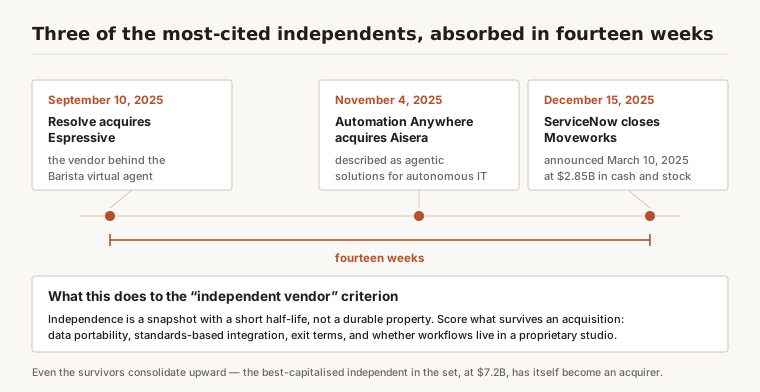
Here is the finding absent from every alternatives listicle I checked. Moveworks was not the only one. Resolve acquired Espressive — the Barista virtual-agent vendor — on September 10, 2025 [16]. Automation Anywhere acquired Aisera on November 4, 2025 [17]. ServiceNow closed Moveworks on December 15, 2025 [2]. Three of the most-cited independent employee-support AI vendors were absorbed inside fourteen weeks.
The irony is instructive. Aisera published a page warning buyers that the ServiceNow–Moveworks deal "brings uncertainty for enterprises" — pressure to standardize, unclear roadmaps, potential price increases. That page was published by a company acquired weeks earlier.
What this means for your criteria. "Independent vendor" is a snapshot with a short half-life, not a durable property. Stop scoring it as a binary and start scoring what survives an acquisition: data portability, standards-based integration, contractual exit terms, and whether your workflows are authored in a proprietary studio or in something you can lift. Even the survivors consolidate upward — Glean, the best-capitalized independent at a $7.2B valuation [15], has itself become an acquirer.
The architectural hedge is to keep the integration layer separate from the assistant. If your connectors are expressed as a protocol-level gateway rather than vendor-proprietary plumbing, replacing the assistant is a configuration change instead of a re-implementation. That is the practical argument for MCP and for treating gateway selection as its own scored decision — criteria in how to shortlist an enterprise MCP gateway, and whether that layer duplicates infrastructure you already run in agent gateway versus API gateway.
Migration and exit: what actually binds you
If you decide to leave, four things hold you, in descending order of difficulty.
Workflow authoring is the real lock-in. Conversational content is portable; the automations underneath it are not. Every workflow authored in a proprietary studio is a rebuild elsewhere. Inventory them and sort by business logic encoded — most organizations find a long tail of trivial ones and a short head of five to ten carrying the entire value of the deployment.
Connector coverage is a rebuild, not a migration. The cost is dominated by re-establishing permission-aware access to your top five or six sources, not by the connector count on a marketing page. Glean's integrations page advertises 275+ out-of-the-box connectors [22] precisely because this is where the cost sits.
Conversation history and audit trails may not travel. Ask what you can export, in what format, and how long you have. The Now Support transition is the live precedent — closed cases were not migrated and required a request [5]. Assume the same applies to conversation logs unless your contract says otherwise.
ITSM coupling is either your escape route or your cage. If the assistant writes into ServiceNow via documented APIs, swapping it is tractable. If it writes via a native integration that exists only because both products are ServiceNow, you are not swapping the assistant without revisiting the platform. Establish which you have, in writing, at signature — not at renewal. The governance surface this creates is the subject of our AI governance pillar.
The decision sequence I would actually run
Not a framework. An order of operations, because the order is where teams get this wrong.
First, fix the date on your evidence. Discard every comparison document, reference call, and internal memo written before December 15, 2025. Anything describing Moveworks as an independent vendor describes a company that no longer exists in that form.
Second, answer the platform question before the product question. Are you standardizing on ServiceNow? If yes, the evaluation is largely settled and the remaining work is tier assignment and consumption forecasting. If the answer is "not decided," buying Moveworks now casts a vote in that decision, and it belongs with whoever owns platform strategy.
Third, price the consumption curve, not the seat count. The April 2026 model bundles AI into every tier and meters usage beyond an allocation [7]. Take your trailing twelve months of interactions, project growth at the rate your pilot demonstrated, and model top-up exposure at two and three years. A deployment that succeeds costs more than one that stalls; the budget owner should hear that before the pilot, not after.
Fourth, decouple the integration layer from the assistant. Keep connectors, identity, and policy in a layer you control. That converts a future acquisition from a crisis into a procurement task — and on the evidence of the last fourteen months, there will be another one.
Fifth, set the renewal date deliberately. With legacy packaging reportedly ending July 1, 2026 [7] and Otto rolling across all products "in the year ahead" [8], a renewal signed today locks a snapshot of a model still in motion. Shorter terms cost more per year and buy optionality worth the premium.
FAQ
Did ServiceNow actually shut down Moveworks?
No. Moveworks continues to be offered as a standalone product within the ServiceNow portfolio, and organizations can buy it independently or as an integrated component of a ServiceNow deployment [4]. What changed is its position. Moveworks' conversational AI and enterprise search now power ServiceNow EmployeeWorks, launched February 26, 2026, and were folded into ServiceNow Otto on May 5, 2026 alongside Now Assist and AI Experience [8]. Support moved to ServiceNow's Now Support portal in March 2026 [5]. The brand and the product survive; the roadmap, support organization, and commercial model are now ServiceNow's, and no public commitment exists on how long the standalone configuration is supported.
What is ServiceNow Otto, and how does it relate to Moveworks?
Otto is ServiceNow's unified AI experience, announced May 5, 2026 at Knowledge 2026. ServiceNow describes it as "a new AI experience that combines the intelligence of Now Assist, Moveworks, and AI Experience to complete work across every department and system" [8]. It reaches users through conversational AI, enterprise search, voice agents, and a data explorer. ServiceNow says Otto "can be first experienced in ServiceNow EmployeeWorks" and will roll out across all products over the following year [8]. Practically, Moveworks is now one of three intelligence sources feeding a larger conversational layer.
How much did ServiceNow pay for Moveworks?
$2.85 billion, in a combination of cash and stock, subject to customary purchase price adjustments. ServiceNow announced the transaction on March 10, 2025 and expected it to close in the second half of 2025 [1]. It actually closed on December 15, 2025 [2]. It was ServiceNow's largest acquisition at the time it closed, but it no longer holds that title: ServiceNow completed its acquisition of Armis for approximately $7.75 billion in cash on April 20, 2026 [19]. Two details worth knowing if you are checking sources. The completion press release does not restate the price, so the $2.85B figure traces to the original March 2025 announcement, which is the primary source to cite [1]. And neither ServiceNow release calls the Moveworks deal a record — the "largest in ServiceNow's history" framing circulating in comparison posts comes from trade coverage, and it is now out of date besides.
Will my Moveworks price go up at renewal?
There is no published list price to compare against, so nobody can answer this generically. What is knowable is that the structure changed. On April 9, 2026 ServiceNow announced a new tiered offer model in which AI is no longer a separate purchase, and unveiled Context Engine [20]. Partner and analyst accounts describe the result as five legacy tiers replaced by three — Foundation, Advanced, Prime — with Now Assist, Moveworks, Workflow Data Fabric, Context Engine and AI Control Tower bundled into every tier [7][21]. Each tier carries an assist allocation with per-unit top-ups beyond it [7]. Custom AI agent and skill authoring sits in Prime [6]. Model the consumption curve, not just the seat count.
Which Moveworks alternatives are still independent in 2026?
Fewer than the listicles suggest. Resolve acquired Espressive, the vendor behind Barista, in September 2025 [16]. Automation Anywhere acquired Aisera in November 2025 [17]. ServiceNow closed Moveworks that December [2]. Three of the most-cited independents were absorbed inside fourteen weeks. Glean remains independent, having raised $150M at a $7.2B valuation in June 2025 [15], as do smaller players like eesel and Workativ, both of which publish pricing [13][14]. The practical lesson is that independence is a snapshot, not a durable property. Score data portability, standards-based integration, and contractual exit terms instead — those survive an acquisition.
References
- ServiceNow announced its intent to acquire Moveworks for $2.85 billion in cash and stock, with closing expected in the second half of 2025 — ServiceNow Newsroom (2025): https://newsroom.servicenow.com/press-releases/details/2025/ServiceNow-to-extend-leading-agentic-AI-to-every-employee-for-every-corner-of-the-business-with-acquisition-of-Moveworks-03-10-2025-traffic/default.aspx
- The acquisition completed on December 15, 2025; the release states the completion date and does not restate the purchase price or characterise the deal's size — Moveworks (2025): https://www.moveworks.com/us/en/company/news/press-releases/servicenow-completes-acquisition-of-moveworks
- Moveworks GovCloud achieved FedRAMP Moderate authorization on a dedicated AWS GovCloud (US) environment, announced February 25, 2026 — ServiceNow Newsroom (2026): https://newsroom.servicenow.com/press-releases/details/2026/Moveworks-from-ServiceNow-achieves-FedRAMP-moderate-authorization-to-provide-secure-conversational-AI-to-public-sector/default.aspx
- ServiceNow launched EmployeeWorks on February 26, 2026, combining Moveworks' conversational AI and enterprise search with ServiceNow workflows, and confirmed Moveworks remains available as a standalone product — ServiceNow Newsroom (2026): https://newsroom.servicenow.com/press-releases/details/2026/ServiceNow-launches-Autonomous-Workforce-that-thinks-and-acts-adds-Moveworks-to-the-ServiceNow-AI-Platform/default.aspx
- Moveworks support moved to ServiceNow Now Support effective March 16, 2026; the legacy support email stopped accepting cases, closed cases were not migrated and require an export request, and starting April 30, 2026 all new Moveworks-related cases from GovCloud tenants are submitted through the Now Support Portal — Moveworks Help (2026): https://help.moveworks.com/ai-assistant/getting-started/support/moveworks-support-transition-to-servicenow-now-support
- Community-authored walkthrough of the April 2026 ITSM tiers — Foundation, Advanced, and Prime — with Prime the only tier permitting net-new custom AI skills and agents on the platform; posted May 28, 2026 by MVP contributor Bill Martin, and user-generated rather than a ServiceNow publication — ServiceNow Community (2026): https://www.servicenow.com/community/itsm-articles/itsm-licensing-in-april-2026-foundation-advanced-and-prime-in/ta-p/3544380
- Partner licensing analysis dating the tier replacement to April 9, 2026, listing Now Assist, Moveworks, Workflow Data Fabric, Context Engine and AI Control Tower as bundled into every tier, and placing legacy SKU end of sale at July 1, 2026 — Crossfuze (2026): https://www.crossfuze.com/campaigns/servicenow-pricing-changes-2026
- ServiceNow Otto launched May 5, 2026, combining Now Assist, Moveworks, and AI Experience into one AI experience, first available in EmployeeWorks and the AI Control Tower — ServiceNow Newsroom (2026): https://newsroom.servicenow.com/press-releases/details/2026/ServiceNow-Otto-creates-the-unified-AI-experience-for-the-enterprise/default.aspx
- Q2 FY2026 results reporting ServiceNow AI crossing $1 billion in annual contract value and 123 deals over $1 million in net-new ACV, up nearly 40% year over year — ServiceNow Newsroom (2026): https://newsroom.servicenow.com/press-releases/details/2026/ServiceNow-Reports-Second-Quarter-2026-Financial-Results/default.aspx
- Microsoft 365 Copilot published enterprise pricing at $30.00 per user/month paid yearly, with Copilot Chat included at no additional cost for eligible subscriptions — Microsoft (2026): https://www.microsoft.com/en-us/microsoft-365-copilot/pricing/enterprise
- Microsoft Agent 365 published at $15.00 per user/month on annual commitment, positioned as a control plane to observe, secure and govern AI agents rather than an employee-support assistant — Microsoft (2026): https://www.microsoft.com/en-us/microsoft-agent-365
- Atlassian's published Service Collection terms give Premium and Enterprise plans 1,000 free virtual-service-agent assisted conversations per month, after which assisted conversations "start at $0.30(USD)/assisted conversation/month with volume discounts", and include Rovo Customer Service at $1 per resolution in the Standard, Premium and Enterprise plans — Atlassian (2026): https://www.atlassian.com/licensing/jira-service-management
- eesel publishes per-task pricing at $0.40 per regular task with no platform fee, no per-seat fee and no monthly minimum, plus a $1,000/month enterprise tier — eesel AI (2026): https://www.eesel.ai/pricing
- Workativ publishes session-based plans at $99/month and $349/month, priced by AI chat session rather than by employee headcount — Workativ (2026): https://workativ.com/ai-agent/pricing
- Glean raised a $150M Series F at a $7.2B valuation announced June 10, 2025, reporting over $100M ARR and 850+ employees; the announcement describes the platform as linking with "more than 100 SaaS applications and enterprise data repositories" — Glean (2025): https://www.glean.com/blog/glean-series-f-announcement
- Resolve announced its acquisition of Espressive, the enterprise conversational-AI vendor behind Barista, on September 10, 2025 — Resolve (2025): https://resolve.io/news/resolve-acquires-espressive
- Automation Anywhere announced its acquisition of Aisera, described as a leading provider of agentic solutions for autonomous IT, on November 4, 2025 — Automation Anywhere (2025): https://www.automationanywhere.com/company/press-room/automation-anywhere-acquires-aisera-supercharge-autonomous-enterprise
- Jarvis is listed on AWS Marketplace by ASCENDING Inc. with published annual contract pricing of $18,000 Basic, $30,000 Pro, and $60,000 Enterprise — AWS Marketplace (2026): https://aws.amazon.com/marketplace/pp/prodview-ckf77lbx67sx2
- ServiceNow completed its acquisition of Armis for approximately $7.75 billion in cash on April 20, 2026, funded through cash on hand and debt — surpassing the $2.85 billion Moveworks transaction — ServiceNow Newsroom (2026): https://newsroom.servicenow.com/press-releases/details/2026/ServiceNow-completes-Armis-acquisition-closing-the-gap-between-asset-visibility-and-cyber-risk/default.aspx
- ServiceNow's April 9, 2026 announcement of a new tiered offer model spanning AI assistance, agentic automation and autonomous operations, stating that "every ServiceNow customer now starts with a complete AI package — no separate purchase, no procurement project, and no integration required", and unveiling Context Engine — ServiceNow Newsroom (2026): https://newsroom.servicenow.com/press-releases/details/2026/ServiceNow-moves-beyond-the-sidecar-AI-era-giving-customers-a-complete-AI-native-experience-across-all-products-and-packages/default.aspx
- Independent analyst coverage of the April 9, 2026 change, describing ServiceNow collapsing its base licences (Pro and Enterprise) and AI add-on plans (Pro Plus and Enterprise Plus) into AI-inclusive packaging with usage-based consumption meters — Constellation Research (2026): https://www.constellationr.com/insights/news/servicenow-ends-ai-add-adds-context-engine-aims-scale-now-platform-usage
- Glean's integrations page advertises 275+ out-of-the-box connectors — "Easily integrate 275+ apps across ecosystems out of the box" — Glean (2026): https://www.glean.com/connectors