
A procurement-side field note: the "Claude discount" you're searching for isn't a coupon — it's a stack of structural levers, and one of them only a partner can pull.
The myth of the 'Claude discount': no public coupon, no cheaper Bedrock token
If you came here looking for a Claude discount for business — a promo code, a coupon, a cheaper token if you route through Amazon Bedrock — I'll save you the search. None of those exist. There is no published Claude enterprise discount percentage on a rate card, and switching to Bedrock does not make a token cheaper. I've run this procurement exercise more than once, and the disappointment is always the same: buyers expect a SKU-level deal and find list pricing instead.
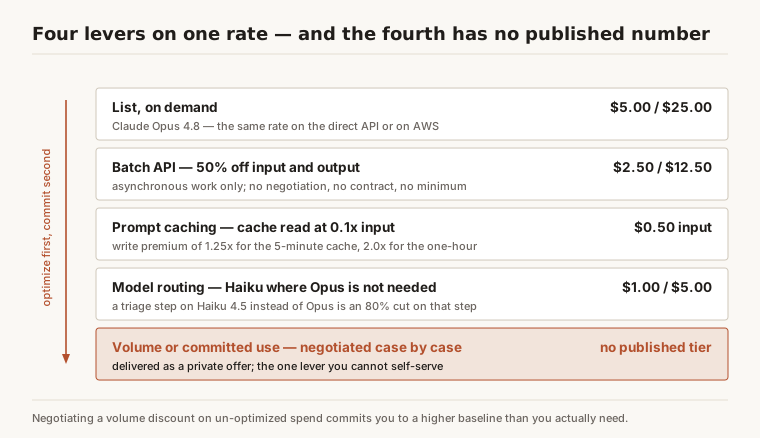
Here's the reality that matters for your budget. Anthropic's per-token rates are public and flat: Claude Opus 4.8 is $5 per million input tokens and $25 per million output, Sonnet 4.6 is $3/$15, Haiku 4.5 is $1/$5 [1]. Those same rates apply whether you call the direct Anthropic API or Claude on Amazon Bedrock — there is per-token parity across channels [2]. So the question "how do I get a Claude discount for business?" has a more useful framing: what structural levers actually lower the bill? There are four, plus one negotiation path. The first three you can self-serve today. The fourth — a negotiated volume or committed-use discount — is case-by-case, with no published tiers [1], and it's where a partner earns its keep.
Let me walk the stack the way I'd walk it in a FinOps review.
Lever 1 — Batch API: a flat 50% off input and output for non-urgent work
The single largest defensible discount Anthropic publishes isn't called a discount at all. It's the Batch API, and it's a flat 50% off both input and output for asynchronous work [3].
That turns Opus 4.8 from $5/$25 into $2.50/$12.50. Sonnet 4.6 drops to $1.50/$7.50; Haiku 4.5 to $0.50/$2.50 [3]. No negotiation, no contract, no minimum — you submit requests to the batch endpoint instead of the synchronous one, most batches finish within an hour, and you pay half.
| Model | On-demand (in/out, $/MTok) | Batch (in/out, $/MTok) |
|---|---|---|
| Claude Opus 4.8 | $5.00 / $25.00 | $2.50 / $12.50 |
| Claude Sonnet 4.6 | $3.00 / $15.00 | $1.50 / $7.50 |
| Claude Haiku 4.5 | $1.00 / $5.00 | $0.50 / $2.50 |
The catch is latency tolerance. Batch is for work that doesn't need a response in the loop: overnight classification, document extraction over a backlog, eval runs, bulk summarization, content enrichment. It's also available on Bedrock at 50% of on-demand for supported models [3]. The one place it doesn't apply is interactive agent sessions — batch can't power a live conversational loop. But for the substantial slice of enterprise AI work that is genuinely offline, this is a 50% cut you're leaving on the table if you're not using it.
Lever 2 — Prompt caching: cache reads at 0.1x base input for repeated context
The second lever attacks the part of the bill that grows quietly: repeated context.
Prompt caching lets you mark a stable prefix — a system prompt, a policy document, a retrieved knowledge base, a long set of few-shot examples — and pay to read it from cache on subsequent calls at 0.1x the base input rate, roughly 90% off the cached portion [4]. On Opus 4.8, that's a cached read at $0.50/MTok instead of $5.00. You pay a write premium the first time (1.25x base input for the 5-minute cache, 2x for the 1-hour cache), then reap the discount on every read after [4].
| Operation (Opus 4.8) | Rate ($/MTok) | vs. base input |
|---|---|---|
| Base input | $5.00 | 1.0x |
| Cache write (5-min TTL) | $6.25 | 1.25x |
| Cache write (1-hour TTL) | $10.00 | 2.0x |
| Cache read (hit) | $0.50 | 0.1x |
Why this matters more than it looks: agentic workloads re-send an accumulating context on every turn. An agent loop reads the same instructions, the same tool definitions, and a growing transcript over and over, so naive spend grows non-linearly with the number of turns. Caching is the lever that bends that curve back toward linear. The break-even is fast: with the default 5-minute cache a single read of a prefix already beats paying full price twice (a 1.25x write plus a 0.1x read versus 2x); the 1-hour cache (2x write) breaks even after two reads.
Lever 3 — Model routing: pay Haiku/Sonnet rates for steps that don't need Opus
The third lever is the one teams skip because it requires engineering judgment rather than a config flag: route each step to the cheapest model that can do it.
Output is priced 5x input across the current lineup, and the model tiers are 5x apart at the top: Opus 4.8 output is $25/MTok, Sonnet 4.6 is $15, Haiku 4.5 is $5 [1]. A multi-step agent rarely needs the frontier model for every step. Classification, routing decisions, short extractions, and "does this look right?" checks run fine on Haiku. Drafting and most reasoning land well on Sonnet. Reserve Opus for the steps that genuinely need the ceiling — the hard plan, the gnarly synthesis, the long-horizon execution.
A worked example: a triage step that runs on Haiku at $1/$5 instead of Opus at $5/$25 is an 80% cut on that step's tokens. Multiply that across the high-frequency, low-difficulty steps in an agent and routing often saves more than batch and caching combined — because it attacks volume where volume actually lives.
One cost reality to keep honest about: the 1M-token context window carries no long-context premium on Opus 4.8 and Sonnet 4.6 — big context is billed at standard per-token rates [1], so you're not punished for stuffing a large prefix (just cache it).
Lever 4 — Volume & committed-use discounts negotiated case-by-case via private offers
Now the lever everyone actually means when they search Claude enterprise volume discount or Claude Bedrock volume discount.
These exist. They are real. They are also negotiated case-by-case, with no published tiers [1]. I want to be precise here because the banned-claim graveyard is full of confidently quoted percentages that don't survive a fact-check — there is no "spend $X, get Y% off" rate card, and anyone quoting one is inventing it.
What's actually on the table is a committed-use or volume arrangement tied to your projected consumption, structured through a private offer on AWS Marketplace and/or a direct commitment with Anthropic. The discount is bespoke: it reflects your volume, your term, your commitment level, and your channel. Because there's no public number, the leverage in the negotiation comes from how well you can forecast and structure the commitment — which is the part most internal teams underprice. The mechanics of where this lands on your bill are worth understanding before you negotiate, so let's look at the plumbing.
How private offers and CCU billing deliver a negotiated rate on your AWS bill
Claude on AWS bills through AWS Marketplace in Claude Consumption Units (CCUs) at $0.01 per CCU — 100 CCU equals $1.00 [5]. Your usage is rated in USD at standard API rates, and critically, negotiated discounts are applied before the conversion to CCUs [5]. That's the mechanism by which a private-offer discount actually reaches your invoice: the discount reduces the dollar amount, then that reduced amount converts to CCUs, then the CCUs hit your consolidated AWS bill.
This is also why "switching to Bedrock to save money" is the wrong mental model. The token rate is identical to the direct API [2]; what AWS billing gives you is consolidation and contract leverage, not a cheaper token. Routing Claude through your AWS account folds the spend into your existing AWS commitment and into a single bill your finance team already reconciles, and it gives you a vehicle — the private offer — through which a negotiated rate can be delivered. The savings come from the discount you negotiate and the optimization levers above, applied on top of consolidated billing. They do not come from the act of changing endpoints.
If you intend to reserve dedicated capacity, note that Bedrock Provisioned Throughput and Reserved capacity are priced via your AWS account team [6] — not a self-serve rate card, and a separate conversation from the consumption-based private offer.
How discount timing works — and why it isn't retroactive
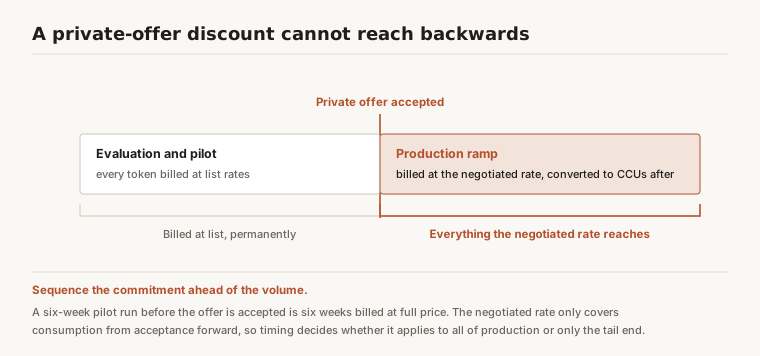
Here is the procurement detail that quietly costs organizations real money: Bedrock private-offer discounts are not retroactive [6]. A discount cannot apply to usage that happened before the offer was accepted.
The implication is concrete. If you run a six-week pilot at list rates and then sign a private offer, every token in those six weeks was billed at full price — the negotiated rate only covers consumption from acceptance forward. I've watched teams burn through a meaningful slice of their first-year budget during an "informal" evaluation phase, only to negotiate the discount after the spend was already locked in at list.
The fix is to sequence the commitment ahead of the volume. Get the private offer structured and accepted before the heavy-usage phase begins, not after you've proven the workload by spending at list. This is a timing decision, not a pricing one — but it's the timing decision that determines whether your negotiated rate applies to 100% of your production spend or only the tail end of it.
What a partner adds: structuring the commitment and governance
Levers one through three you can pull yourself this afternoon. The fourth — the negotiated discount delivered through a private offer — is where self-serve hits a wall, and where a partner does work you can't do alone. ASCENDING is an AWS Premier Consulting Partner and Anthropic partner, and the value shows up in three specific places.
Structuring the commitment. Because there's no published tier, the discount is a function of how you forecast and frame your consumption. A partner who has structured these offers before knows how to size the commitment against realistic usage, how to stage the term, and how to sequence acceptance ahead of the volume so the non-retroactive rule works for you instead of against you.
Unlocking pricing you can't request. Private offers and committed-use arrangements are not a button in a console. They flow through partner and account-team channels. The negotiated rate is, quite literally, pricing you cannot self-serve — and a partner is the path to it.
Governance that makes the commitment safe. A committed-use deal you can't actually consume is a stranded asset. The same partner who structures the offer can stand up the cost controls, model-routing policy, and usage visibility that ensure you hit your commitment without overshooting it — which is where governing Claude spend on Amazon Bedrock connects the discount to day-two operations.
Disclosure: Explore Agentic is published by ASCENDING, which builds Jarvis AI on Claude and Amazon Bedrock. We have a commercial interest in the partner-led path described here; the per-token and optimization facts are from Anthropic's published pricing regardless.
Putting it together: a realistic order-of-operations to lower the bill
Here's the sequence I'd actually run, cheapest-effort first:
- Turn on prompt caching for every stable prefix. Highest ROI per hour of engineering, and it's the lever that tames agentic context growth [4].
- Route by difficulty. Move classification, extraction, and checks to Haiku/Sonnet; reserve Opus for steps that need it. Output at 5x input means cheap steps compound [1].
- Batch everything asynchronous for a flat 50% off [3].
- Forecast your post-optimization volume. Only now do you have a defensible number to negotiate against — and you're not over-committing on un-optimized usage.
- Structure and accept a private offer before the heavy-usage phase, since discounts aren't retroactive [6], and let it deliver through CCU billing on your consolidated AWS invoice [5].
- Stand up governance so you consume the commitment without overshooting.
Note the ordering: optimize first, commit second. Negotiating a volume discount on un-optimized spend means committing to a higher baseline than you actually need — you'd be locking in waste.
The bottom line
There is no Claude coupon, and Bedrock doesn't sell a cheaper token. The real Claude enterprise discount is a stack: a flat 50% on batch, ~90% off cached reads, model routing that pays Haiku rates where Opus isn't needed, and — on top of an optimized baseline — a case-by-case volume or committed-use rate delivered through a private offer and applied before CCU conversion on your consolidated AWS bill [3][4][1][5]. The self-serve levers are yours today. The negotiated rate is pricing you can't request through a console, isn't retroactive, and rewards a well-structured commitment — which is precisely the part a partner is built to do.
FAQ
Is there a Claude discount code or coupon for businesses?
No. Anthropic does not publish a coupon, promo code, or public discount tier for Claude. Business savings come from structural levers — the Batch API's flat 50% off, prompt caching at roughly 90% off cached input, and model routing — plus volume or committed-use pricing that is negotiated case-by-case rather than redeemed with a code.
Is Claude cheaper if I run it through Amazon Bedrock?
Not on a per-token basis. Claude's per-token rates are identical across the direct Anthropic API and Claude on Amazon Bedrock. What AWS billing gives you is consolidation onto your existing AWS invoice and a vehicle — the private offer — through which a negotiated discount can be delivered. The token itself is the same price; the savings come from optimization and any negotiated rate, not from changing endpoints.
How do Anthropic volume discounts work?
Anthropic's volume and enterprise discounts are negotiated case-by-case, with no published tiers or fixed "spend X get Y%" schedule. The arrangement reflects your projected volume, term, and commitment level, and is typically structured through a private offer on AWS Marketplace or a direct committed-use agreement. Because there's no public number, the outcome depends heavily on how well the commitment is forecast and structured.
What does Claude Enterprise pricing look like?
Claude's Enterprise plan is custom: a combination of seats plus usage billed at API rates, negotiated rather than published. There is no public per-seat price or seat minimum on a rate card — the figure is set as part of a direct or partner-led negotiation that reflects your seat count and projected usage.
What is a Bedrock private offer, and can discounts be backdated?
A Bedrock private offer is a custom pricing agreement delivered through AWS Marketplace that applies a negotiated rate to your Claude usage and bills it on your consolidated AWS account. Private-offer discounts are not retroactive — they cannot apply to usage incurred before the offer is accepted. That makes timing critical: accept the offer before your heavy-usage phase begins, or you pay list rates for everything that came before.
How are Bedrock Provisioned Throughput and Reserved capacity priced?
Bedrock Provisioned Throughput and Reserved capacity reserve dedicated model capacity, and they are priced via your AWS account team rather than through a self-serve rate card. This is a separate track from the consumption-based private offer: provisioned/reserved capacity is about guaranteed throughput, while the private offer is about a negotiated rate on consumption-based usage.
Why use an AWS + Anthropic partner instead of negotiating directly?
A partner unlocks pricing you cannot self-serve. Private offers and committed-use arrangements flow through partner and account-team channels rather than a console button, so a partner is the path to the negotiated rate. They also structure the commitment so it matches realistic usage, sequence acceptance ahead of the volume to work around the non-retroactive rule, and stand up the cost governance that ensures you consume the commitment without overshooting.
References
- Claude pricing (per-token rates, batch, caching, 1M context, volume/enterprise discounts negotiated case-by-case): https://platform.claude.com/docs/en/about-claude/pricing
- Claude on Amazon Bedrock — per-token parity across the direct API and AWS: https://platform.claude.com/docs/en/build-with-claude/claude-on-amazon-bedrock
- Batch processing — 50% off input and output for asynchronous requests: https://platform.claude.com/docs/en/build-with-claude/batch-processing
- Prompt caching — cache read 0.1x base input, write 1.25x/2x premiums: https://platform.claude.com/docs/en/build-with-claude/prompt-caching
- Claude Platform on AWS — CCU billing at $0.01/CCU, discounts applied before conversion: https://platform.claude.com/docs/en/build-with-claude/claude-platform-on-aws
- Claude on Amazon Bedrock — private-offer discounts not retroactive; Provisioned Throughput/Reserved priced via your AWS account team: https://platform.claude.com/docs/en/build-with-claude/claude-on-amazon-bedrock